Measures of Economic and Demographic Stress
We use several measures of stress, against a more general and less measurable historical background. The most direct economic measure is the fluctuation in grain prices in regional markets, reflecting supply-side climatic influences on harvests, since in a largely subsistence economy, little change in demand occurred.4 This fluctuation is measured as annual (or monthly) differences from a moving average, and analysis focuses on changes in the elasticity of mortality and fertility with respect to grain prices, over time.5 Increases in elasticity (positive for mortality, negative for fertility) are taken as indicators of increased stress.
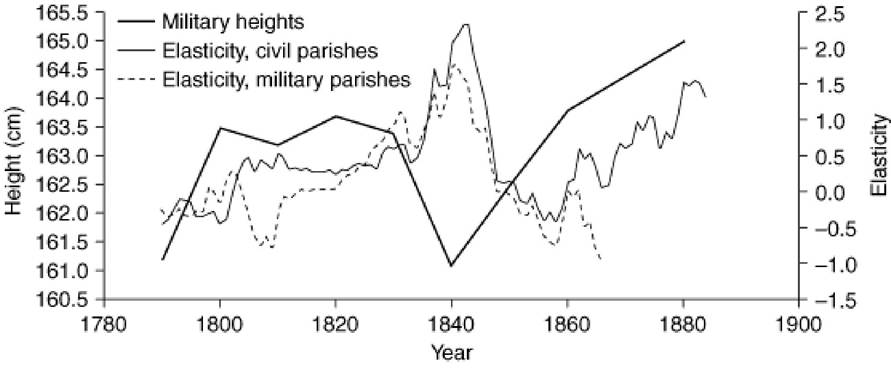
Information on the stature of persons is another potential measure of stress. Figure 11.1 shows the five-year lag sum elasticities of mortality and fertility with respect to grain prices for twenty-five Croatian parishes (including the seven used for reconstitution), and the heights of Hungarian soldiers, centred on their decade of birth (Komlos 1989: table 2.1).6The sensitivity of mortality and fertility to price shocks rises in the post-Napoleonic period, reaches a peak in the 1840s, and then falls back by the early 1850s. Detailed analysis suggests increased sensitivity of mortality across a broad range of military parishes in times of military mobilization (Hammel and Galloway 2000^). The rise in the 1840s suggests increasing crisis for the peasants before civil emancipation in 1848 and liberalization of military tenure in 1850. The fallback suggests some amelioration thereafter when the fruits of the labour of civil serfs became their own with cancellation of feudal obligations, but before the burdens of amortization were felt. Similarly, military serfs may have invested more when they were assured of the heritability of tenure for their children. After 1848 there were fewer mobilizations, and cordon duty was less onerous, since the Bosnian—Serbian frontiers functioned more as customs borders than as military lines or anti-plague barriers.7 The fallback may also reflect an improved disease environment after
Figure 11.1 Five-year lag sum elasticities of mortality for civil and military Croatian parishes, and Hungarian military heights centred on decade of birth
cessation of the great cholera epidemics or simply a culling of the more vulnerable in the previous peak.
There is also some evidence of increasing crisis in the elasticities beyond the 1850s. After the amelioration of the early 1850s, the elasticity of mortality increases again for civil serfs. This increase may reflect the burden of amortization and pressure to produce or work for cash. There is a spike and then a fallback in the elasticity of mortality for military serfs. The elasticities of fertility ameliorate in the 1850s, and then intensify (negatively) for a time in the 1860s. It is notable that the elasticity of fertility in the same year as a price shock (and indeed with a monthly lag commensurate with the second trimester of pregnancy) comes to dominate the fertility response, suggesting that abortion became more frequent as a means of fertility control. Increased recourse to abortion (for which the region was notorious in medical, legal, and ecclesiastical circles) may indicate increased economic pressure to control births and may have had deleterious health effects.8
There are no height data on Croatian military recruits; as an approximation we examine here information from Komlos' study of Hungarian recruits (1989), which we might use as a rough guide to regional conditions. The heights of recruits, shown by the decade of their birth, descend to a low point at about the same time as the peaking of elasticities of mortality and fertility with respect to price shocks. These minimal adult heights may reflect malnutrition in childhood and also retarded development in utero and during infancy; that is, they may reflect the nutritional status of the mothers. However, there is no indication in these data (on Hungarians) that this nutritional crisis deepened or even continued much beyond the 1850s. Instead, it may reflect economic and social conditions leading to the Revolution of 1848.
We should also take into account changes in family composition of households. Multiple family households seem relatively rare in the earliest censuses of 1698 and 1702.
A large proportion of households at that time was of new inmigrants, and these were predominantly nuclear in structure.9 Reliable data on household size and composition are rare, and all such data are difficult to interpret. Nevertheless, complex households appear to increase to the midnineteenth century and then decline. We conjecture that increases in size and complexity were an adaptation to an increasing scarcity of land that did not allow subdivision of holdings into viable plots for heirs. Economies of scale were generated in larger and more complex households, since adult labour inputs could be specialized. Households could continue to be autarkic and generalist, as they appear to be in the earliest census (Hammel and Kohler 1997).10 The general social and economic history literature for Croatia is replete with discussions of the collapse of the ‘joint household system' or %adruga in the last half of the nineteenth century. As noted, firm, consistent, and comparable data, especially in time series are hard to find, and samples are often small. Nevertheless, we cite as an example Capo- Zmegac's finding (1990) of an increase in the proportion of multiple-family households on the estate of Cernik (one of our seven reconstituted parishes) in the first part of the nineteenth century, and a decline in that proportion in the second half.Many authors have deplored the decline of the gadruga, citing as evidence instances of the division and dissolution of households. In this they ignore the fact that, as epiphenomenona of an agnatic, patrivirilocal residence pattern, such households normally dissolved, only to be reconstituted in later generations.” Notwithstanding this criticism, the frequency of occurrence of such households did decline, and their corporacy was diminished. Especiallyimportantwas the growing frequency of ‘secret divisions’ (tajne diobe), in which peasants divided their holdings without reporting the often prohibited change.
Contemporary political debate and legislation focused intensely on mechanisms for preserving the family system, traditional inheritance practices, and a guaranteed minimal size of homestead.’2It is important to note the social position of women in these ‘patriarchal’ households. The senior wife, usually the wife of the eldest competent male, thus in principle the ‘father's wife’ or ‘elder brother's wife’, managed the labour of coresident women, and her domination of them and of her sons was an important dynamic. Women born into the household ordinarily left it on marriage.’3 Women marrying into the household were strangers to it and typically viewed as the sources of conflict and ultimate fission. The relations between mothers-in-law and daughters-in-law, and between brothers' wives, were classically difficult. Women worked hard, often in field labour and especially when men were absent. The most recent brides were at the bottom of the hierarchy. Their husbands were usually junior males who, as younger men, were most likely to be called away for military duties.
4.
More on the topic Measures of Economic and Demographic Stress:
- Measures of Economic and Demographic Stress
- Demographic Response to Short-term Economic Stress
- A New Approach to Standard of Living
- Introduction
- Conceptualizing and Measuring Standard of Living
- Introduction
- References
- Introduction
- Area, Data, and Statistical Model
- NOTES