The Study Region
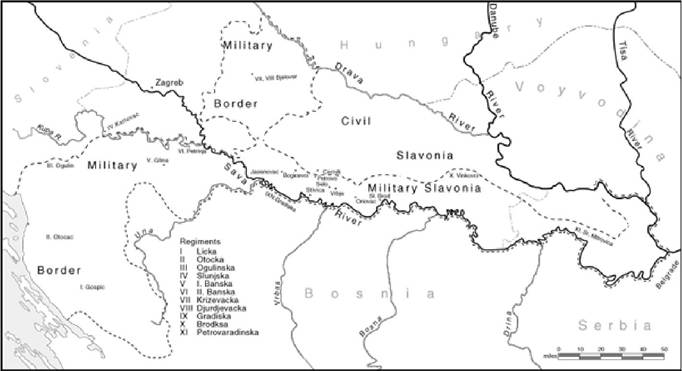
The region (see Map 11.1) is of interest because until 1848 part of it and until 1871 the remainder, were inhabited by a servile peasantry. It exhibited scarcely any modern economic development until after the First World War.
Slavonia is the triangle of land between the Drava and the Sava rivers, with its apex in Srem and its base at the Ilova River. It fell to the Ottomans in 1526, was
Map 11.1 Croatia, Slavonia, and the Military Border
reconquered by the Habsburgs 1683-90, and repopulated by both Catholic and Orthodox Slavs as well as some Hungarians, Slovaks, and Germans. Population growth on the new frontier was rapid, both by natural increase and migration. Households were relatively autarkic, and tended to become more complex over historical time. Economies of scale in such households provided some relief from emerging land shortage, even though agricultural intensification (other than through increased or more efficient labour inputs) was virtually nil (Hammel and Wachter 1996^, b; Hammel and Kohler 1997; Kohler and Hammel 2001).
From the earliest reoccupation, but formalized in 1745, the region along the Sava River was part of the Austrian Military Border, directly administered by the Habsburg crown, populated by peasants obliged to render perpetual military service. Ultimately, the Border system was abandoned, largely because of its ineffectiveness under late nineteenth-century conditions. Six of the seven parishes used in this analysis were military parishes. The Military Border experienced fourteen mobilizations in the period under consideration (1756, 1763-4, 1778-9, 1788-90, 1792, 1799, 1804-12, 1814-15, 1820-21, 1831, 1846, 1848, 1859, 1866). These mobilizations differed in intensity and duration, but we have virtually no detail on which local regiments were most impacted in each.1
The impact of military service on the Bordermen was very great.
Even in peacetime, frontier duty could draw off an important fraction of adult manpower, from about 10% (Rothenberg 1966: 92; Roksandic 1988: vol. I, 24) to a third of militarily able men (under the so-called canton system). Although feudal taxes and obligations were less in the military than in the civil zone, there was a head tax, and obligatory labour demands were high. For example, in 1810 the six regiments west of Slavonia furnished additionally about 5 days/year from men who were not invalided (see below) (Roksandic 1988: vol. I, 24, 27, 122). The church imposed a tithe. Conditions were sometimes exacerbated by illegal exaction of labour for the benefit of Austrian officers. The burdens reached critical impact in wartime. In 1792-1801 the Border mustered over 100,000 men, almost double the usual number of about 55,000, and in those wars suffered 38,000 casualties (Rothenberg 1966: 93). During the hostilities with Turkey, 1787-91, the total population of parts of the Slavonian and Banat regions of the Border is reported to have plummeted from 343,000 to 57,000 persons (Vanicek 1875, III: 474). The Third Provisional Croatian Regiment that was formed under French command during the Napoleonic occupation of the western Border lost 80% of its personnel on the Russian front in 1812 (Roksandic 1988: vol. II, 292-3). In 1802, 54% of the adult male population of the six western regiments was classified as invalided; in 1810 it was still 42% (Roksandic 1988: vol. II, 30-1). The Military Border was decommissioned in 1871 and united with civil Croatia in 1881. Unlike civil serfs, military serfs incurred no amortization burden on emancipation.The region north of the Border was part of civil Croatia, administered by Croatian feudatories of the Hungarian crown. Feudal tenure in civil Croatia was terminated in 1848, but former serfs incurred a heavy financial burden, required to amortize the value of the land they received over the next twenty years. (Implementation was
delayed perhaps by a decade or two on account of administrative and legal confusion.) Many civil serfs were landless or almost landless and worked for wages on the latifundia that dominated the civil zone of Slavonia.
Agriculture in both zones was extensive, with an emphasis on stockbreeding, and there was little improvement in agricultural technology. Accommodation to land pressure was achieved by economies of scale in large, complex, joint households, which appear to have become more common after about 1750.2 These were later undermined by increasing monetization and intra-household rivalry, especially after emancipation, as money taxes replaced feudal labour obligations, and also as the more personalistic elements of the Napoleonic and successor codes began to replace the more communally oriented customary law.
Peasants produced mostly for subsistence. However, as monetization progressed, and debt burdens mounted, peasants in the civil zone increasingly worked for wages to pay debts and taxes. In the military zone, men not on border patrol nor stationed away from home often worked for wages in repairing roads, hauling goods, and so on, in addition to their corvee obligations. In both zones, open range pig herding was a source of money income. Peasant plots were ultimately minuscule and in civil Slavonia coexisted with large estates. Attempts to introduce manufacturing (glass or silk spinning) mostly failed, in part because of the lack of transportation infrastructure. There was some commercial extraction of natural resources (charcoal, lumber, and potash) after 1870, especially in the former military zone. Until the mid-nineteenth century freight transport for export was by wagon over rough mountain roads to Adriatic ports. The Sava River was choked with debris and unsuitable for large-scale water transport. The first railroad reached Zagreb only in 1861; the line serving Slavonia from the Danube along the Sava to Zagreb and ultimately to Rijeka was not built until 1871. All these lines terminated in ports controlled by Austria or Hungary. Commercialization of agriculture on large properties was impeded by lack of transport, by competition from Austrian and Hungarian interests, and by the import of cheap foreign grain to regional markets (Vienna, Budapest) through Adriatic ports and thence via Austrian and Hungarian rail lines (Tomasevich 1955; Karaman 1972).
Both mortality and fertility were sensitive to fluctuations in grain prices (thus plausibly to grain supply), and that sensitivity peaked in the 1840s (Hammel 1985; Hammel and Galloway 2000a, b), as social and economic conditions worsened. Fertility control was known and practised from an early date and levels of fertility show evidence of decline perhaps as early as the 1760s—80s, plausibly in response to land shortage and parental desires to provide viable inheritance to their children (Hammel 1993; Hammel and Herrchen 1993; Hammel 1995). Abortion was practised at least from the 1760s, and appears to have increased in response to economic privation (Hammel and Galloway 2000a). The region, like neighbouring parts of Hungary, became politically notorious for its low fertility (Andorka and Balazs- Kovacs 1986; Vassary 1989). The military population, although subject to occupational risks until 1871, seems to have been in a more favourable economic position.3
3.