Conceptualizing and Measuring Standard of Living
International comparisons of the standard of living raise three issues. The first is regional diversity. Both Europe and Asia contained leading and lagging provinces. Like must be compared with like before any judgement can be made as to which continent was most advanced.
The second issue is the distribution of well-being within each continent. If inequality was greater at one end of Eurasia than the other, then equal average incomes would be consistent with the rich being richer while the poor were poorer. Distributionally sensitive indicators of the standard of living are needed, as are indicators of the average. The third issue concerns the definition of the standard of living. It is a complex concept, and it is far from obvious how it should be measured.Though one could argue that the ideal way to define standard of living is by the total utility a person derives from consuming a set of goods as a result of labour, investments, or transfers, this approach is not operational. The reason is that the utility of various goods depends on personal characteristics and cannot be measured (Sen 1987: 14). Hence, most concepts of the standard of living focus on goods themselves, or the ability to access them; the latter often measured by production or income. Since the volume of goods accessible with a certain income depends on the prices of these goods, income is usually deflated by a cost-of-living index. Real income and real wages calculated in this way are widely used, not only for modern but also for historical comparisons. For modern societies, we have information about income both at individual and aggregate level, while historical data for individuals are rare. Instead we quite often have data on wages for various occupations. But the standard of living can be gauged in other ways as well.
Such a broader concept is reflected in the Basic Need Index, developed in the 1970s by the International Labour Organization (Ghai et al.
1977). This index includes food, clothing, shelter, health, education, water, and sanitation. The problemof how to weight these various items has been addressed repeatedly and different solutions proposed but a general consensus is still lacking. It also turns out that a ranking of countries, based on the Basic Need Index, is very similar to the one that uses real income per capita since the goods and services included in the index end up being a very large proportion of national income (World Bank 1984).
United Nation's Human Development Index (HDI), which is a composite of real income (GDP per capita), health (as measured by life expectancy), and knowledge (i.e. education), has replaced the Basic Need Index both in scientific and political circles. This new index correlates with the Basic Need Index as well as the gross domestic product (GDP) per capita (World Bank 1984), but the HDI places greater weight on education and health. In developing countries in the twentieth century, health and education have improved more rapidly than income with the result that the HDI has grown faster than GDP per head (Crafts 1996).1 This is both a strength and a weakness. It is a strength because it emphasizes improvements in well-being that are not captured by GDP per head, but it is a weakness in that it imposes arbitrary weights on the constituent series and, in the process, double counts education and health: they enter the index in their own right but also as part of GDP (Bengtsson 2004).
The standard of living can also be defined in terms of Amartya Sen's (1992) concepts of ‘functionings' and ‘capabilities'. Since utility, which is the ultimate standard of well-being in this approach, is immeasurable, ‘functionings' and ‘capabilities' are introduced as measurable counterparts. Figure 1 illustrates the relationships. It is based on John Muellbauer's useful overview of standard of living concepts (1987: 40), as expanded by Bengtsson (2004), who added income and prices to the original figure.
Figure 1 illustrates how income is used to buy a certain amount of goods depending on prices. These goods have certain material characteristics, such as the amount of calories and proteins. Environmental factors, which also have an impact on these goods, include both individual liberty and common non-material conditions such as climate, clean air, and the absence of crime. Together with the personal characteristics, such as metabolism, they determine an individual's capabilities.
Figure 1 Transformation of income to utility through goods, material characteristics, capabilities, and functionings
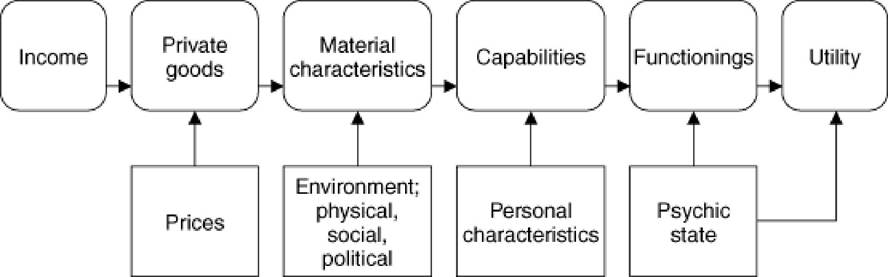
Finally, capabilities in conjunction with the individual's psychic state, which includes personal characteristics as well as social constructs like religious faith or ideological beliefs, determine his or her functionings. These range from such elementary things as adequate nutrition, good health, physical robustness, and longevity to more complex ones such as self-respect (Sen 1992: 39).2 Functionings are important since the utility an individual can realize depends on his or her functionings, and they are measurable, while utility is not. The upper boxes show transfers from income to utility, while the lower ones should be perceived as constraints or conditional factors.
As Figure 1 suggests, the standard of living can be measured at any point along the chain from income to functionings. The various measures are correlated, although imperfectly. Thus, they give us different views of the standard of living. We exploit that fact in this book. We avoid the weighted indices like the HDI, because they suppress information by aggregating the components. Instead, we examine the components separately. We consider economic concepts like income and consumption; demographic concepts related to functionings like height and life expectancy; and a recently developed indicator: the ability to overcome short-term economic stress.
These concepts can be applied to the ‘average’ person in society by applying aggregate data, to particular social groups, or to individuals when samples of individual level data are available. Whereas only limited details of the well-being of various groups can be obtained with highly aggregated measures, their strength lies in the fact that they cover large populations. While measures constructed for individual and family levels give details, they often cover small geographical areas and are therefore difficult to generalize from. In intermediate position, we have measures that show the situation for certain occupational or social groups. Thus, to obtain details and for generalization, the standard of living indicators at various levels of aggregation are needed.
All chapters in the book either compare one or a few measures across several countries or regions, or two or more measures within the same country or region. We use them coherently and simultaneously to get a better understanding of the historical well-being of various social groups in a number of countries in Europe and Asia. In doing so, we not only extend the means of comparison but also the objects of comparison, that is, we include more countries in the analysis than has been the case in earlier studies. And, by including standard of living indicators at micro, meso, and macro level, we obtain both details and generalization.
We start with the economic measures of living standards to illustrate our approach. Real GDP per head is the most commonly used economic measure of living standards. Maddison (1995) has projected global estimates of modern incomes back to the year nought, and his calculations support the classical economists, in that Europe has had the lead over China throughout the last two millennia. Like other researchers, however, we have serious doubts about the reliability of extrapolations that extend centuries into the past. Not only do they cumulate measurement errors, but they also impose modern price structures on historical
economies, producing radically different types of commodities (Prados 2000).
Instead, we explore real income measures that are based on early modern sources. The most practical indicator is the real wage. This measure is ‘distributionally sensitive' in that it compares the standard of living of workers. This is both a strength and a weakness: a strength because it is targeted more closely to the masses of the population than GDP per head, and a weakness since it excludes incomes due to land and capital. Several chapters in the volume explore these complexities.The next group of measurements are the demographic indicators. Health has received considerable attention from historians who have studied the history of heights, and we draw on that research for international comparisons, as we also do on more direct measures, such as life expectancy. Literacy has likewise been the subject of some research, and we discuss its determinants and consequences, but the information here is more limited than that for health and income.
Finally, at the end of this book, we study the standard of living with an indicator that has not been widely used, namely, the ability to overcome short-term economic stress; in particular, changes in the price of food.3 In pre-industrial societies, food amounted to half or three quarters of expenditure (Myrdal 1933: 115; Scholliers 1960: 174; Abel 1966/ 1980: 142; Jorberg 1972: 182; Somogy 1973; see Livi-Bacci 1991: 87; Fang 1996: 93, 95; Pomeranz, Chapter 1, this volume). Consequently, an increase in the price of food sharply reduced the standard of living. The effect was particularly marked among the poor, who spent the biggest share of their income on food. Normal fluctuations in grain prices caused fluctuations of 10% to 20% in the calorie consumption of the poor, and the high grain prices following bad harvests had an even greater impact (Bengtsson 2004). The poor were less able than the rich to borrow money, and that inability compounded their difficulties. Poor labourers were even more vulnerable than poor cultivators; at least the latter grew some food, while the for mer had to purchase their consumption.
Poor labourers, in particular, were forced to rely on charity or public assistance.There were demographic responses—some intentional, some not—to high food prices. In the worst case, high prices caused death for those unable to buy enough to eat. In less extreme situations, people resorted to demographic strategies in response to high food prices. These included postponed marriages, migration, and delayed births. Studies of the correlation of death, migration, marriage, and childbearing with food prices, therefore, provide a new approach to the measurement of the standard of living. When aggregate data show that high food prices raised mortality or reduced fertility, one can conclude that the bulk of the population had a low standard of living. If disaggregate data show that only labourers exhibited such responses, then we know that average living standards were higher, but the poor were still vulnerable. With careful attention to the data, the study of the demographic response to price fluctuations tells much about the average standard of living in a society and about the situation of the least well-off.
In addition to the conceptual complexity, the scarcity of data also makes the inter-continental comparison of well-being a difficult quest. Previous efforts have often relied on fragmentary quantitative data or qualitative sources like travellers'
accounts, anecdotes, etc. This is not said to depreciate the value of previous research efforts, but to stress the need for more research and new evidence. By broadening the concept of the standard of living, we also broaden the evidence that can be brought to bear on the issue. In this way, we can avoid the weaknesses of individual data sources and reach more robust conclusions.
The contributions have been grouped into three parts, each corresponding to an important dimension of standard of living. The first is economic: There are many indicators of economic well-being including the history of income, food production, wages, and prices. What do they tell us about the well-being in pre-industrial Europe and Asia? The second is demographic: Was Malthus right in claiming that mortality was high in most eighteenth-century populations due to population pressure on land? Did food shortage indirectly influence body height? Do demographic indicators of wellbeing show similar patterns as economic ones? The third combines the economic and demographic indicators into the new concept of standard of living previously discussed: Did pre-industrial populations in Asia respond to economic fluctuations by changes in mortality and fertility similar to Europe? How did the well-being of the poorest members and the better-off compare with regard to vulnerability to short-term economic stress?
3.