The Recent Controversy in the Theory of Capital
Sraffa’s statement cited above (1960: 6) contains the key not only to a critique of Marx’s labour-value based reasoning, but also of the long-period marginalist concept of capital.
This concept rests on the possibility of defining the “quantity of capital”, whose relative scarcity and thus marginal productivity is supposed to determine the rate of profits, independently of that rate. Following the logic of Sraffa’s argument, this is not possible other
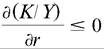
Since for a given system of production the amount of labour is constant irrespective of the level of the rate of profits, also the ratio of the value of the capital goods and the amount of labour employed, or capital-labour ratio, K/L, would tend to fall (rise) with a rise (fall) in the rate of profits:

This is the first claim of marginalist theory. The second claim is that RWEs are also positive. A positive RWE means that with a rise (fall) in the rate of profits - and the corresponding fall (rise) in the wage rate - cost-minimizing producers switch to methods of production that generally exhibit higher (lower) labour intensities, thereby “substituting” for the “factor of production” that has become more expensive - “capital” (labour) - the one that has become less expensive - labour (“capital”). Hence (6) is taken to apply also in the case with a choice of technique. The assumed positivity of the RWE involves the marginalist concept of a demand function for labour (capital) that is inversely related to the real wage rate (the rate of profits).
Careful scrutiny of the marginalist reasoning shows that it cannot generally be sustained: there is no presumption that PWEs and RWEs are invariably positive. In fact there is no presumption that techniques can be ordered monotonically with the rate of profits (Sraffa 1960). Reswitching implies that, even if PWEs happen to be positive, RWEs cannot always be positive. As Mas-Colell (1989) stressed, the relationship between K/L and r can have almost any shape whatsoever. The intervals in which K/L is an increasing function of r are spoken of as capital reversal. This implies that, if the neoclassical approach to value and distribution is followed, the “demand for capital” is not decreasing, and therefore the resulting equilibrium, provided there is one, is not stable. Hence the finding that PWEs and RWEs need not be positive challenges the received doctrine of the working of the economic system, as it is portrayed by conventional economic theory (see Pasinetti 1966; Garegnani 1970; see also Harcourt 1972; Kurz and Salvadori 1995: ch. 14; 1998c).
More on the topic The Recent Controversy in the Theory of Capital:
- The Recent Controversy in the Theory of Capital
- References and further reading
- Legacy
- Friedrich August von Hayek (1899-1992)
- The Cambridge capital controversy
- Hayek, Lindahl, Hicks and neo-Walrasian equilibria
- Eugen von Bohm-Bawerk (1851-1914)
- Choice of techniques
- References and further reading
- The Response to the First Volume of Capital (1867)