Choice of Technique
The fact mentioned above concerning relative prices as a function of the rate of profits is important also because the problem of the choice of technique from among several alternatives can be studied by making use of it.
Suppose, for instance, that commodity t can be produced also with method: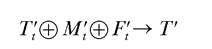
Then the following equation can be added to system (2)

with the additional unknown p't. The study of the ratio p'tlpt allows one to say when it is profitable to use the old method and when the new one: if p'tlpt is smaller than unity, cost-minimizing producers will choose the new method, whereas if it is larger than unity they will stick to the old method; in case the ratio happens to be equal to unity, the two methods can co-exist, because they are equi-profitable.
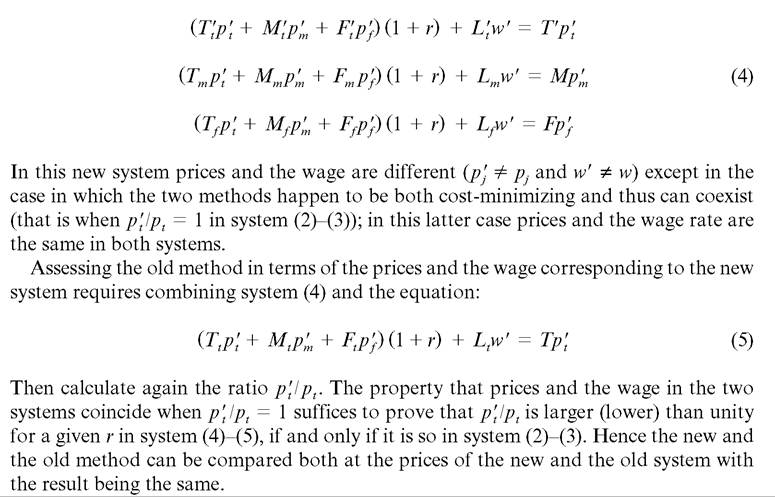
If the new method is cost minimizing and has replaced the old one and on the further assumption that the rate of profits is unchanged, then equations (2) are replaced by the following equations, which represent the new system of production:
A technique is called a system involving a number of methods of production equal to the number of commodities involved, each method producing a different commodity. A technique that is chosen at a given income distribution (a given w or a given r) is called a cost-minimizing technique at that income distribution. The fact that a relative price can pass through a given value at several (feasible) income distributions implies that a technique can be cost-minimizing at different values of the rate of profits, with other techniques being cost-minimizing in the interval in between.
This possibility is known as reswitching; it played an important role in the criticism of neoclassical theory during the so-called Cambridge controversies in the theory of capital (see Harcourt 1972).The argument above presupposes the special case of single production or circulating capital only. The circulating items of capital advanced in production contribute entirely and exclusively to the output generated in the period under consideration, that is, they “disappear” from the scene during the period. Things are different with regard to the fixed items that contribute to a sequence of outputs over several periods, that is, after a single round of production its items are still there - older but still useful. The appropriate framework for analysing durable instruments of production would therefore be a system with multiple-product industries or joint production. For a discussion of joint production proper, like the familiar cases of mutton and wool or coal and coke gas, a discussion of fixed capital and of scarce natural resources, such as land, see Sraffa (1960), Pasinetti (1977), Schefold (1989), Kurz and Salvadori (1995) and Bidard (2004).