The Wage Curve
Up until now the argument was based on the assumption that real wages are given in kind at some level of subsistence. The classical economists however saw clearly that the share of wages in the product may rise above mere sustenance of labourers.
As early as in the Essay on Profits of 1815, Ricardo had stressed that “it is no longer questioned” that improved machinery “has a decided tendency to raise the real wage of labour” (Works IV: 35). In this case a new wage concept was needed. This case had already been studied by Ricardo and had made him establish the inverse relationship between wages, conceived as a share in the product, and the rate of profits: “The greater the portion of the result of labour that is given to the labourer, the smaller must be the rate of profits, and vice versa” (Works VIII: 194; emphasis added). Sraffa also adopted the concept of “proportional wages”, as he was to call it, albeit with two important changes. First, when workers partake in the sharing out of the surplus product, the original classical idea of wages being an integral part of social capital, that is, advanced at the beginning of the period of production, is difficult to sustain. Sraffa after some deliberation therefore decided to treat wages as a whole as paid out of the product, that is, paid post factum. Secondly, he expressed the share of wages as the ratio of total wages to the net product assessed in terms of normal prices, w. These changes necessitated reformulating the price equations by taking explicitly into account the amounts of labour expended in the different industries, Li (i = t, m, f), because wages are taken to be paid in proportion to those amounts, and by defining these amounts as fractions of the total annual labour of society, that is, Lt + Lm + Lf = 1. In addition it is assumed, following the classical economists, that differences in the quality of labour have been previously reduced to equivalent differences in quantity so that each unit of labour receives the same wage rate (see Kurz and Salvadori 1995: ch. 11).We may now formulate the corresponding system of production equations for the case of the three kinds of commodities mentioned by Mill, where now the quantities represented by Ti, Mi and Fi refer exclusively to the inputs of the three commodities employed as means of production. We get:
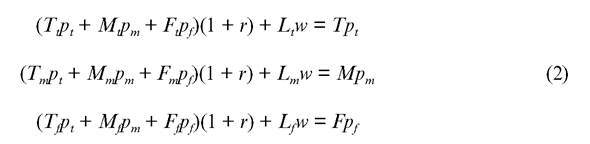
Taking the net product as standard of value, we have the following additional equation:

Taking one of the distributive variables, the share of wages w (or the rate of profits r) as given, one can determine the remaining variables: r (or w) and the prices of commodities. In the case of single production contemplated in equations (2), Sraffa corroborates Ricardo’s finding of an inverse relationship between the share of wages and the rate of profits, also known as the w-r relationship or wage frontier:


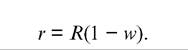
He also establishes the fact, which was already known to Marx, that in the case in which commodities are produced by means of commodities, the maximum rate of profits, R, which obtains when wages are hypothetically equal to zero, is finite. Sraffa constructs a particular standard of value, the Standard commodity, which has the property that, if applied, renders the wage frontier linear:
We may replace in the equation of a commodity the different means of production used with a series of quantities of labour, each with its appropriate “date”, and thus arrive at what is known as “reduction to dated quantities of labour” (see Sraffa 1960: ch. 6).
Sraffa shows that, whereas the wage rate as a function of the rate of profits is necessarily decreasing (but does not need to be so in the case of joint production), any relative price as a function of the rate of profits typically does not follow a simple rule: the function can alternately be increasing or decreasing, and can pass through a specific real number several times (which is constrained by the overall number of commodities involved).
Finally, we owe Sraffa the distinction between “basic” and “non-basic commodities”. Basic commodities enter directly or indirectly the production of all commodities, whereas non-basics do not. (Mill’s above scheme with three industries knows only basic commodities.) Only basic commodities play a role in the construction of the Standard commodity and the determination of the maximum rate of profits.