Choice of techniques
Two results of the analysis of long-period technical choice deserve mention.
The enlargement of the analysis to consider the dependence of the long-period choice of production methods on income distribution modifies data (3) from given adopted
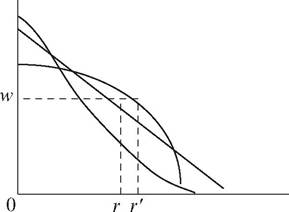
Figure 1 w(r) curves of different techniques
methods to (3') given adoptable methods.
Leaving aside some special cases of joint production, wage curves allow a graphical representation of how choice between alternative production methods operates (Figure 1). A wage curve, or w(r) function, shows how the real wage depends on the rate of profits if the technique (that is, ensemble of methods of production, one for each industry) is given. Once a numeraire is chosen, a different w(r) curve can be traced for each possible technique; they are all decreasing, and their NorthEast or “outer” envelope indicates the maximum real wage obtainable for each rate of profits (and vice versa). The main result is that the cost-minimizing choice of production methods will tend to reach this outer envelope.This refutes Marx’s claim of a secular tendency of the rate of profits to fall owing to the tendency of technical progress to replace labour with machines. Marx’s idea was that the introduction of more mechanized methods of production that reduce average cost, while convenient at the old prices for the capitalist who first introduces these methods, ends up by lowering the average rate of profits when their adoption becomes generalized and raises the average organic composition of capital. However, the above result implies that new methods introduced because they are more convenient are associated with wage curves outside, at least locally, the old envelope (or leave it unchanged if not concerning a “wage industry”), so if the real wage stays constant the new uniform rate of profits cannot be lower, and will be higher, for example, from r to r' in the figure, if the change concerns a “wage industry”.
At least this, of Marx’s reasons for pessimism on the future of capitalism, must be rejected. However, the result is a strengthening of the surplus approach, which is shown not to contradict the secular rise of real wages. A strengthening of the surplus approach, and therefore of Marx, is argued by Garegnani and others to be more generally entailed by the replacement of Marx’s equation (2) with Sraffa’s more correct equations that do not use labour values, because the role of the labour theory of value in Marx, as in Ricardo, was that of the imperfect tool - the only one available at the time - to determine the rate of profits surmounting the danger of circularity well grasped by Dmitriev; other aims traditionally attributed to the labour theory of value in Marx, such as proving exploitation or dispelling fetishism, are in fact achieved by the surplus approach’s overall explanation of economic phenomena, and seem to depend, in Marx, on the labour theory of value only because of that theory’s role in explaining the rate of profits. For example, on the fundamental issue of the origin of profits, the replacement of equation (2) with a more correct determination of r in no way questions Marx’s explanation of why profits are positive, which is only another side of his classical approach to wages.Sraffa proves another very important result, also shown in Figure 1: two wage curves can cross more than once, the “reswitching” phenomenon. The reason is that it is not true that if the rate of profits rises the relative normal price of two different commodities, or of the same commodity produced with two different methods, changes monotonically: it may at first rise, then decrease, and then rise again, owing to the complex influence of compound interest. (This had not been suspected even by Marx or Bortkiewicz.) This makes it impossible to see a commodity as produced by capital (conceived as a single factor) and labour combined in a proportion independent of income distribution, because if that were the case the change in the relative price of two commodities (or of the same commodity produced with two methods) would be monotonic, the commodity produced with the higher proportion of capital to labour always rising in relative price when the rate of profits rose.
Sraffa notes: “The reversal in the direction of the movement of relative prices, in the face of unchanged methods of production, cannot be reconciled with any notion of capital as a measurable quantity independent of distribution and prices” (1960: 38). The implications for the marginalist approach are further discussed below in the section on the Cambridge controversy in capital theory.It takes some years for attention to turn to the explanation of the “normal degree of utilization” of fixed capital implicitly assumed behind the technical coefficients that determine normal prices. Most fixed plants are not utilized 24 hours a day, seven days a week; since a faster consumption of durable capital reduces interest costs, the reason for not utilizing it maximally - apart from legal prohibitions - must be that some other cost, especially hourly wages, is higher for production outside normal hours. Marris (1964) is the first to raise this issue but not as part of the problem of determining prices of production; however, later it is seen (for example, Kurz 1990) that the issue can be studied as a problem of long-period choice of techniques, again dependent on income distribution (including now timetable wage differences).
Thereby it is made clearer that any tendency to identify normal and maximum utilization of capital is unwarranted. Maximum productive capacity is generally planned to be abundantly in excess of planned normal average production, not only because of higher wages for work in unusual hours but also because of regular periodic fluctuations in demand, of the desire to be ready to serve unexpected increases of demand without losing custom to competitors, and possibly of expectations of a trend of increase of demand that makes it convenient that new plants be bigger than necessary to satisfy initial demand. Therefore unexpected increases of demand will be generally easily met by increased utilization of existing plants. (The initial increase of production is made possible by the existence of inventories of intermediate goods, which are initially run down but are rapidly reconstituted by the increased production of the industries that produce them. The adaptability of production to decreases of demand of course poses no problem.) This, coupled with the general presence of overt and hidden unemployment and with the possibility of overtime, implies a considerable adaptability of production to demand not only for single industries, but also for the entire economy; this gives an essential role to aggregate demand in explaining aggregate output and growth of productive capacity, and denies that there is in general a trade-off between consumption and investment (Garegnani and Palumbo 1998).
More on the topic Choice of techniques:
- Choice of techniques
- Choice of Technique
- Choice of technique
- Sraffa and von Neumann
- Amartya Sen was born on 3 November 1933 in Santiniketan where he went to school.
- The Recent Controversy in the Theory of Capital
- Introduction
- Techniques of Model Building and Scientific Progress
- Econometrics Software
- Our objectives and approaches