From Speculation to Investment: Keynes, the Investor
Commodity speculation took the lion's share of Keynes's investments during the 1920s— a pattern that probably began to change when Keynes's second major setback came in 1927, and then in the wake of the 1929 crash.
Even though Keynes went on trading commodities until the outbreak of World War II, when activity in these markets was partially suspended, early in the 1930s he shifted to equities, his main sources of income being capital gains and dividends.In fact, Keynes's activity as an investor in shares dates back to the early 1920s, especially in his capacity as institutional investor,7 and shares loomed large in his own portfolio in the 1930s and 1940s. There is also some indication of a change of investment strategy after the 1929 stock exchange collapse, although at the time Keynes had little exposure vis-a-vis Wall Street.
In this section, we examine his dealings in that small subset of shares that were connected to the tin industry. The reason for doing so is to compare this investment activity with his speculation activity in the metal. David Chambers, Elroy Dimson andJustin Foo (2015), investigating Keynes’s investment for King’s College, have shown that mine shares accounted for the major part. Keynes allocated on average four times the weighting to stocks of mining firms as compared to nonmining firms. When Keynes was convinced of the quality of an investment, besides taking it for himself, he was keen to suggest it to all the institutions he was involved in. As an example, we know that in 1936 King’s College held several of the tin shares Keynes had in his own portfolio (letter from Richard Kahn to Keynes, December 24, 1936, Keynes Papers, KC/5/5/250).
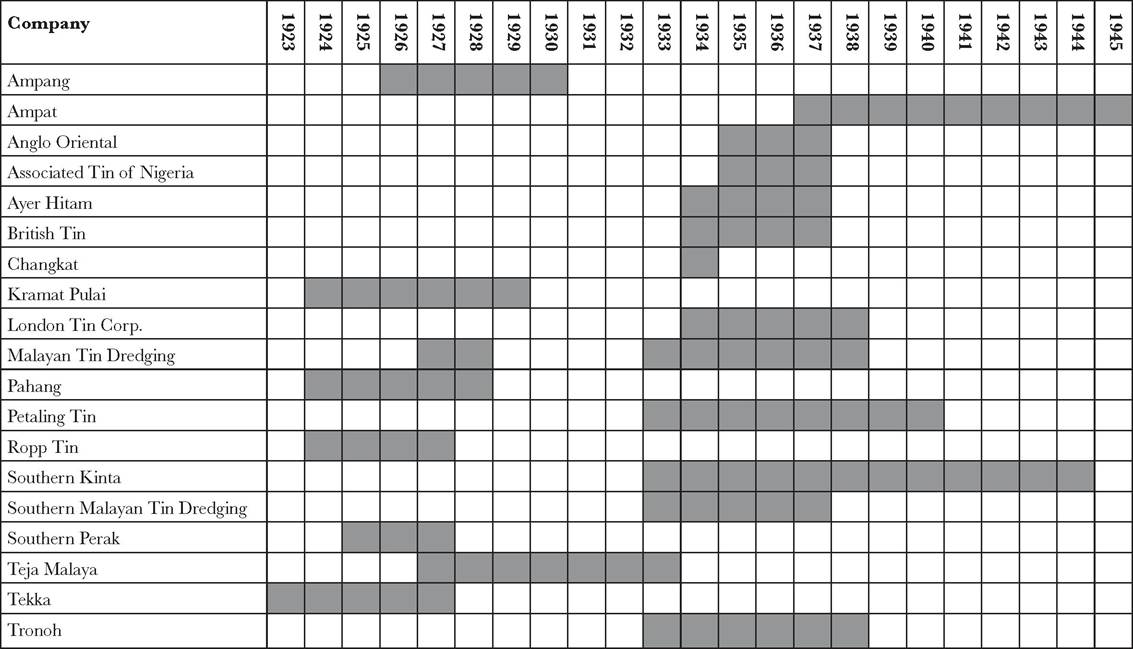
The companies whose shares Keynes held in his portfolio—of which we will say more below—are listed in table 13.5. Keynes’s purchases of tin-producing company shares were concentrated in two periods, which roughly coincided with the beginning of the upswings of the price of the metal: the 1924-25 and 1933-34 years.
The first period of investments was over by 1929, while the price of tin was falling rapidly, as were the profits of most of the companies that produced it and the prices of their shares. Keynes avoided heavy losses by selling almost all his shares in 1928, matching the similar withdrawal from the derivative tin market. The second period of purchases of shares coincided with the years of the buffer stock, which stabilized the tin price. This period ended in 1937, as we will see below, while in 1936 and 1938 he went back to the futures market. His total investment in tin shares is shown in figure 13.1, which is based on Keynes’s evaluations on January 1 of each year.8Between the two periods, there was a break of almost four years, which coincided with tempestuous turmoil on the financial markets due to the Great Depression and abandonment of the gold standard by the Bank of England.
In both periods, Keynes appears to have been guided by the pursuit of rewarding dividends more than capital gains. He was not engaged in intense speculative trading. Once he had acquired the shares of a company, he kept them for months and sometimes for years. In 1924-25, he made some use of call options, but none at all in the 1930s. In total he fell back on call options 11 times in the attempt to get a lower price; however, when he failed, he bought the shares he was interested in on the market, showing that his choices were based on consideration of the company’s prospects, and that he was not after quick gain.
In the first period, he invested mainly in British-owned companies in Malaya, which was then the biggest and fastest growing tin-producing country, with over one-third of the world production. His preferences were for the companies established before World War I like the Pahang Consolidated Company, established in 1906 and the largest in terms of capital in 1920, and the Kramat Pulai, established in 1906. Pahang Co. was active in lode mining, but most British companies that dominated the Malayan market had prevailed over the Chinese producers there thanks to the introduction of the new capital-intensive technique of bucket dredging.
Keynes had shares of the “doyen” of these companies, the Malayan Tin Dredging Co. and of Southern Perak, another dredging company. InTable 13.5 Keynes’s holdings of tin shares (gray squares).
Source: Our elaboration from Keynes’s Papers.
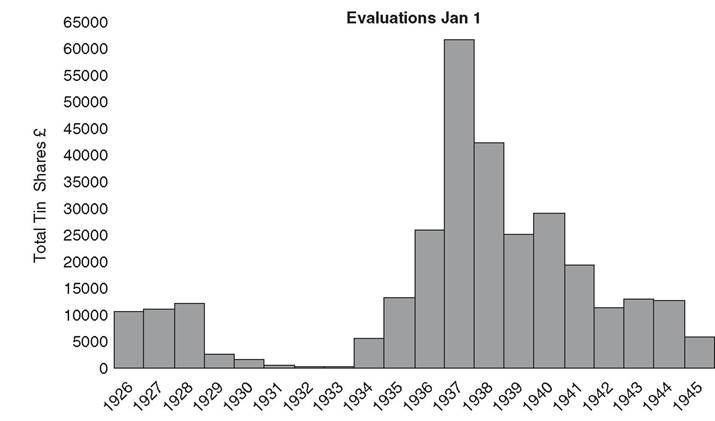
Figure 13.1 Tin shares (£) in Keynes’s portfolio.
Source: Our elaborations from Keynes’s Papers.
1927, Keynes added the shares of a third dredging company to his investments, the newly floated Teja Malayan Tin Dredging This purchase was his only participation in the 1926-27 “scramble for tin mining company shares,” when tin had reached £290 a ton and “a plethora of mines were floated on the London Stock Exchange and the total issued capital of British registered mining companies in Malaya shot up from £3.6 million in 1920 to £18.7 million in 1927” (Helten and Jones, 1989, 168).
However, he also tried some geographical diversification, but always within the British Empire. He invested in the Ropp Tin Company, the largest producer in Northern Nigeria, owned by South African Capital, which was particularly generous with his shareholders (“the largest dividend-payer of the field,” The Economist, August 4, 1928). Although Keynes usually preferred companies with British and City people on their boards, he made an investment in a newcomer on the Malayan scene, the Ampang Tin, a subsidiary of the American Guggenheims’ Yukon Gold, which after expensive prospecting in the 1920s, began its activity in Malaya in 1923 (Hillman, 2011, 71).
On the contrary, we found no evidence of Keynes being tempted by the 1920s activities of John Howeson, who was engaged in a rationalization of the tin industry (together with the other “tin baron” of that period, the Bolivian Antenor Patino). He built a personal empire through acquisition and consolidation of many existing companies all over the world.
As an outsider—he was born in India and his father was German—at first he was not welcomed by the London financial circle, but, step by step, thanks to an extensive network of relations and his impressive personality, he came into control of a vast financial system, responsible for investors’ funds amounting to over £4 million (ibid., 64). His flagship in Malaya was the Anglo-Oriental Mining Corporation, established in 1928. In spite of the support given to Howeson by Oliver Lyttelton, probably one of the most knowledgeable men in the metal trade and a close friend of Keynes, Keynes held back from the shares of the Anglo-Oriental until 1935, when Howeson was accused of fraud and a new board was appointed without him (Howeson was jailed in 1936). Anglo- Oriental played a crucial role in the reshaping of the tin industry. At the end of the decade, three British holdings—London Tin Corporation, British Tin Investment (BTI), and General Tin Investment Ltd.—controlled 43 percent of the Malayan tin output (and 17 percent of world production) (Yacob, 2007, 77). The companies numbered nearly 80, but ownership was highly concentrated.Keynes resumed his investments in tin shares in the spring of 1933. This was a particularly promising period for the tin industry. The International Tin Agreement of 1931 had barely succeeded in preventing the ruin of the industry, while the price of tin remained well below the threshold of £200 per ton for more than three years (1930-32) because of the depressed demand. In the spring of 1933, American demand picked up, spurred by two events: the devaluation of the dollar, which stimulated the recovery, and the end of Prohibition. Beer could again be sold freely, and the demand for cans put pressure on the available tin stocks. There were even tensions on the market, since the increased demand could not immediately be met by increased production.
By April 1934, the tin stocks that the International Tin Pool had accumulated to sustain the price of tin were entirely liquidated, world tin stocks were at what was considered a normal level and it was reasonable to assume that the price could hold firm or increase, thanks also to the buffer-stock scheme.
It was then that Keynes further increased his investments in the tin industry, to peak in 1937, as did the price of tin. After 1937, Keynes began to sell most of his tin shares. By October 1937, he was writing to F. C. Scott, the Provincial Insurance Company chairman: “I feel that the time has come for reducing our holding of base metal shares without being too ambitious about prices” (quoted in Westall, 1992, 372).In 1938, Keynes foresaw poor dividends as consequence of the fall in the tin price at the end of the previous year, although he was still optimistic about the long-term outlook of the tin shares. As he wrote to Scott in October, “In the long run Tin shares are as good as ever every way. The question is whether these long-term prospects will win over the factor of low current earnings” (Keynes Papers, PC/1/5/230).
Turning now to individual shares, we note that Keynes's largest investments were in three companies: British Tin Investments, Southern Kinta and Anglo-Oriental Mining. All of them had their main interests in Malaya. In 1934, Anglo- Oriental managed 26 mining companies in Malaya, and Keynes invested in some of them: Ampat Tin Dredging, Associated Tin of Nigeria, Changkat and London Tin Corporation.9 The investment in Anglo-Oriental was short-lived and extremely profitable. Keynes purchased cumulative participating preferred shares, which guaranteed priority in dividend distribution. He bought them in five installments over the years 1935-36, when the company went into safer hands than those of Howeson, who had, however, given Anglo-Oriental a leading position in the Malayan industry through acquisitions and consolidations. Keynes sold his shares in 1937 at double the price he had bought them.
Anglo-Oriental also owned and managed Southern Kinta Consolidated, the largest operating company in the British Empire endowed with new dredges brought in from acquired companies so that “with direct costs of around £45 per ton of concentrate in 1939 [Southern Kinta] was capable of meeting any competition” (Hillman, 2011, 268).
Southern Kinta shares were still in Keynes’s portfolio in 1943—confirming Keynes’s confidence in companies that were able to keep up with technological progress. Keynes held Southern Kinta throughout its most profitable period, when it paid shareholders an annual average of 23 percent. A remarkable performance, but other British tin companies in Keynes’s portfolio (Ayer Hitam, Kramat Pulai, Tronoh and Pahang) yielded annual averages of 15 percent and above (Rippy, 1953, 119).British Tin Investments was a finance house founded in 1932 by separating the production division from the equity investments of a British-American company. It specialized “in the management and technical advice of such [tin] companies and hold substantial investments in the individual companies in which they are interested”(Keynes, 1940, 14). In 1934, Lyttelton became its chairman and thenceforth was the leading figure in the tin finance. It was in 1934 that Keynes bought a first installment of BTI, to which he added a large amount one year later, when the price reached an unusually low level. His timing was not equally successful in 1937, when he bought another small lot at the highest price of the year. He kept these until the end of the war, when he sold them at a very low price.10 However, the shares had never stopped yielding significant dividends,11 even in time of war.
In figure 13.2, we plotted the price of tin with the price of several of the tin shares in the years in which Keynes held them in its portfolio. As a general observation, we can say that he was a momentum trader, that is, he bought on a rising market, with the exception of London Tin, in which he invested heavily when its price was falling. As expected, the share prices followed the trend in the price of tin fairly closely. With a good knowledge of the fundamentals of the metal, tin share prices could be predicted with a fair degree of certainty.
In order to understand why Keynes was so keen on investing in British-managed tin companies, an observation in his memorandum to the Treasury in October 1940 may be of some help. When advising the British government on how to increase Britain’s dollar resources, Keynes declared that tin (and rubber) shares would not hold much appeal for the US private investors, mainly “for the reason that they are out of touch with the managements which are situated in London and in the East, and have no means of gauging their efficiencies” (1940, 14). Keynes clearly believed that he was able to do so.
5.