Betting on Derivatives: Keynes, the Speculator
Keynes’s interest in tin dates to 1921, when he began his speculation in metal options and futures, together with currencies and cotton, while preparing his reports on commodities for the London and Cambridge Economic Services, the Special Memoranda on Stocks of Staple Commodities (henceforth Memoranda), which he authored between 1923 and 1930 (Keynes, 1923-30).4
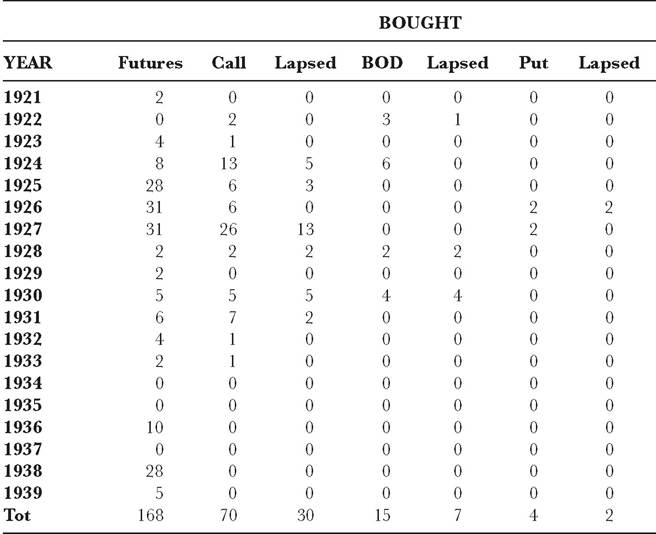
In the tin market Keynes experimented with all the derivatives available to him at the time and held the highest number and the largest variety of contracts, experimenting with a great variety of combinations of investment strategies (see table 13.3).
After 1925, he also took delivery of some of his futures and stocked tin in the London Metal Exchange warehouses, thus moving part of his operations onto the spot market (Keynes Papers, SE/11/2/38). His activity in tin derivatives ceased completely only in the years 1934-35, when the buffer-stock operation, which successfully limited the range of price variations, made speculative activity unprofitable, and again in 1937.The pattern of high volatility that was typical of tin prices, while providing scope for speculative activity, exposed him to the risk of heavy losses when the timing of buying and selling did not match the price swings. This was particularly true in the case of option dealing, bearing in mind that only the European types (namely those which could be exercised only at maturity) were available to him.5
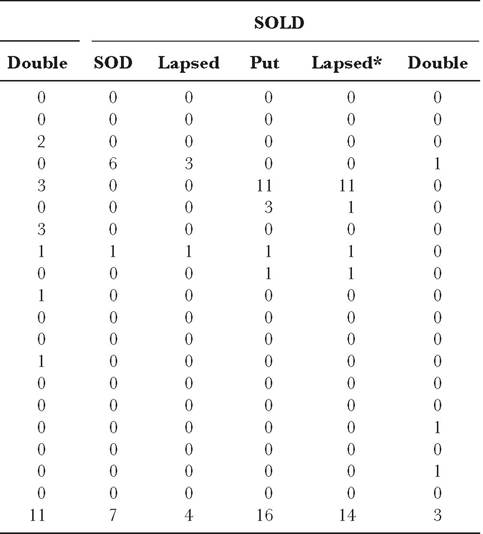
Keynes’s operations always reflected expectations of an increase in the price of the metal. He was a bull in the tin market most of the time. Only very rarely did he try to take advantage of an expected decrease in the price of tin (and he failed), by buying put options (Keynes Papers, SE/11/2/35) and selling SODs (seller’s option to double) (Keynes Papers, SE/11/2/33). The SOD was an option that implied the sale of a given quantity of the metal for future delivery together with the possibility of doubling the quantity to be sold at the same price.
The price of a SOD was slightly lower than that of a normal future, but this loss was more than offset by the possibility of doubling the profit if the price fell below the strike price. When Keynes sold them, he expected the price to fall, but it rose and he incurred a loss. The same happened with the two puts he had bought in the expectation of a price fall, and he let them lapse (Keynes Papers, SE/ 11/2/38).Most of Keynes’s operations were carried out in the years 1924-27. In these years, his bull expectations led him to buy futures for considerable numbers, but also to buy call options and BODs (buyer’s option to double). The latter were futures at a price higher than a normal future but with the possibility of doubling the quantity to be bought. It is not easy to understand the reasons behind Keynes’s choices among these alternatives. The price of options did not follow a precise rule, and lacking information we are unable to compare the alternatives in terms of cost. We know that, given that Keynes operated on borrowed money and that the average purchase of futures cost several thousand pounds, Keynes may have preferred the far riskier (and more profitable in the case of
Table 13.3 Number of operations in tin futures and options made by Keynes.
* The buyer did not exercise the option. Source-. Our elaboration from Keynes’s Papers.
success) call options because of lack of resources and not simply because he was indulging his gambling spirit. The price of a call option for tin varied according to market conditions, but on analyzing Keynes’s ledgers we concluded that its price ranged from less than 3 percent of the future price to more than 6 percent. This means that it was never less than £6 per ton and was sometimes as high as £15 per ton. The difference between the price of a BOD and a normal future, on the contrary, was between £3 and £6 per ton, and therefore purchasing a BOD entailed the expectation of a slightly higher price in order to be profitable and a larger initial outlay for the initial quantity
During the period May-October 1925, Keynes joined a tin pool.6 It was in this period that he added another instrument to his speculative activities, and he dared to sell put options for substantial amounts of the metal, relying on an increase in the price of tin, over which the pool had considerable influence. The risk was high, but nearly all the put options lapsed and Keynes pocketed the premium, which was in the range of 5 or 6 percent.
His sale of put options was successful 14 out of 16 times.There are not many cases when Keynes attempted to hedge his positions. He bought put options for this reason only twice (Keynes Papers, SE/11/2/48). In a few other cases, when he had bought futures for very large amounts, he tried to minimize the cost of hedging either by selling a SOD for half the amount involved or by buying a double. The latter was an option that gave the buyer the possibility of buying or selling—whichever he preferred—a given amount at a given price at some future date. In other words, the buyer of a double bet on very high volatility of the price, at least high enough to cover the cost of the option, which was indeed high (on the contrary, the seller of a double bet on relative constancy of price). Keynes often bought and sold double options for their own sake (Keynes Papers, TC 4/3/131 and 237), but occasionally he used them for hedging purposes. In this case, he bought a future and a double for the same amount of the metal and for the same date (Keynes Papers, SE/11/2/21) so that if the price rose he could increase his profit by exercising the double as a call; otherwise, if the price fell, he could minimize the loss by exercising the double as a put.
We may wonder just how good Keynes was at predicting the price trend. A rough answer can be found first in calculating the percentage of options he exercised, and then the percentage of the put he sold and that the buyer did not exercise. In the case of call, this percentage was 57 percent; in the case of BODs it was 53 percent; in the case of the put he sold, it was 87 percent. To this we should add the percentage of the times when the price of the metal he sold at the expiration date was higher than the price of the future, and this, on the basis of our calculations, was 57 percent. Unfortunately, this undoubtedly skillful activity was not necessarily profitable, due to the high commission and transaction costs, which, in the case of futures, were 0.1 percent on the buying and selling price and 0.5 percent to the metal broker.
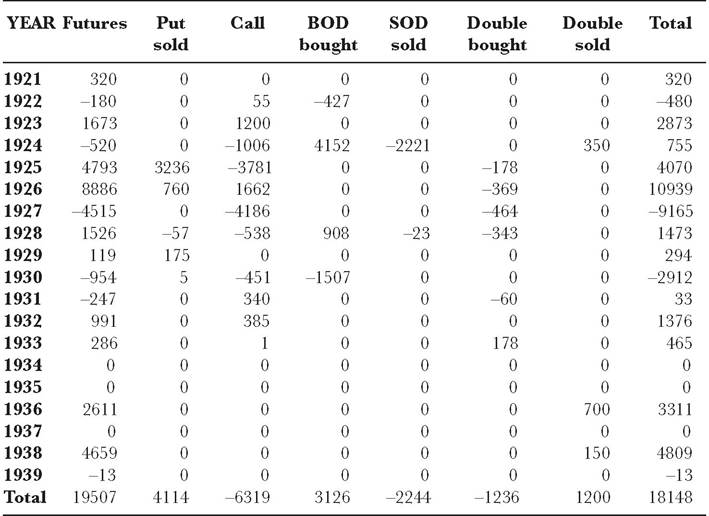
In the case of options, commissions applied only when they were exercised as percentage of the price of the metal bought or sold.A measure of the profitability of Keynes’s operations in tin is much harder to arrive at, since investment in tin was a variable portion of his portfolio. Profits and losses are shown in table 13.4 as absolute amounts in sterling. Futures made up the greatest share
Table 13.4 Keynes's total profits and losses in tin derivatives (£).
Source: Our elaboration from Keynes's Papers.
of Keynes's investment in tin (the average transaction was £6,634 compared with £258 of the average transaction in put and call options). While for futures we calculated the average return as 3.2 percent on a three-month basis, the average return for options is much less significant due to the high variance. As table 13.4 shows, Keynes made half of the total profit of the period in 1926, which he lost almost entirely in 1927. Another large loss was incurred in 1930, which might account for his reduced speculative activity in tin, which was resumed only in 1936 and 1938—years that in any case saw him extremely active in the markets.
4.