Introduction
In a recent paper, Alessandro Roncaglia, reconstructing the long-term developments and structure of the oil markets, noted that this “industry is complex, with production stages that are technically quite different from one another[;.] it is characterised by strong economic and political interests intertwined in an interplay of conflicts and alliances that evolve over time, while technology, the organization of the markets and their size also dramatically change” (2015, 151).
This also applies to tin, a commodity whose characteristics made it an object of several cartels dominated by intertwined national and private interests, marked by high price volatility, control of which was pursued by various forms of international agreements, with or without the support of buffer stocks, from the 1920s to the 1980s. Tin was also the commodity that John Maynard Keynes dedicated most attention to as speculator, investor and commentator. It was probably the commodity in which he invested most, together with cotton and wheat, and where he suffered the greatest losses, alongside rubber. His trading in tin spanned from 1921, when he first bought a future contract, until his death in 1946.
In this chapter, we present a reconstruction of Keynes's dealings in tin, as economist, speculator and investor, taken as a lens through which to examine the tin market in the interwar period.[11]
Table 13.1 London standard tin (£ per ton), monthly average price.
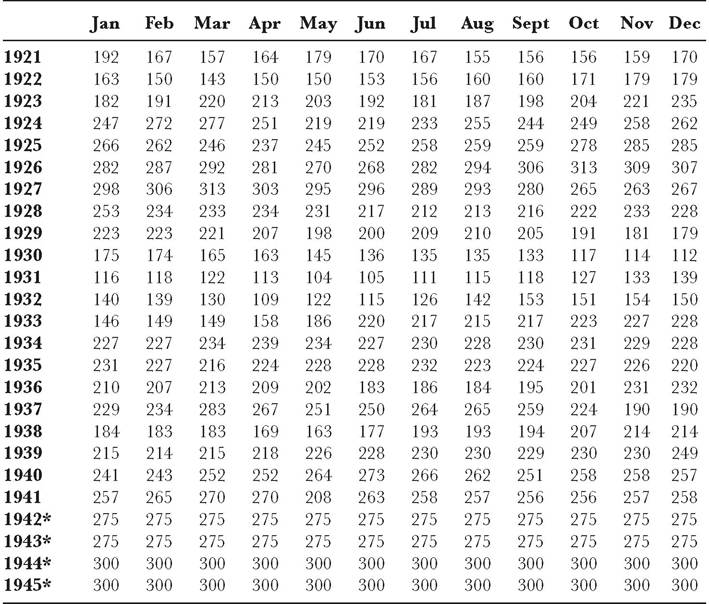
* Prices at which the Non-Ferrous Metals Control supplied tin.
Source: Our elaboration from Knorr (1945) and London Times, The West Australian.
When the short-lived commodity boom after World War I was over, the price of tin dropped sharply (see table 13.1). This led the governments of Malaya and the Netherlands East Indies (NEI), which controlled more than half of the world production, to embark on the scheme—named after the location in Java (Bandoeng) where they met for a conference in 1921—designed to take tin off the market in order to raise its price (Eastham, 1936).
At the time of its formation, the Bandoeng pool held as much as 34 percent of the world stocks, which it gradually released on the market until its dissolution in 1924. As from 1923, production failed to keep up with consumption, and, by 1926, the price of tin had risen more than 100 percent above the level of 1921. Prices peaked in October 1926, but in 1928 they began to fall. This was the year in which the Tin Producers Association was formed to hold tin off the market and raise its price by voluntary restriction of production. This initiative evolved into the International Tin Control Scheme (ITCS), launched in March 1931. It was an official agreement—the first of this kind that aimed at controlling price volatility—signed by the governments of Malaya, Bolivia, Nigeria and NEI, and administered by an International Tin Committee (ITC) representing the four members that produced 80 percent of the world tin output.Table 13.2 LME tin turnovers (000 tons).
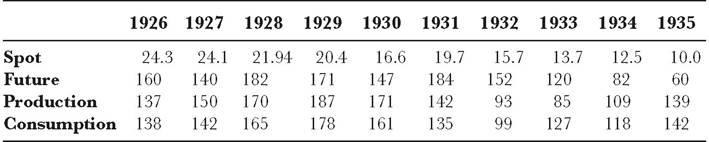
Source: Eastham (1936).
ITCS imposed restrictions on exports. Quotas were allotted to each participant according to the production levels of 1929 (Knorr, 1945, 108). The scheme was supported by the International Tin Pool (1931) made up of privately held stocks, the size of which was regularly published. ITCS was to last until 1933.
Before the end of that year negotiations started for a second agreement, which, like the previous one, was based on production restrictions, and began in January 1934 for a three-year period. This agreement, however, was officially supported by the Tin Buffer Stock Scheme (1934), operated by a committee appointed by the governments with representatives in the ITC, with the purpose of preventing the price from rising above £225 or falling below £215 per ton (Khan, 1982, 163). The purpose of the buffer stock was to give the industry “a working capital in metal tin, enabling it to meet immediate requirements in full when current production cannot be expanded rapidly enough to meet current consumption, or—more important—when current demand is swollen temporarily by the anticipation of an increased future consumption.”3 The buffer stock was on average successful in keeping the price within the predetermined range until 1936.
According to Jack Kenneth Eastham (1936, 25), the scheme reduced speculative activity in the London Metal Exchange (LME), as measured by the turnover in 1934-35, despite the upward trend in production and consumption as from 1933 (see table 13.2).In 1938, just before the outbreak of the war, the third agreement was launched, with the formation of another buffer stock with the price target in the range of £200-230 per ton. The agreement was intended to last until 1941.
At the outbreak of the war, nonferrous metals were put under control of a division of the Ministry of Supply. Private tin dealings on the London Metal Exchange ceased in December 1941 and the Ministry of Supply determined the price at which tin was supplied, while dealings in the other metals were suspended in 1939 (Roddy, 1995, 21). By 1940, discussions were under way to give rise to the fourth agreement, which was ratified in 1942, with a termination date set in 1946 (Hillman, 2011, 314-16). However, the agreement did not put any restriction on the production of tin, which was encouraged to build American strategic stockpiles, and the agreement eventually proved ineffective because of theJapanese occupation of Southeast Asia. The United States continued to accumulate stocks of tin, absorbing the excess of production over consumption, until 1956.
The LME was reopened in 1949, but the outbreak of the Korean War disrupted the lifting of control in the tin market. A conference was held in Geneva in 1953 and negotiations for a new agreement were initiated. Between 1956 and 1989, six other agreements were formed, making up to 70 years of control of the tin industry.
3.