Understanding Market Behavior: Keynes, the Economist
The foregoing review of Keynes’s investment activity in tin, in both derivatives and shares, prompts two questions. The first is how his behavior compares with the statements he made in several speeches, memoranda and correspondence about his investment philosophy.
The second is why Keynes was so fascinated by the “devil’s metal,” which took up such a large share in his portfolio. It is noteworthy that not a single year went by after 1921 without Keynes investing in some tin-related assets.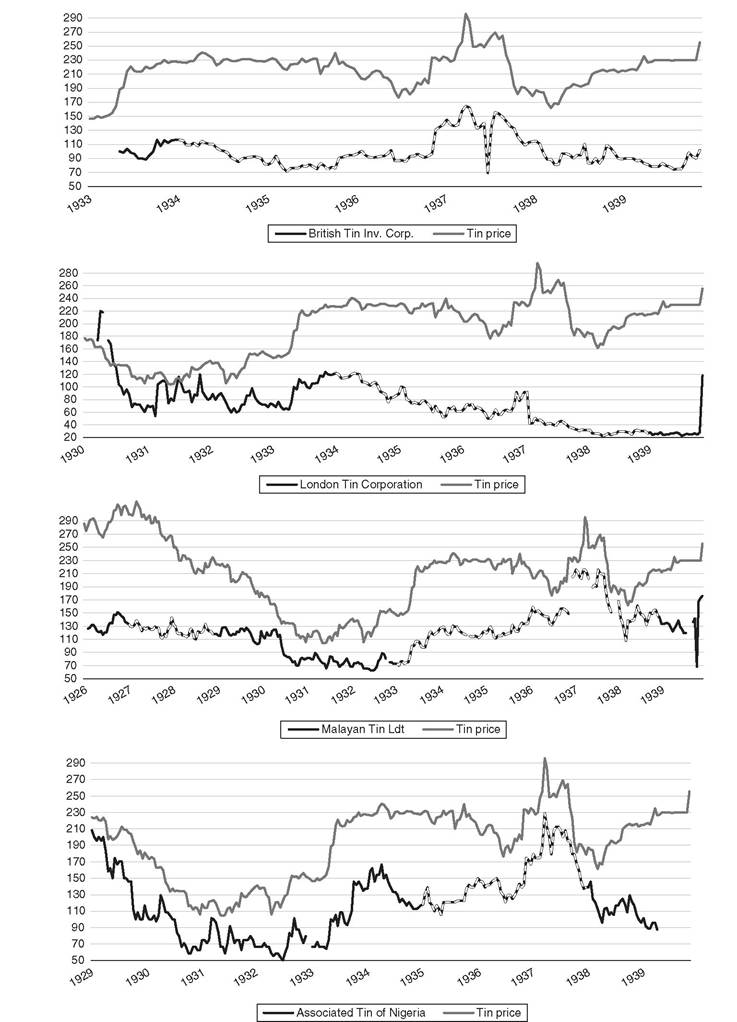
Figure 13.2 Tin prices (£ per ton) and tin shares prices (£ per unit). Source: Our elaborations from Keynes's Papers.
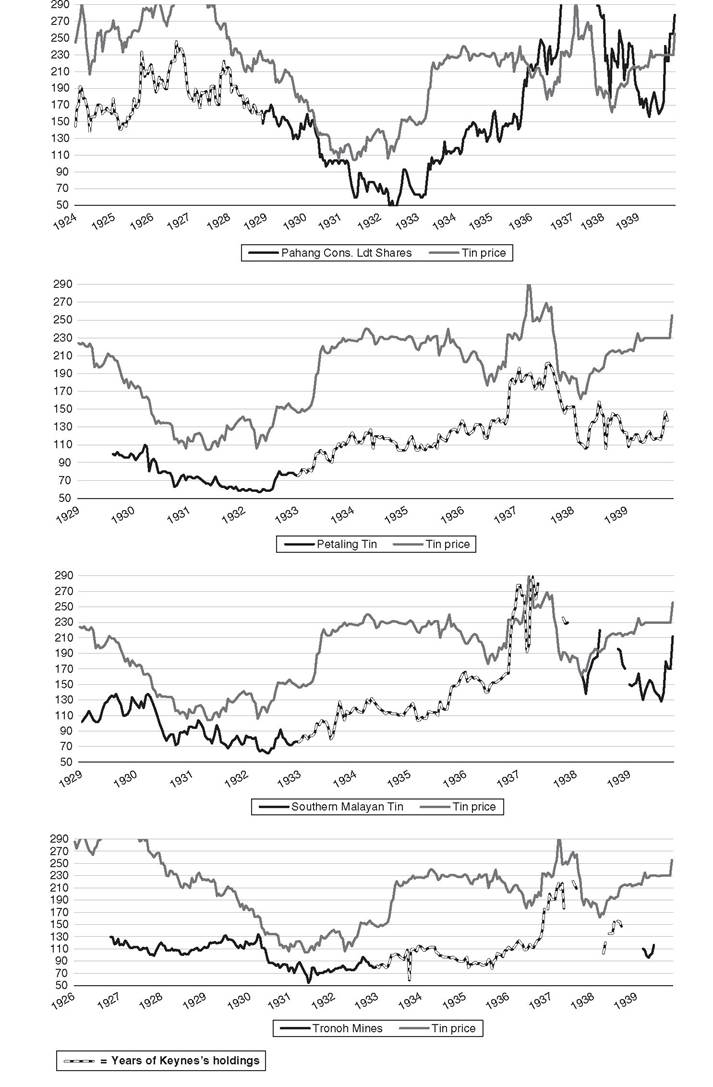
Figure 13.2 (cont.)
As far as trading in tin as a commodity is concerned, it was part of his general interest in commodities possibly influenced by the knowledge he was acquiring as a professional economist. In the Memoranda he commented on some of the commodities he traded in (cotton, copper, tin, lead, sugar, jute, rubber, wheat) as well as a few others (nitrate, coffee, tea, petroleum, wool) that he did not trade in. He provided information on the level of stocks and consumption, the flow of production and the trend of prices, always presented with assessment of the quality and reliability of the data. In fact, Keynes's approach to trading was based on evaluation of the amount of information available for each individual commodity and the degree of uncertainty about the future course of the main factors underlying it. Collection of the “relevant information” available was the premise to evaluating the “weight” of any argument that could be inferred from it, according to the conceptual framework that Keynes used in his Treatise of Probability to illustrate any decision-making process.
As for the availability of information and the degree of uncertainty (which affects the confidence that could be accorded), information on tin, as indeed on copper and rubber, was plentiful but of variable quality, unlike cotton and wheat—the other two commodities in which Keynes invested heavily. For the latter, reliable information was plentiful but subject to considerable uncertainty due to the unpredictability of extraeconomic factors (weather, parasites).Keynes described the characteristics of tin as follows: “Tin is a particular commodity in that both production and consumption are exceptionally insensitive to moderate changes of price, with the result that violent price fluctuations ensue whenever the difference between the two has to be absorbed into stock” (1925, 377).
It follows that with price fluctuations speculative activity is indeed potentially profitable, provided that the price swings are anticipated correctly by monitoring the level of stocks. However, this was easier said than done, since figures on tin in UK or US warehouses and afloat from or still in the producing countries could not be reckoned with precision at any given time. Even monthly figures relative to the visible stocks of tin held in warehouses in Europe and the United States “are apt [...] to be extremely misleading” (Keynes, 1926a, 417). The reason is that these statistics “ignore the stocks of tin and tin ore in the Straits Settlements” and “tin which is sold direct to consumers without passing through the Metal Exchange warehouses or the export returns” (Keynes, 1928, 506).
Keynes's trading experience influenced, and in turn was influenced by, his views on speculation, which are not given systematic treatment in his work but can be sketched out in roughly chronological order, drawing on the statements he made on the subject scattered here and there in his writings.
First, there are the manuscript notes for the preparation of his Lectures on the Stock Exchange in preparation for the course he gave at Cambridge in 1910, where he distinguished between gambling and speculation, according as to whether risk is or is not calculable (an approach very similar to Alfred Marshall's; see Dardi and Gallegati, 1992).12 The distinguishing criterion lies in the amount of knowledge possessed by the actor in either case: “the possession of superior knowledge [is] the vital distinction between the speculator and the gambler”).
For Keynes what mattered was not measurement of comparative success in gambling and in speculation, which may be dependent on other factors, but evaluation of the nature of the action in the two cases. Unlike speculation, gambling is not reasonable because it is a behavior that has no basis in knowledge, although of course a gambler may at times be a winner and a speculator a loser.The next question is whether “superior knowledge” enables the speculator to predict the future course of prices. There are passages in the Lectures that seem to confirm this, but the view was short-lived. As Keynes became more closely acquainted with the working of the markets, he presented an analysis of speculation on different grounds (see “The Forward Market in Foreign Exchanges” (1922), incorporated into the Tract on Monetary Reform (1923), and his article “Some Aspects of Commodity Markets” (1923)). Here not only is the speculator not a “gambler,” but his ability through superior knowledge to forecast the future is downplayed. He is not “a prophet” (ibid., 260) but rather a risk bearer: “The most important function of the speculator in the great organized ‘future market’ [is that of] a risk bearer” (ibid.). The point of speculator as risk bearer, and profits being the remuneration for risk bearing, not for forecasting skill, is reiterated in the Treatise on Money, where he presented a more refined version of his theory
When we get to the General Theory, the analysis of speculation (chapter 12) marks a departure from Keynes’s previous views. The nature of speculative activity is defined as that of “ ‘forecasting the psychology of the market’ and is distinguished from enterprise, which is defined as the ‘activity of forecasting the prospective yield of assets over their whole life.’ ” Thus “speculation” is no longer an attempt to gauge the “prospective yield,” on the basis of superior knowledge of fundamentals, but a bet on a “favourable change in the conventional basis of valuation” (Keynes, 1936, 159).
So that “the energies and skill of the professional investor and speculator are mainly occupied [...] not with making superior long-term forecasts of the probable yield of an investment over its whole life, but with foreseeing changes in the conventional basis of valuation a short time ahead of the general public” (ibid., 154).Since, “as the organization of investment market improves, the risk of the predominance of speculation does [...] increase” (ibid., 158), speculation is hardly likely to constitute the bedrock for price stability in those markets.
In the case of the commodities markets, a sudden and large increase in open interest positions, unrelated to new information about fundamentals coming to the market, pushes futures prices up if the increase is in demand (an increase in long positions) and down if the increase is in supply (an increase in short positions). So accumulated net long positions in futures, constituting as they do a bet that prices will rise, actually make spot prices rise. Conversely, accumulated net short positions would make spot prices fall. In both cases a high price volatility ensues in the commodity markets.
Speculators are viewed as unable to generate a stable price environment since there is no incentive to buy surplus stocks in a falling market. Moreover, because it takes time to increase supply, speculators may act as amplifying factors in pushing up prices and stimulating uneconomic and excessive output.
The last stage in the development of Keynes’s views can be located in the article on “The Policy of Government Storage of Foodstuffs and Raw Materials” (1938a), where he began to elaborate various buffer-stock schemes, as a means to stabilize prices, in a systematic way, although he had already advocated government storage of foodstuffs and raw materials in 1926 (1926b). In that article, starting from the observation that for four commodities (rubber, cotton, wheat and lead) “which are [...] fairly representative of raw materials marketed in competitive conditions, the average annual price range over the last ten years has been 67 per cent”,—Keynes pointed out—“An orderly programme of output, either of raw materials themselves or of their manufactured products, is scarcely possible in such conditions” (1938a, 451).
This explains the need for a buffer-stock scheme (see Fantacci et al., 2012).As far as investing in shares is concerned, Keynes presented his golden rule in a letter to F. C. Scott on August 15, 1934: “As time goes on, I get more and more convinced that the right method in investment is to put fairly large sums into enterprises which one thinks one knows something about and in the management of which one thoroughly believes” (1934b, 57). In another letter to Scott, dated June 21, 1934, Keynes outlined the key reasons why he liked Union Corporation, the large South African mining company, one of his largest and most successful core holdings. Mainly it was the fact that “he trusted the management very highly” (1934a, 56).
And a few years later, he made clearer how many companies he knew “something about” and how many there were in whose management he “thoroughly believed”: “I myself follow very closely, or think I have some knowledge, of upwards of perhaps 200 investments [...]. Now out of the 200 which one tries to follow more or less, there are probably less than 50 in all classes about which, at any given time, one feels really enthusiastic” (“Memorandum for the Provincial Insurance Company,” 1938b, 98).
The tin companies fared well in this respect, as Keynes himself explained in October 1940:
Taking only those which are quoted on the London Stock Exchange there are about 50 tin companies [.]. The nominal capital of the British owned tin shares in Malaya was (at the end of 1936) about £7 million with a present market value of between two and three times that sum. [...] There are certain finance houses, such as London Tin or British Tin [...] which specialise in the management and technical advice of such companies and hold substantial investments in the individual companies in which they are interested. (1940, 13-14)
Figure 13.3 shows how the tin companies were interconnected through an interlocking of directors and managers. There is evidence that Keynes was acquainted with several of the people involved in the management of mines-related firms.
This is borne out in Chambers and Dimson (2013, 224-25), who wrote that:when the 7,632 potential personal contacts from Keynes's time at Eton College, Cambridge University, the Treasury during World War I and from public life are matched with the directors of the 247 firms in which he invested, Keynes was ultimately connected to 46 of those firms (Eldridge, 2012). His connections proved particularly influential in the mining sector. The existence of a connection to a director at the time of investment led Keynes to allocate on average four times the weighting to stocks of mining firms as compared to non-mining firms, and furthermore this benefited performance.
In particular, several of the tin companies whose shares Keynes's held in his portfolio in the 1930s had Lyttelton as manager or director. From 1920, Lyttelton had been
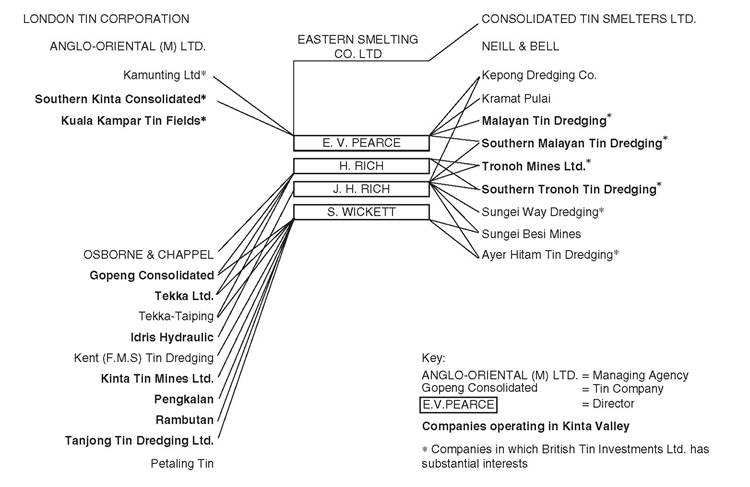
Figure 13.3 Interlocking directorships and mining agencies in tin industry. Source: Khoo and Lubis (2005).
employed by the British Metal Corporation (BMC), where he was managing director between 1925 and 1939. BMC was a major shareholder of Anglo-Oriental Mining and British Tin Corporation. In 1934, he was appointed as the government’s primary informal adviser on zinc, lead, tin and copper. He was also chairman of the London Tin Corporation and served on the boards of a number of foreign companies engaged in the metal trade. He was one of the few people who effectively controlled the global metal trade (Ball, 2004). As Lyttelton himself recounted in his Memoirs, “In the international metal trade [...] no more than perhaps 25 men really counted in the industry [...]. After the retirement of Cecil Budd, I, later, was one of the 25 who could claim to have a say in this world-wide industry” (1962, 130-31). On the outbreak of World War II in September 1939, Lyttelton was appointed controller of nonferrous metals for the government.
Besides personal acquaintance with the few people who “counted in the industry”, there is no doubt that Keynes knew a lot about tin from his speculation in options and futures. As early as 1926, he observed that “most of those who hold shares probably do not understand the metal market, and are constantly upset by its fluctuations” (Keynes Papers, LCE/3/114, 11 December 1926). Keynes, instead, was placed in the situation of having access to “superior knowledge” in that market and trusted tin shares to perform well. The data seem to confirm this (see table 13.6).
Table 13.6 Dividends distributed by some tin companies in Malaya from their foundation to 1951.
| No years | Initial year | Annual average% | Highest 5 years | Annual average% | |
| Ayer Hitam | 21 | 1930 | 20.4 | 1937-41 | 41.0 |
| Kinta | 48 | 1903 | 18.5 | 1946-50 | 30.5 |
| Kramat Pulai | 39 | 1912 | 39.4 | 1934-38 | 97.7 |
| Malayan | 37 | 1914 | 28.9 | 1936-40 | 60.5 |
Source: Rippy (1953).
6.
More on the topic Understanding Market Behavior: Keynes, the Economist:
- Corsi M., Kregel J., D’Ippoliti C. (Eds.). Classical Economics Today: Essays in Honor of Alessandro Roncaglia. Anthem Press,2018. — 275 p, 2018
- Conclusions
- Conclusions
- Methodology and ideology
- Mr. Keynes and the "classics"5 - and Modern Keynesians
- From the boardroom to the financial gambling casino: how the long-term expectations that determine capital investment became unstable and confidence in expectations evaporated in the 1930s
- Conclusion
- Disequilibrium and Non-Walrasian Equilibrium Modelling
- Bibliography
- The economic cycle