A Controversial Model
The Walras-Morishima model is here reconsidered in the perspective of the Cambridge Debate on the theory of capital. This is a preparatory exercise in a specific context. On the one hand, it is related to the attempt to demonstrate that the Cambridge critique concerned not only the surrogate production function but also general equilibrium as well (Garegnani, 2011; Schefold, 2008 and 2011).
On the other hand, the contribution is related to the attempt to investigate the conditions under which a surrogate production function can be approximated despite the occasional occurrence of reswitching and reverse capital deepening (Han and Schefold, 2006; Schefold, 2013). I hope that a later work will build on the foundations laid here and that this focus will fit in with the interests of the group of friends of Alessandro Roncaglia who dedicate this Festschrift to him in appreciation of his distinguished academic career.Walras’s model of capital formation has always been controversial (for an overview of the debates, see Roncaglia, 2005, 342). The observation that Walras’s model of capital formation links up with the problematic of the production function goes back to Piero Garegnani (1960). A pointed application of Garegnani’s analysis was made in John Eatwell’s (1987) contribution to The New Palgrave Dictionary of Economics on Walras’s theory of capital: Eatwell endeavored to show that in general the production of only one capital good was compatible with normal profits on the cost of production and the availability of endowments in arbitrary proportions. But, with only one capital good available in the subsequent period, the system could not reproduce itself. He linked this insight to the broader claim that, apart from narrow exceptions, the neoclassical theory of distribution can explain the rate of return on capital only, if only one capital good is available.
For the amount of capital and the rate of profit are needed to determine the cost of production in the long run and to derive normal prices, but normal prices also serve to measure the amount of capital as the aggregate value of capital goods. The circular determination of prices is possible in an equilibrium of the classical type, where distribution is exogenously given, but if distribution is endogenous and depends on the supply of, and the demand for, factors of production, these have to be measured before formulating the schedules of supply and demand, or else the long-period method must be abandoned. The quantityof capital is unambiguous in models with only one capital good, and so Eatwell’s analysis seemed to confirm a general hypothesis of a deficiency of neoclassical theory in an important representative case: the Walrasian model, although set up to show how many capital goods reproduce themselves, is certain to result in a uniform rate of profit only, if there is only one capital good, but then the system can in general not reproduce itself in the subsequent long period.
The interest in the Walras-Morishima model thus derives from the fact that it represents a neoclassical model of capital formation with a uniform rate of profit. However, it has been recognized that the Walrasian system in its original form cannot be solved in general, because the given endowments are incompatible with the general rate of profit—inequalities have to replace equalities, and different types of solutions become possible (some with normal prices, some not), which have not yet been analyzed fully. The aim of this chapter is to provide more insight into the nature of the different solutions, focusing on the conditions for “normal” solutions with a uniform rate of profit and such that all capital goods are produced so that some form of reproduction of the system is possible. The analysis of the Walras-Morishima model has been complemented by the presentation of a hybrid in which the reproduction of the capital goods is assured, because their quantities are determined endogenously, while the labor supply remains exogenous. This hybrid model may be used to illustrate problems of classical, neoclassical and Keynesian economics, and its analysis has also led to new insights about the improbability of reswitching and the certainty of Wicksell effects (Schefold, 2016).
The Walras-Morishima model first appeared in the Zeitschrift fur Nationalokonomie in 1960 (Morishima, 1960). The paper was reprinted with few changes in Michio Morishima (1964) and taken up again in Morishima’s (1977) book on Walras’s economics but with modifications that we cannot take up here, since they concern wider aspects of the interpretation of Walras. The model has been discussed by others, in particular, as stated, by Eatwell (1987) in The New Palgrave Dictionary of Economics. Morishima’s proof of the existence of equilibrium has been examined and corrected in small detail by Jan van Daal (1998). For a broad historical account, see Donald Walker (1987). I received an essential stimulus from the book by Fabio Petri (2004) on capital theory Garegnani was the first to insist on the contradictory nature of Walras’s approach: one hypothesis on which the theory is built (the arbitrary composition of the endowments) is incompatible with the determination of a system of equilibrium prices with a uniform rate of profit.1
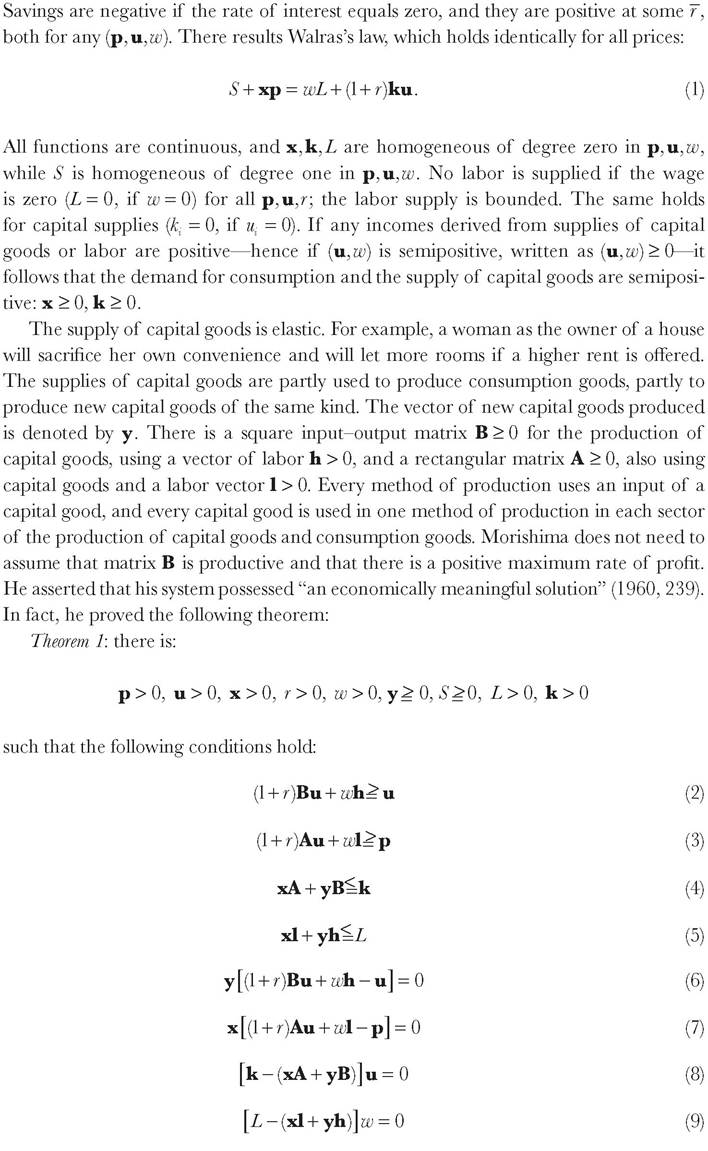
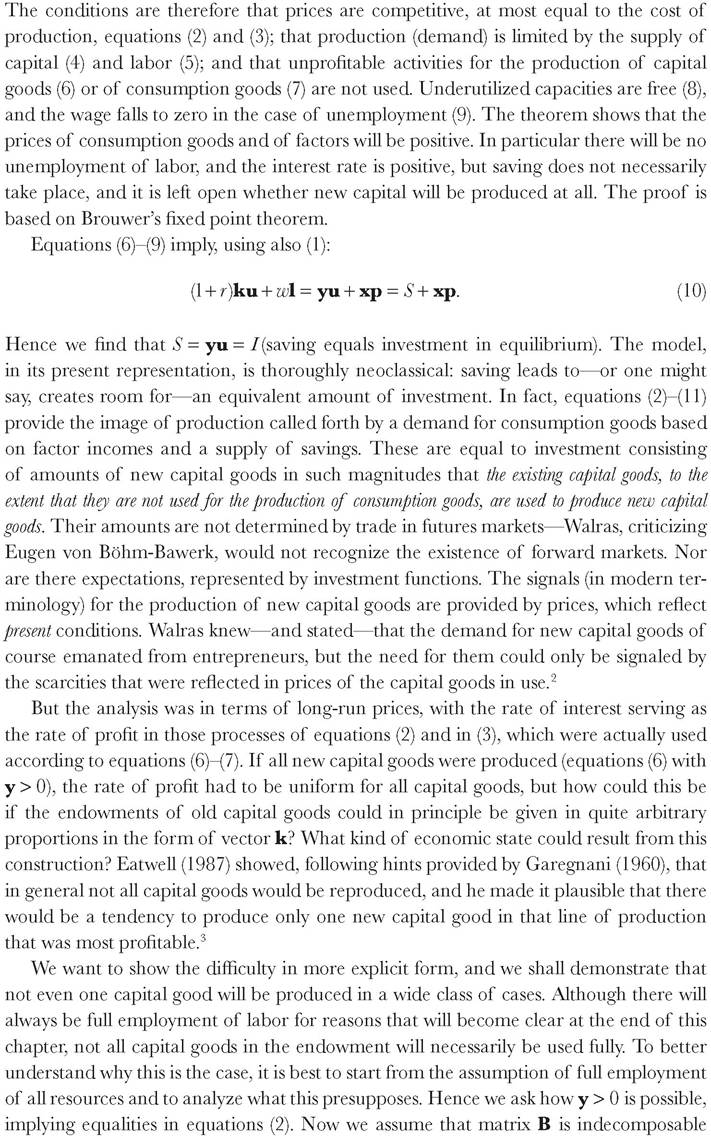
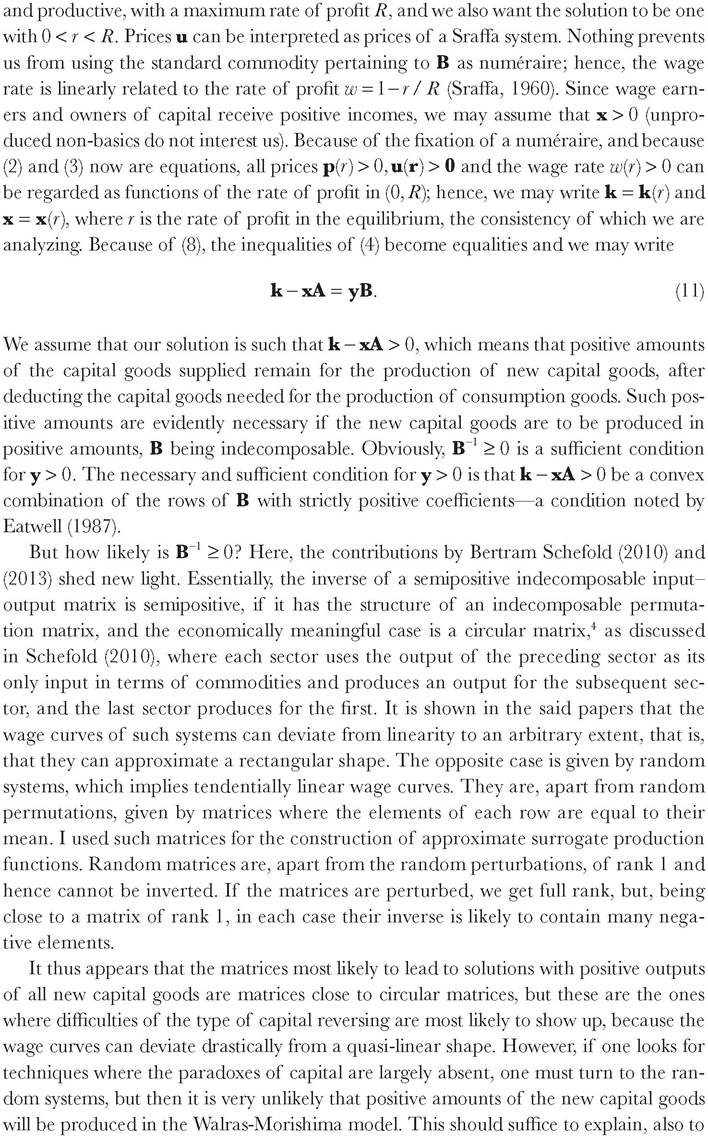
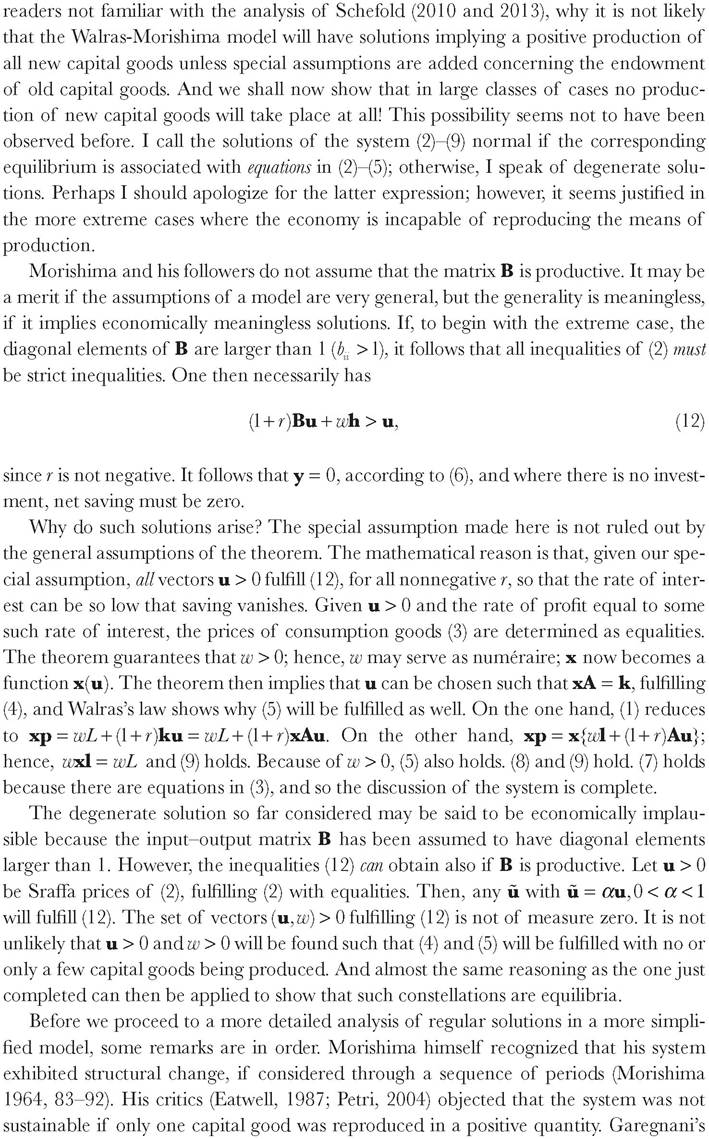
The model contains n consumption goods with prices p, m capital goods with prices u, labor (all of one kind in our simplification) with wage rate w and the rate of interest (equal to the rate of profit) r. We neglect depreciation and assume that all capital goods are used up during the production period (circulating capital only); this means that the effect of the failure of the system to reproduce certain capital goods is more dramatic than if capital goods depreciated more slowly. We neglect the Walrasian costs of insurance and hence we do not find it necessary to introduce special prices for the services of capital. The demand for consumption goods is a n-vector x = x(p, u, w,r), the supply of labor a function L = L (p, u, w, r) and the supply of capital goods an m -vector k = k( p, u, w, r). The demand for consumption goods and the supply of labor and capital goods results from utility maximization, along with a supply of savings 5 = 5 (p, u, w, r).
objection (1960) may be interpreted as the observation that arbitrary endowments are incompatible with the uniform rate of profit. Here we have found that the model may imply degeneracy such that the system suffers sudden death in that the capital is consumed entirely.
Walras himself was looking for an adaptation of a production of new capital goods to the demand of entrepreneurs. He explicitly said that “the demand of new capital goods comes from entrepreneurs who manufacture products and not from capitalists who create savings” (Jaffe’s translation, as quoted by Walker, 1987, 857). A similar quote is found in Eatwell (1987, 869): “new capital goods are products; and the condition of equality between their selling price and their cost of production gives us the equations required for the determination of the quantity manufactured” (see equations (8) and (4)); however, Eatwell (ibid.) also says, “the demand price of any new good is determined solely by the demand for the stock of its services currently available.” There was no other way, given that Walras neither accepted forward markets nor wished to introduce expectations based on information other than that contained in current prices. But then it is difficult to discuss investment without imposing the conditions of a steady state or, more simply, that of stationarity. This leads us to a brief discussion of a simplified model.
2.