Notes
1 The Piero Sraffa Papers are kept at the Wren Library, Trinity College, Cambridge (catalogue available at https://janus.lib.cam.ac.uk/db/node.xsp?id=EAD%2FGBR%2F0016%2FSRA FFA).
2 This interpretation is criticized in Kurz (2012 and 2015) and in Kurz and Salvadori (2015); see also de Vivo and Gilibert (2013).]
3 See also Garegnani, 1998.
4 As we shall see, in November 1927 Sraffa dubbed “first equations” and “second equations” his schemes describing cases of economies producing no surplus and positive surplus.
5 The relevant notes are currently identified by the catalogue of the Piero Sraffa Papers with the reference number D3/12/3. Garegnani most plausibly argued that that document—kept in a folder headed by Sraffa “Notes London, Summer 1927 (Physical Real Costs etc.)”—may be taken to reflect Sraffa’s first attempt to prepare a text he would have used to deliver the lectures on advanced theory of value he was expected to start in Cambridge in October 1927. Those lectures, however, were delayed, first to the next term, then to the subsequent academic year, and came to be based on a different set of notes. For these reasons, document D3/12/3 [A4] was dubbed by Garegnani “pre-lezioni” or “prelectures” (Garegnani, 2004 and 2005). In this chapter we follow the same convention (after reference to the catalogue of the Sraffa Papers we add, in square brackets, the reference number of the earlier catalogue, prepared by Khrisna Bharadwaj and Pierangelo Garegnani soon after Sraffa’s death—this should facilitate comparisons with the hybrid notation that appears in Garegnani’s 2004 and 2005 articles).
6 In the prelectures, even though Sraffa clearly illustrates the difference between the two concepts (see D3/12/3/36, 41), “ultimate cause” and “ultimate standard” of value tend to be treated as synonyms (see also Sraffa Papers, D2/4/3(19) and D3/12/7/120, where Sraffa states that this was how the two concepts were treated by classical authors).
7 From one of his letters to his sister-in-law (letter from A. Gramsci to T. Schucht, March 24, 1929; Gramsci and Schucht, 1997, 332), we know that before being arrested, Gramsci owned a copy of the same edition of Marx's Theories of Surplus Value (the 1924-25 French edition), which is now kept among Sraffa's books and which Sraffa certainly used. This information and a statement in a letter sent by Sraffa to Tatiana Schucht (“Of course, there is the Histoire des doctrines economiques, in 8 small volumes, that Nino knows,” letter from P. Sraffa to T Schucht, June 21, 1932; Sraffa, 1991, 74: our translation) allows us to argue that before November 1926, Sraffa too had already owned that book and that he had talked about it with Gramsci.
8 A pencil note in square brackets at top of document D3/12/3/8 [A4/4iv] reads, “From here on numeration on top is by PG”, where PG certainly means Pierangelo Garegnani.
9 Garegnani (2005, 465) quoted about a third of the following passages.
10 Read: theory of value.
11 It may also be stressed that a wage basket was described by Sraffa as “1 kg of bread + 1/2 kg of meat” (D3/12/3/44 [A4/ 16iii]); we will return to this point in note 36, below.
12 This sentence closely resembles the phrase used in Production of Commodities: “an extremely simple society which produces just enough to maintain itself” (we may also note the absence of any reference to an economy's net product or surplus).
13 We assume that the note in D3/12/3/44 [A4/16iii], which may be compared with other annotations on the margins of the prelectures, was written in the summer of 1927 or, at the latest, between that period and November 1927.
14 Reducing production processes to a hypothetical absolutely necessary commodity in the more general case described in D3/12/3/44-46 [A4/16iii-v] would have required a much more complex analytical apparatus and presented little or no chance in actually comparing the approximation it could have delivered with those implied by alternative methods mentioned by Sraffa himself in the same sheet.
15 We further consider this hypothesis below.
16 A = a1 + a2
B = b1 + b2
and
x = ax + bx
y = ay + by
17 See note 36, below.
18 A -a1 = b1 = a2
B -b2 = a2 = b1
19 The lack of that distinction can be recognized in other documents, e.g., D3/12/5/2 [A6/1i], D3/12/11/54 [E2/48], D3/12/11/84 [E2/74i] and D3/12/11/87 [E2/75].
20 x = ax + bx
y = ay + by
and
x = ax + ay
y = bx + by
21 The set of equations referred to in point (2) above could be associated to Marx's conditions of simple reproduction. But, given that they are abandoned with no further elaboration and that Sraffa immediately moved to consider another set of equations, we may gather that such a similarity with Marx's conditions of simple reproduction was either not noticed or taken to be of no interest by Sraffa.
22 x = ax + ay y = bx + by
23 This amounts to applying the method of substitution before eliding the presence of the same variable on both sides of the equation representing the production process of an input. This method leads to reach a solution by an infinite number of steps. Ordinary application of the method of substitution (i.e., eliding the presence of the same variable on both sides of the relevant equation) would lead to a quicker solution.
24 This would correspond to what Sraffa had written in the prelectures: “by going back enough in the genealogy of production [...] and stopping along each branch so soon as we have resolved it into our necessary commodity” (D3/12/3/44 [A4∕16i]). Two notes kept in folders respectively dated “December 1927” and “Winter 1927-28” touch on the relationship between method of substitution and reductions (see D3∕12∕10∕71 [E3∕26] and D3∕12∕6∕4 [CXVI 3i]).
25 The repetition of equation x = ax + ay at the end of the document may reflect the intention, also abandoned, of starting a new attempt to solve the system.
26 Few steps, just like in the case developed by Sraffa, would have clearly shown the pattern of the solutionyy = (b+b2)x + b2y = (b+b2+b3)x + b3y.
27 A reduction of production process of x to x itself may be recognized in an already quoted sentence in the prelectures: “In the case of corn [.] at each step backwards we would find a part of cost being wheat and the other not, and setting aside the first while going on analysing the latter, this non-wheat residue would ultimately be reduced to practically nothing” (D3∕ 12∕ 3∕45 [A4∕16iv]). Strictly speaking, however, the context in which this sentence appeared was not that of a reduction intended to determine the value of a commodity, but that of an illustration of the mechanics of reduction as such. A reduction intended to determine the value of a commodity had appeared few lines earlier in the same sheet of the prelectures, and in that case production process of y was appropriately reduced to x: “we might find exactly the total amount of [.] corn (if this were the ideal necessary commodity, which it is not) that has actually entered into the production of, say, this book, and covers entirely its cost of production at the exclusion of any other commodity” (D3∕12∕3∕45 [A4∕ 16iv; underlining as in the original manuscript).
28 Here Sraffa also notes, “what if (x - a1x) > ∑axdd,
29 Most likely, this note, referring to the calculation of limits of a numerical series, had been inspired by what Sraffa had read in the section on geometrical progressions in a book by Mineo Chini explicitly mentioned in other manuscripts. The book, Corso Speciale di matematiche. Con numerose applicazioni. Ad usoprincipalmente dei chimici e dei naturalisti (see de Vivo 2014, 89; see also note 43, below), is still kept in Sraffa's library. Chini's Corso speciale was an introductory handbook based, as Chini himself stated in its preface, on university-level teaching experience of the mathematics needed by students who were to engage in experimental sciences; the latter characteristic, together with examples and exercises distributed throughout the text, mainly relating to chemistry and to natural sciences in general, justified the subtitle of the book.
We may presume that Sraffa (who owned the sixth edition of the book, issued in 1923, while a subsequent edition was issued in 1926) bought it between 1923 and 1926, i.e., in the years he was starting his academic career (he began teaching at the University of Perugia in academic year 1923-24, and in March 1926 he moved to the University of Cagliari). It would not be surprising if that book had been recommended to Sraffa by Ettore Molinari, professor of chemistry at Bocconi University (Sraffa's father was the rector of that university) and a prominent figure of the Anarchist movement, or by his son, Alessandro Molinari, who had graduated from Bocconi University in 1920 with a thesis on Russian Soviets (when, in June 1922, Piero Sraffa was appointed director of the Labor Office of the Province of Milan, Alessandro Molinari was director of the Labor Office of the Municipality of Milan, and they certainly were acquainted with each other).30 The manuscript reads: “The mistake has been not make it explicit in the initial equations that product is greater than total factors. Therefore here they are written again” (D3/12/6/1(6); underlining as in original manuscript).
31 Read: Keynes approves first equations.
32 Seemingly, Italian authorities failed to associate the letter, which had to be published anonymously, with the name of Piero Sraffa (see Naldi, 2005, 387-89; 2008, 17; Lattanzi and Naldi, (2015, 17-18)).
33 For the first page of that letter, see item D3/12/5/32 [A6/13] (it may also be noted that manuscript D3/12/5/33 [A6∕14i] is dated by Sraffa “2.12.27”). This point is further considered below.
34 Most likely: Saturday, November 26, 1927.
35 Keynes attributed Sraffa's excitement to his own approval of his ideas; we assume that at least in part that excitement came from the fact that those ideas reflected results he had reached very recently. A fact at variance with Keynes's description may also be stressed: in those days Sraffa drafted many notes, including a long one (D3/12/4/15-16 [A5/ 14i-ii]) relating at least in part to the content of the very conversation with Keynes of November 26, which is explicitly mentioned in it (this document, bearing the title “Metaphysics,” has been often quoted; for its full text see Naldi (2016, 120-21).
Furthermore, Sraffa most likely did not leave England during Christmas vacations because—after his letter on Gramsci's detention—he was in danger of being arrested by the Italian police or, eventually, of being refused permission to reenter in Britain, as had already happened in January 1923: see Naldi (2005, 380-81 and 388-89).36 Gehrke and Kurz (2006, 97fn6) suggested that this notation, where heterogeneous quantities such as a1 and b1 or 7B and 4C are straightforwardly added together, may reflect Sraffa's familiarity with chemical formulas. In our view, a more direct explanation may be attained by observing the passage reproduced from the prelectures, where a wage basket was described as “1 kg of bread + 1/2 kg of meat” and the real cost of producing a given article as “a given set of diverse commodities” (D3/12/3/44-46 [A4∕16iii-v]). On such a basis, Sraffa may be expected to have initially treated the magnitudes that appear in the equations as strictly physical quantities, linking them by the signs + and =.
37 On the top of the sheet Sraffa wrote, “(From folder headed: ‘End of Nov. 1927')” and “Without surplus” (the two phrases seem to have been written at different times).
38 Other calculations, mainly located on the bottom of the page, were crossed out by Sraffa and are not reproduced here.
39 On the top of the sheet Sraffa wrote, “No surplus (stesse equazioni)” (“No surplus (same equations)”).
40 We doubt that this fact may be interpreted as a sign that Sraffa was treating A as absolutely necessary commodity (such an interpretation would be at variance with the fact that the value of B in terms of A is calculated from the equation describing the production process of A). Other calculations, located on the bottom of the page, were crossed out by Sraffa and are not reproduced here. On the back of this sheet Sraffa wrote another system of equations where no surplus was considered, but crossed it out. The system (which is reminiscent of that in item D3∕12∕6∕1(4)) is the following: 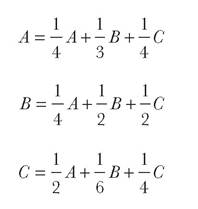
41 There is no reason to doubt that Sraffa immediately saw that the solutions could be understood as exchange ratios and as values. Indeed, in a manuscript kept in a folder headed by Sraffa “Winter 1927-28 Looms, etc.” we read, “[the equations] have infinite sets of solutions [...] the solutions of each set are proportional. These proportions are univoche. These proportions we call ratios of Absolute values. They are purely numerical relations between the things A, B [...].” (D3/12/5/2 [A6/ 1i]; our insertions within square brackets). The same point emerges even more clearly from manuscripts kept in a folder headed by Sraffa “Winter 192728”: “these are still homogeneous equations and give us only ratios between unknowns: this is satisfactory for values, but is it for R? It will give us the ratios between R and our apparent unknowns a, b [.]. Now these are only «one unit of measure of each commodity» (1 bushel of wheat, 1 ton of coal etc) [.]. If this were unsatisfactory, we could put the equations in a form which shows explicitly that our real unknowns are values” (D3/12/6/17-18 [C XVI 4ii, iii]). Accordingly, he introduced “[unknowns] V The value of A in terms of B, etc” (D3/12/6/18 [C XVI 4iii]; our insertions within square brackets; see also D3/ 12/ 11/ 89, 101).
42 On the top of the sheet Sraffa had also annotated the following: “Try negative surplus (loss)” and “Surplus only in A with two unknowns there are two solutions Why?” (the different sentences seem to have been written at different times).
43 “See Chini p 41 (equations are contradictory therefore no solution exists) Equations must be non contradictory independent.” “Chini page 41” certainly refers to the book by Mineo Chini already mentioned in note 29, above. For other references to Chini’s book in the Sraffa Papers, see Kurz (2012, 1545-47).
44 We may also recall that, if on November 26 Sraffa recorded that he had shown to Keynes his “first equations” (i.e., his scheme for the case of no surplus), he certainly had already defined a set of “second equations” (i.e., a case of positive surplus).
45 On the top of the sheet Sraffa had annotated, “Surplus «a separate industry».”
References
de Vivo, G. 2000. “Produzione di merci a mezzo di merci: note sul percorso intellettuale di Sraffa.”
In Piero Sraffa: Contributiper una biografia intellettuale, edited by M. Pivetti, 265-95. Roma: Carocci.. 2003. “Sraffa’s Path to Production of Commodities by Means of Commodities. An Interpretation,” Contributions to Political Economy 22, no. 1: 1-25.
-----. 2014. Catalogue of the Library of Piero Sraffa. Torino and Milano: Fondazione Luigi Einaudi and Fondazione Raffaele Mattioli.
de Vivo, G., and G. Gilibert. 2013. “On Sraffa and Marx: A Comment,” Cambridge Journal of Economics 37, no. 6: 1443-47.
Garegnani, P. 1998. “Sui manoscritti di Piero Sraffa,” Rivista Italiana degli Economist! 3, no. 1: 151-56.. 2004. “Di una svolta nella posizione teorica e nella interpretazione dei classici in Sraffa nei tardi anni Venti.” In Convegno internazionale Piero Sraffa, Atti dei Convegni Lincei, 159-94. Roma: Accademia Nazionale dei Lincei.
-----. 2005. “On a Turning Point in Sraffa’s Theoretical and Interpretative Position in the Late 1920s,” European Journal of the History of Economic Thought 12, no. 3: 453-92.
Gehrke, C., and H. Kurz. 2006. “Sraffa on von Bortkiewicz: Reconstructing the Classical Theory of Value and Distribution,” History of Political Economy 38, no. 1: 91-149.
Gilibert, G. 2001. “Gramsci, Sraffa e il secondo libro del Capitale? In Marx e Gramsci: Memoria e attualita, edited by G. Petronio and M. Paladini Musitelli, 159-72. Roma: Manifestolibri.
-----. 2003. “The Equations Unveiled: Sraffa’s Price Equations in the Making,” Contributions to Political Economy 22, no. 1: 27-40.
Gramsci, A., and T Schucht. 1997. Lettere (1926-1935), edited by A. Natoli and C. Daniele. Torino: Einaudi.
Kurz, H. D. 2012. “Don’t Treat Too Ill My Piero! Interpreting Sraffa’s Papers,” Cambridge Journal of Economics 36, no. 6: 1535-69.
-----. 2015. “Sraffa’s Equations ‘Unveiled’? A Comment on Gilibert.” In Revisiting Classical Economics: Studies in Long-Period Analysis, edited by H. D. Kurz and N. Salvadori, 192-224. Abingdon: Routledge.
Kurz, H. D., and N. Salvadori. 2004. “Man from the Moon: On Sraffa’s Objectivism,” Economies et Societes 35: 1545-57. Reprinted in Interpreting Classical Economics: Studies in Long-Period Analysis, edited by H. D. Kurz and N. Salvadori, 120-30. Abingdon: Routledge, 2007.
-----. 2005. “Representing the Production and Circulation of Commodities in Material Terms: On Sraffa’s Objectivism,” Review of Political Economy 17, no. 3: 69-97.
-----. 2015. “On the Beginnings of Sraffa’s Path to Production of Commodities by Means of Commodities: A Comment on de Vivo.” In Revisiting Classical Economics: Studies in Long-Period Analysis, edited by H. D. Kurz and N. Salvadori, 226-44. Abingdon: Routledge.
Lattanzi, E., and N. Naldi. 2015. “Documenti su Piero Sraffa all’Archivio Centrale dello Stato e all’Archivio Storico Diplomatico (Documents on Piero Sraffa at the Archivio Centrale dello Stato and at the Archivio Storico Diplomatico).” Centro Sraffa Working Papers no. 12. Roma: Centro di ricerche e documentazione Piero Sraffa. Available at: http://www.centros- raffa.org/ cswp_details.aspx?id=13
Marcuzzo, M. C. 2005. “Piero Sraffa at the University of Cambridge,” European Journal of the History of Economic Thought 12, no. 3: 425-52.
Naldi, N. 2005. “Piero Sraffa: Emigration and Scientific Activity (1921-1945),” European Journal of the History of Economic Thought 12, no. 3: 379-402.
-----. 2008. ‘Archival Research and the Reconstruction of Piero Sraffa’s Intellectual Biography: An Interim Report.” In The Keynesian tradition, edited by R. Leeson, 4-41. Basingstoke: Palgrave Macmillan.
-----. 2016. “Sulle conversazioni fra Sraffa e Wittgenstein.” In Sraffa e Wittgenstein a Cambridge, edited by G. Cospito, 113-39. Pisa: Edizioni della Normale.
Roncaglia, A. 1975. Sraffa e la teoria deiprezzi. Bari: Laterza. (English edition: Sraffa and the Theory of Prices. Chichester: John Wiley, 1978).
Sraffa, P 1925. “Sulle relazioni fra costo e quantita prodotta,” Annali di economia 2, no. 1: 277328. (English translation by J. Eatwell and A. Roncaglia: “On the Relations between Costs and Quantity Produced.” In Italian Economic Papers, vol. 3, edited by L. L. Pasinetti, 322-63. Bologna: Il Mulino and Oxford: Oxford University Press, 1998.)
-----. 1926. “The Laws of Returns under Competitive Conditions,” The Economic Journal 36, no. 144:535-50.
-----. 1960. Production of Commodities by Means of Commodities: Prelude to a Critique of Economic Theory. Cambridge: Cambridge University Press.
--------. 1991. Lettere a Tania per Gramsci, edited by V Giarratana. Roma: Editori Riuniti.