A Stationary State
The amount of capital, expressed in standard prices, is qAp = K = kp. This amount of capital is endogenous, and the quantities of capital goods are fully employed by definition of the activity levels.
But the financing of the investment is not a matter of course.The difficulty surfaces in the formulation of Walras’s law. Households formulate their supply of savings and their demand for consumer goods at alternative interest rates and prices subject to the evaluation of their incomes, to be derived from given factor endowments, at different factor prices. Here, the endowment of labor but not the endowments of the several capital goods are given. As a substitute, in what then is a hybrid model, we assume that households take the capital goods actually employed in the previous period as their endowments, as the use of those capital goods leads to the payment of the corresponding factor income. Hence Walras’s law is  where k is given by (13). Factor endowments and demand in (16) are therefore interdependent not only as regards the prices, but also as regards the quantities k. The question is which decisions lead to the investment of k that ensures reproduction and is defined by (13).
A complementary interpretation could be based on the dual decision hypothesis. It was introduced by Glower (1965) to explain the deficiency of effective demand in an equilibrium framework. The demand emanating from workers should not be calculated on the basis of the total of labor supplied, as in (1), but according to the amount of labor actually employed, for only employed laborers have the purchasing power of the wages paid out to them, while the purchasing power of the unemployed may be zero (if they neither get unemployment benefits nor can use past savings and if they have no access to credit).
In our variant of the budget constraint (16), the owners of capital command purchasing power to the extent that the capital goods are employed in the stationary state. It is conceivable and could be assumed that the endowment of capital is larger, but any excess of capital as in Walras’s law (1) over capital employed as in equation (16) then does not result in additional income and therefore not in effective demand for goods. The owners of capital could thus be said to be rationed in their demand. Again the question must be posed from which decisions the quantities of capital result (13) that ensure stationary reproduction.Mathematically, the system is consistent and leads to a solution with a given technique, whatever the endowment of labor, because capital adapts. Intuitively, if the amount of labor is increased or diminished, the amount of capital used and produced in stationary states will be higher or lower according to equation (13), and with the increase or diminution of the factor supplies, the demand for consumption goods and the supply of saving will move in parallel so that it becomes possible to find an equilibrium, using plausible additional assumptions.
An assumption regarding savings is required. We are only interested in normal solutions. Hence prices (14) can be given as functions of the rate of profit p(r), and similarly the wage rate w(r); hence, x = x(r), 5 = 5,(r). The Walras-Morishima model assumes that
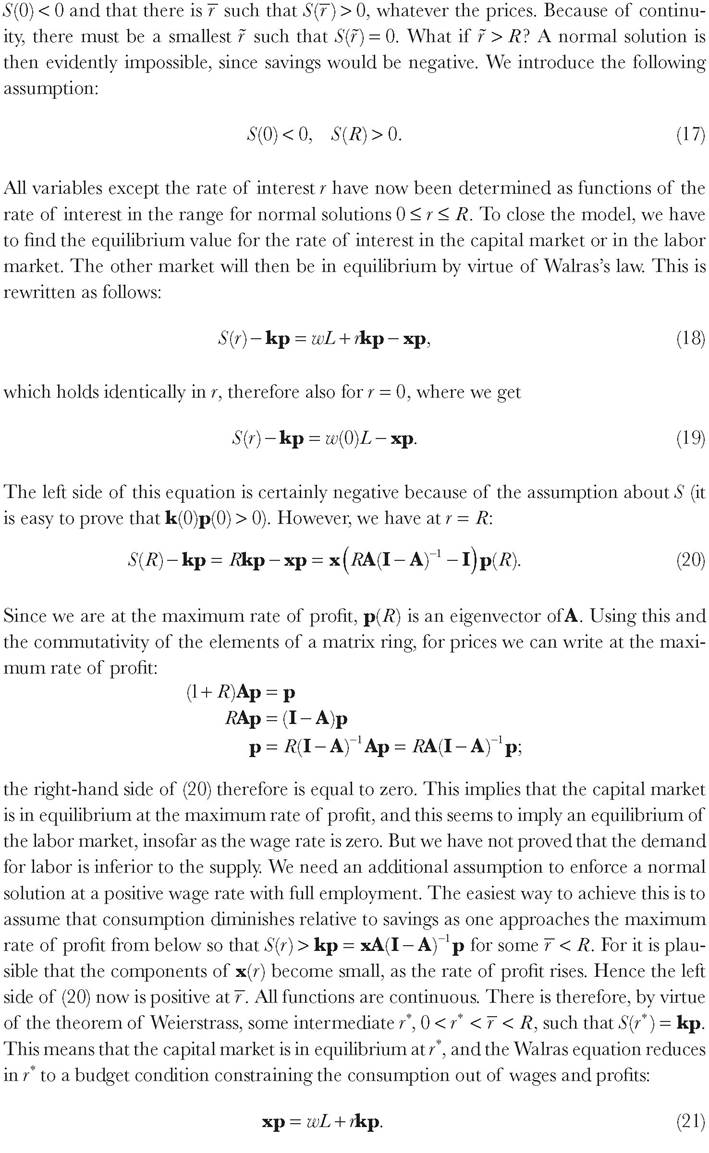
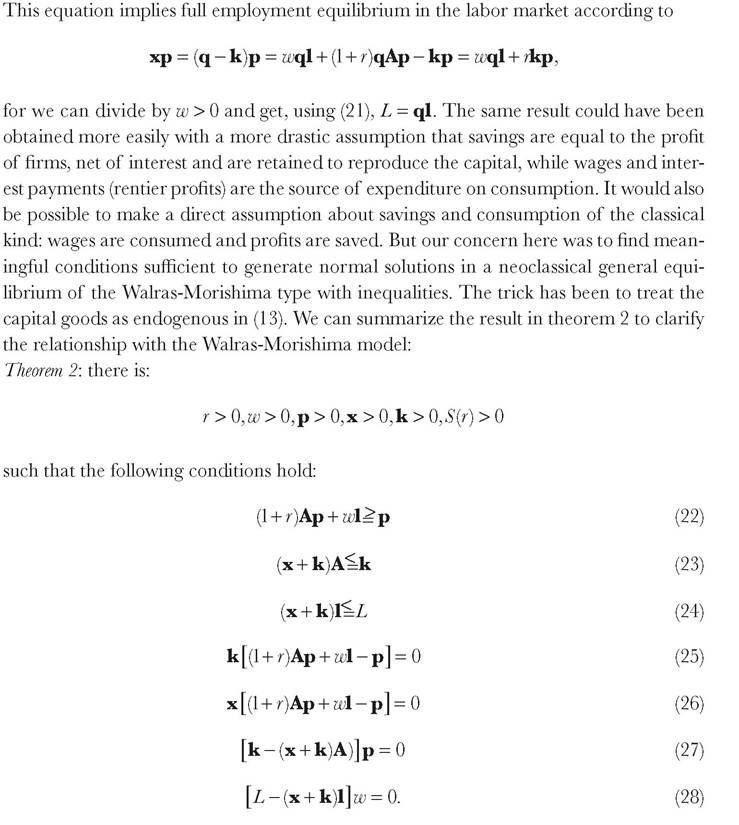
To achieve formal symmetry, (26) has been added to (25). Walras’s law (1) remains, with the interpretation of the capital stock changed, however.
The hybrid character of the model results here from (23), which, in our solution with all inequalities turned into equalities, yields (13). Demand on the left and supply on the right are interdependent in (23), so that the model is not really Walrasian anymore.
The stationary state must insofar be interpreted as a center of gravitation; the equations do not describe a pure neoclassical model.Like any model with normal solutions, this one is useful for analyzing disequilibria. Starting from the equilibrium at r*, imagine a slight change of taste. Consumers decide to save more at given k. One expects that xp will fall and unemployment arises (which would have to be regarded as Keynesian).
Or assume that the rate of profit is lowered below r* and that w rises. Savings 5 must fall, and consumption expenditure xp is expected to rise at given k, but this capital stock cannot be expected to be adequate for the production of the increased demand for consumption goods; hence, classical unemployment arises. Richard Kahn (1977), in the discussion surrounding Edmond Malinvaud’s (1977) theory of unemployment, thought that such classical unemployment could not be sustained, because the excess demand for goods would drive up money prices and lower the real wage so that there would be a tendency to return to equilibrium (Schefold, 1997, 404). A neoclassical economist might argue that the Keynesian unemployment was unstable. Excess saving would drive down the rate of interest, savings would be reduced directly and households would be encouraged to buy more goods. This overlooks the dual decision hypothesis: the unemployed, bereft of income, could not return to the previous levels of expenditure.
The model with normal solutions thus allows a more transparent analysis of their character than is possible on the basis of a mere proof of the existence of possibly degenerate solutions to the equations of the Walras-Morishima model, but our simplified version is hybrid, because the endowment of capital goods has been determined endogenously, and yet this endowment is regarded as given (as quasi-exogenous) when the households determine their demand for consumption goods. The alternative would be to introduce capital as a value magnitude, as part of the endowment of households.
Since this endowment would represent an arbitrary quantity relative to the given endowment of labor, the employment of both factors would be possible in a stationary state only if conditions for a substitution between capital and labor were introduced. This is discussed on the basis of Schefold (2013) in Schefold (2016), in order to investigate the existence of technical conditions under which production can adapt to a given capital-labor ratio (determined by factor supplies) so that full employment results. The general equilibrium models seem to be much more general than the neoclassical model based on the aggregate production function, but if one looks for the economically relevant solutions with a uniform rate of profit, if one takes the neoclassical postulate seriously that this rate of profit must be determined through supply and demand for “capital” and finally if one looks at the conditions necessary for a stable equilibrium, one is compelled to return to the surrogate production function, with its formal elegance and its logical difficulties. Garegnani (1960) sensed this more than 50 years ago and Schefold’s (2016) parallel paper is an attempt to demonstrate it with more developed methods.