Compositional problems
There are several kinds of potential compositional problems (see Section 4, Table 11.1).
• Marriages begin at the latest in the seven parishes (B, C, G, O, P, S, V)28 in 1790, end in six in 1857, and in one in 1864.
• Baptisms are recorded in all seven parishes from before 1790 to 1857 in seven parishes but beyond 1857 only in four (B, C, G, and V).
• Burials are recorded in all seven parishes from before 1790 to 1857 in seven parishes but beyond 1857—1891 in one (O) and to 1898-99 in four (B, C, G, and V).
From this it can be seen that it is all right to start analysis in 1790 (by which time data quality is already excellent), but not clear where to end it. Indeed, a case can be made that it is all right to start analysis in any parish as soon as the data in it seem reliable, since overall results would be affected over time only by inter-parish compositional differences, which could be controlled. After 1857 there are no more marriages, with the result that lower order parities gradually disappear from analysis, since the stock of marriages ages after 1857. Mortality should drop for several years since there were no new first births (which are the riskiest), but gradually mortality might rise, as more and more birth were at successively higher and somewhat riskier parities and as women aged. We solve this problem by truncating graphical analysis in 1860, before compositional change in the parity structure becomes severe, or by controlling for parity in the regression analysis.29
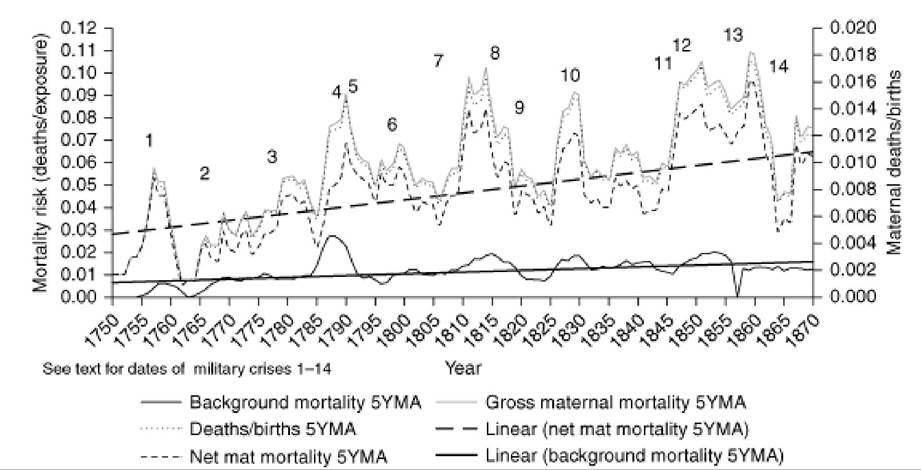
Figure 11.5 Gross maternal, background, and net maternal risk and probability of dying in childbirth, by year, five- year moving averages for all parities
6.3