Risk factors
Different plausible factors may account for differences in MM risk. We have some expectations from the literature and earlier work on this region.
1. Some factors are presumably biological, namely parity, age, multiple birthing, and prior stillbirths.
Generally speaking, the risk of death in childbirth is highest at the first parity, falls, and then climbs at successive parities, although it may fall offFigure 11.4 Maternal mortality by age and parity, Slavonian data
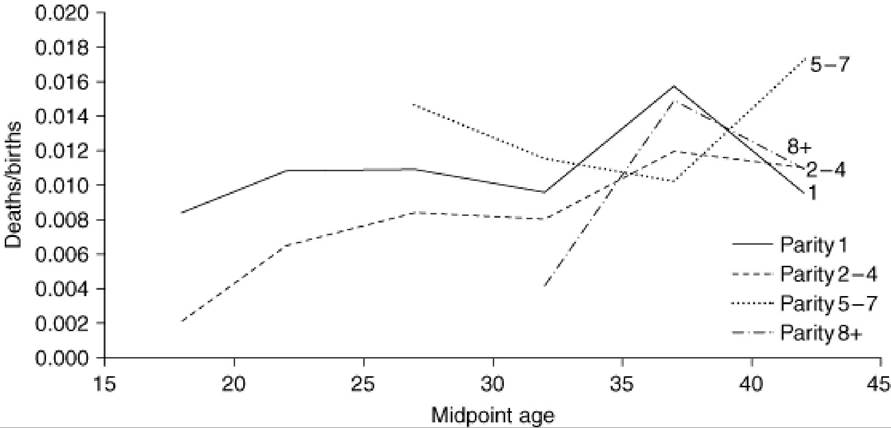
on account of selection effects, the more robust women surviving to have the higher order births. The risk tends to increase with age at each parity. Figure 11.4 shows data from the Slavonian parishes. Risk in the Slavonian data rises with age at parity 1 except for the rare cases of women having a first birth past age 37 (where numbers are minuscule). Risk also rises with age at parities 2—4. Risk declines with age up to age 37 for parities 5—7, then rises; the decline is anomalous. Risk rises with age for parities over 7, then falls at the end, but the estimates are based on rather small numbers. Thus, the general expectations are more or less confirmed where data are sufficiently dense. At any age, risk is usually highest for parity 1, then lowest at parity 2—4, then increasing with parity except for selection effects. At any parity, risk tends to increase with age, although this trend exhibits some irregularities. These are also the same patterns described by Knodel (1986: table 7) for historical German data.
2. An interesting question is whether the risk of death is increased by short birth intervals. It is difficult to examine it without adequate pregnancy histories. For example, under a maternal depletion hypothesis we might expect a negative relationship between mortality and the length of the previous interval or of the mean interval over all previous births.
However, if intervals are lengthened by unknown stillbirths or abortions that may traumatize the mother, or if conception delay is lengthened by ill health, this relationship could be obscured or even reversed. Therefore we expect that risk will be lower where the lifetime average birth interval is long, but higher where the immediately preceding interval is long.263. Some ecological factors may enter. Some parishes are closer to the Sava River and thus to swamps that were malarial until quite late in the nineteenth century. Six of the seven parishes were military. Earlier work leads us to anticipate that civil parishes became more sensitive to economic fluctuation and were under greater economic stress before emancipation in 1848, with some amelioration thereafter. However, a greater reactivity to economic conditions may have occurred while general mortality levels were declining. The great cholera epidemics of the 1830s had ceased by then, and by the later decades of the century, swamps were being drained, so that endemic malaria was less of a problem.27 As noted, these two trends may not be in conflict; that is, it is possible that overall mortality was declining while at the same time mortality was becoming more sensitive to short-term economic changes. The proportion constituted by maternal deaths out of all deaths of married women increased after 1850. It is not attributable to the intrusion of ill-prepared physicians into the birthing process (cf. Hogberg and Brostrom 1986), since we do not have any evidence of the entrance of physicians or of the use of lying-in hospitals in this area.
4. A likely effect of increased labour demands brought about by monetization and pressures to produce cash, could have been increased workloads for women. Female workloads could also have been induced by episodic withdrawal of male labour, especially in the military parishes, during periods of mobilization. Since the organization of female labour in joint households was hierarchical, and the youngest brides traditionally did the hardest work, we might expect that younger women would show the strongest evidence of sensitivity to such labour demands. We will show that mortality at first parity increased faster than mortality at higher parities.
6.2