Updating Coefficients: The RAS Procedure
The construction of input-output tables requires massive amounts of information, often obtained by means of extensive - mostly also expensive - surveys. These surveys are usually not taken every year, but only every five or ten years.
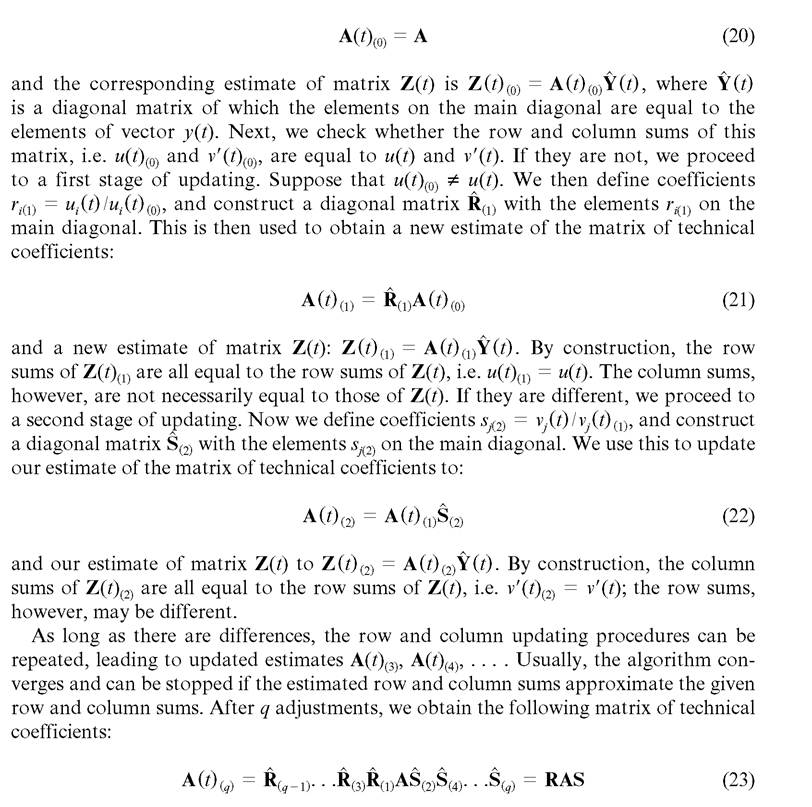
For the years in between, one usually has some information available. Updating techniques have been developed in order to estimate the technical coefficients for the years for which there is only limited information.The best known technique is the RAS, or biproportional matrix balancing, technique. Assume that the complete matrix of technical coefficients of a given base year is known; let it be equal to A. We want to obtain an estimate of the matrix of technical coefficients in year t, which we will designate as A(t). The information available for year t is: the total output of each sector, the total intermediate sales of each sector, and the total intermediate purchases of each sector. In technical terms, we know the output vector y(t), and both the row and column sums of the matrix of intermediate deliveries Z(t). The vector of row sums is by convention designated as u(t) and that of column sums as v'(t).
To begin with, we simply assume that the matrix of technical coefficients has remained unchanged. Our initial estimate of A(t) is therefore:
Many variants of the basic RAS approach have been developed over the years.