Applications of Input-Output Analysis
Input-output models are versatile tools which can be adapted to study many different policy issues. We illustrate this by looking at interregional, international and environmental input-output models.
The interregional input-output model, originally developed by Walter Isard (1919-2010), is based on the assumptions that there exist several regions within a country, and that detailed data are available on the transactions between sectors located in the same region as well as on those between sectors located in different regions. Without loss of generality, we suppose there are just two regions, North and South. The matrix of inter-industry transactions can then be written as:
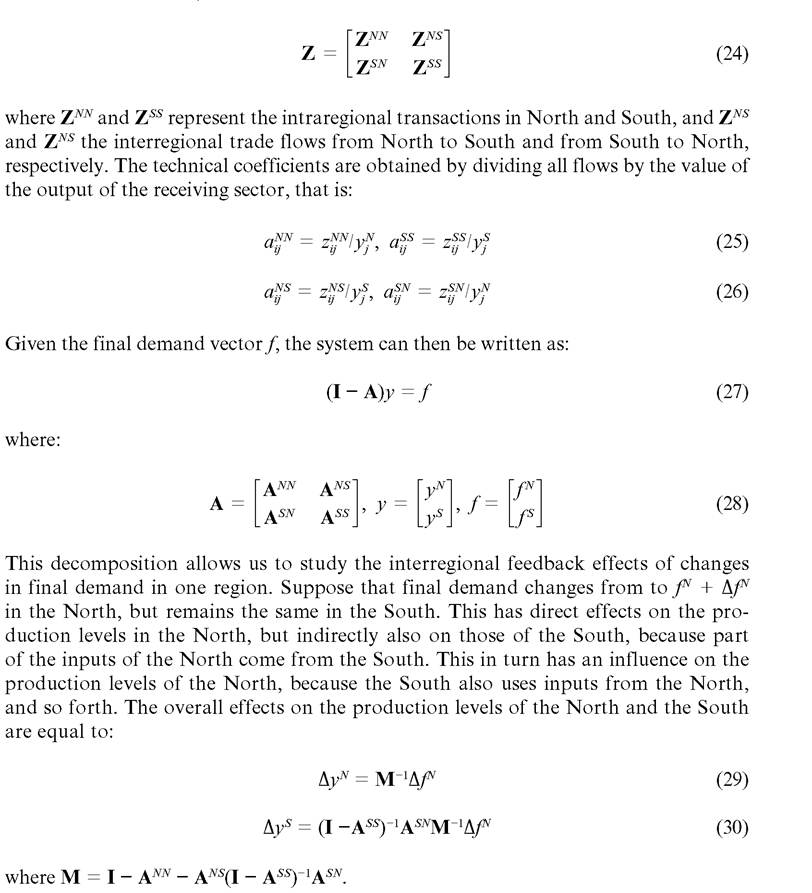
A full-blown interregional input-output model requires a lot of data, which are often not available. This has led to the development of alternative models which require less detailed data. These include the multiregional input-output model of Hollis B. Chenery (1918-1994) and Leon N. Moses (1924 2013), and the balanced regional model of Leontief and others.
Many international input-output models closely resemble the regional input-output models, with import and export flows replacing the interregional trade flows. Several of such models have been developed for both Asian and European countries. In the 1970s Leontief himself took the lead in the development of a world model, with the support of the United Nations. This model was meant to be an instrument to promote economic development and to improve environmental policy.
In fact, a growing concern for environmental problems has been a driving force for the development of extended input-output models known as environmental input-output models. A simple way to proceed is to assume that it is possible to measure how much pollution is generated by each industry. Suppose this information is collected in matrix E, of which each row represents the amount of pollutants generated per unit of output of the corresponding industry. The total amount of pollutants which corresponds to the industry output vector y is therefore equal to:

Making use of (10) we can link the amount of pollutants to final demand by the expression:

This allows us to estimate the total environmental impact of final demand or of a change of it. A more refined model is obtained when pollution abatement is also taken into account. This can be done by introducing pollution abatement industries among the sectors of production of the economy.