The Kinai
Here we review four series of real wage indices: for agricultural day labourers and for carpenters, both of whom were employed by a wealthy farmer in Kami-Kawarabayashi, a village near Osaka, for day labourers in Kyoto, and for carpenters in Osaka.
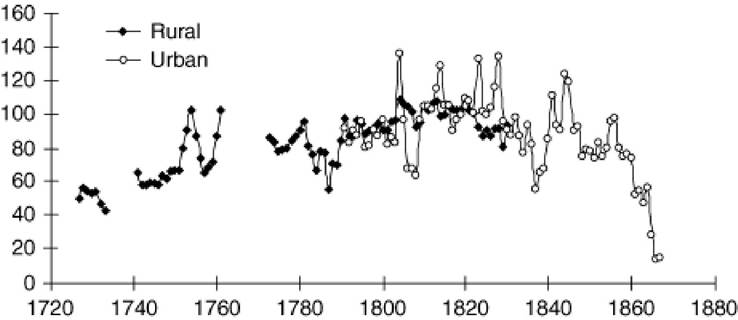
As far as the Kami-Kawarabayashi and Kyoto indices for the 1727—1830 period are concerned, they are only slightly different from those I presented in the 1978 article. The difference is in the deflator. The previous ones were deflated by cost-of-living indices estimated by Mataji Umemura (1961), in which rice was given a weight of 46%. This was probably too high a weight in the Tokugawa consumption basket. There is another series of consumer price indices calculated by Hiroshi Shimbo based on much the same data but with a different rice weight of 30%, which may be a little too low (Shimbo 1978: 31—5). Given the fact that the rice price fluctuated more wildly than the prices of other consumer goods, it is expected that the use of the latter weight would produce a slightly less volatile series of real wages. For this reason, I decided to use the Shimbo series to deflate nominal wages in the Kinai. As for the period after 1830, I extend the Kyoto series of day labourers to 1867 and introduce a new real wage series for skilled urban workers that begins in 1830. For these post-1830 series, too, the Shimbo estimates are used to deflate the nominal wage rates. The results are shown in Appendix Table 3.A1.To take a long view, Figure 3.1 charts movements of real wage indices for both rural and urban unskilled workers in the Kinai. A close look at the overlapping period 1791—1830 reveals that, although the urban indices are more volatile than the rural ones, the direction of movement in the two series does not disagree. Indeed, actual wage data show that in the early eighteenth century the wage rate for day labourers in the city of Kyoto was substantially higher than that in Kami-Kawarabayashi, a village a little more than 40 km away from the city.
However, during the 1750s and 1760s Kyoto's market rate caught up to the village's (Saito 1978: 92). Thereafter, the wage rate for the city's unskilled workers was equilibrated with that for agricultural work. In the base period of 1802—4, for example, the wage rate for spring tasks performed by Kami-Kawarabayashi farm workers was 1.0 monme while the corresponding spring rate in Kyoto's casual labour market was on average 0.92 monme. Turning toFigure 3.1 Labourers' real wages: the Kinai, 1727-1867 (1802-4=100)
Source. Appendix Table 3.A1.
Figure 3.2 Wage differentials: the Kinai, 1732-1865 (1802-4=100)
Source. Appendix Table 3.A1.
the long-run trend, it is evident that, up to about 1820, the real wage level rose. After 1820 the trend was reversed. The next two decades saw extremely volatile movements caused by the shogunate's debasement of currencies between 1818 and 1829 and by the so-called Tempo famine of 1833-8. From 1820 to 1870 real wages were on the decline, and the decline was particularly steep after 1840. This fall reflected a higher rate of price increase in the Kinai than in eastern Japan, due chiefly to changes in the money market during the late Tokugawa period.
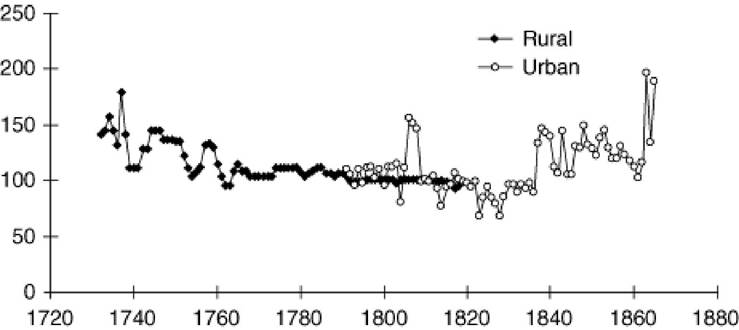
The corresponding graphs of occupational wage differentials are shown in Figure 3.2. The graph for earlier periods represents ratios of carpenters' to agricultural day labourers' wage rates in the village of Kami-Kawarabayashi, while the latter shows urban differentials, that is, the ratio of Osaka carpenters' wages to Kyoto day labourers'. In the base years of 1802-4, the village carpenters' wage rate was 2.6 times higher than the spring rate for agricultural labourers while the urban carpenters earned 4.7 times more than the unskilled did, suggesting that urban craftsmen enjoyed a higher skill premium than their rural counterparts.
However,such urban—rural differentials changed over time, as Figure 3.2 (in which the ratios in 1802—4 are set at 100) demonstrates. Clearly there is an inverse relationship between Figures 3.1 and 3.2, which not only confirms what was said about the period up to 1830 in my 1978 article, but can also be generalized: during the Tokugawa period, the wage level of poorer sections of the working population caught up with that for the better paid when real wages rose. In contrast, the wage gap between the two sections of the workforce widened when the wage level declined in real terms. What remains uncertain, however, is to what extent the sharp decline in the real wage level of the Kinai was representative of the whole economy since the macroeconomic weight of silver, which was the standard medium of exchange in western Japan, was substantially undermined in the course of the late Tokugawa period. We should, therefore, turn to wage data in the gold-using east.
2.2