The Distribution among Factors of Production: The Marginalist Approach
Ricardo emphasized the extension of cultivation to new lands more than the intensive cultivation of a given land, even though his theory contemplated both cases (Works IV: 14). By contrast, the complete recasting of the theory of distribution, which characterized the “marginal revolution” (started in the 1870s) distinctly focused on a variable intensity of cultivation of a given land and this ultimately led to an altogether different distribution theory.
A formal statement of marginal conditions in wage setting is due to Jevons (1871 [1970]: 194), while the basic principle can be traced back to Johann Heinrich von Thunen. An early neat and rigorous account of distribution along marginal lines is in Wicksteed (1894 [1992]); Wicksell’s Lectures (1901 [1934]) are generally recognized to be the best synthesis of the formal arguments put forward by Leon Walras, Menger, Bohm-Bawerk, Wicksteed and by his own original work (Wicksell 1893 [1954]) (see Stigler 1941: ch. 10).
The first logical step was a rethinking of rents in terms of differential calculus. Let there be only two factors of production, labour and land (in private ownership and entirely cultivated). The landlord acts as entrepreneur and hires labour. He pays labour in kind when output becomes available; the limit of increasing returns to labour “has long been passed” (Wicksell 1901 [1934]: 110) and diminishing returns (to labour) prevail. In such circumstances:
to the landowner, it can evidently never be economically advantageous to pay an additional labourer more in wages than the additional product obtained from employing him. But [by competition] none of the labourers previously engaged can claim higher wages than the last one engaged.... On the other hand, if there is perfect competition between employers, wages cannot sink materially below [that amount]. (Wicksell 1901 [1934]: 111-12; emphasis in the original)
If the number of labourers is a, then the gross product...
may be represented algebraically as a function f(a) of the number a. The wages of the last labourer, as of every other labourer, is then represented approximately by the differential coefficient f'(a). (Wicksell 1901 [1934]: 116)The rent and wage rate (in kind) are, therefore, respectively:


In equation (3), rent is a residual. It can be easily seen that it rises as employment rises, so long as f'(a) < 0. Wicksell carefully stressed that this conforms with the Ricardian theory of (intensive) rent (Wicksell 1901 [1934]: 116; see also the models of Pasinetti 1960, and Samuelson 1978). An even closer similarity with the Ricardian theory of intensive rent is when “a” is an index of capital-plus-labour, as in the case of Wicksteed (1894 [1992]: 66).
The equations above were only a first step, however. A “residual theory of rent” was not a theory at all, according to our authors. Rather, it was “simply a statement that when all other factors of production have been payed off, the “surplus” or residuum can be claimed by the land-owner” (Wicksteed (1894 [1992]: 66). For, by the same token, one can formulate a “residual theory of wages”, as Wicksteed (1889: 312) himself did a few years earlier; a masterly illustration of this symmetry is in Wicksell (1901 [1934]: 124-5).
Further steps were to be made in order to explain all remunerations by the same principle. There should not be separate “laws” of rent, wages and profits, but a single law for all of them. The main problem with which Wicksteed dealt was precisely whether a single principle existed, such that the sum of the remunerations “cover the product and be covered by it” (cf. Steedman 1992: 13-14) without any surplus or deficit. Aiming at this, the new theory completely abandoned the classical “surplus approach”.
The keystone was the assumption of constant returns to scale, and the consequent properties of homogeneous functions of the first degree.
It is notorious that Wicksteed dedicated many pages to a cumbersome proof of Euler’s theorem, which he appeared not to know. Yet, as noted by Flux (1894: 311), “Euler’s equation gives at once the result”. If a is the (column) n-vector of input use, including land, and w is the (row) n-vector of the input rentals, including land rent, in terms of the output, and f(a) is the production function homogeneous of degree one, we have: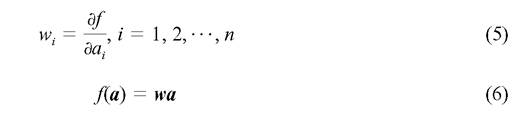
There was no need to express any reward as a residuum, because the residuum was identically equal to the factor’s partial derivative multiplied by the amount of that factor used.
Wicksell acutely observed that this important property was satisfied not only when “large-scale and small-scale operations are equally productive” (Wicksell 1901 [1934]: 126), but also “at the point of transition from “increasing” to “diminishing returns” (relatively to the scale of production)” (ibid.: 129). He also argued that “the firm must always, economically speaking, gravitate” (ibid.) towards this point, which he called “full equilibrium”.
A specific merit of Wicksteed must also be mentioned: he insisted on the fact that the new theory was inconsistent with an aggregate view of labour, capital and land. In fact, marginal productivity is a technological phenomenon, which concerns physically specified inputs:
we must regard every kind and quality of labour that can be distinguished from other kinds and qualities as separate factors; and in the same way every kind of land will be taken as a separate factor. Still more important is it to insist that instead of speaking of so many £ worth of capital we shall speak of so many ploughs, so many tons of manure, and so many horses, or foot-pounds of “power”. (Wicksteed 1894 [1992]: 83-4)
The focus of distribution theory shifted, therefore, from big social classes to the owners of technically specified inputs and new basis for the analysis of wages and wage differentials was provided.
This appeared to be more adequate than the classical theories not only on logical grounds but also in consideration of the fact that the Malthusian pressure on wages gradually relaxed, and productivity increase proved to be the main permanent source of the increase in real wages and in leisure time, which characterized the second half of the nineteenth century. This link was reinforced by a reverse causation, from wages to productivity. Wicksell, perhaps inspired by Alfred Marshall, noted that “the mental and physical health and strength of the worker, and consequently the efficiency of labour, are largely dependent on the wages received and, within certain limits, rise and fall with the wage” (Wicksell 1901 [1934]: 104; see also Marshall 1920 bk VI: ch. XIII).Equations (5) and (6), however, still do not provide a complete theory of income distribution. First, they formulate conditions that input rentals must satisfy (under differentiability assumptions), but do not determine them. At most, they offer a theory of input demand. Second, given their disaggregate nature, they do not involve explicit conditions for the rate of profits or interest.
As to the next steps, there are important differences between Wicksteed and the authors of general equilibrium orientation, like Wicksell. While the former basically remained within the boundaries of a partial equilibrium theory of the price-taking enterprise (see Steedman 1992: 35), Wicksell went somewhat further.
He assumed, as a first approximation, a fixed supply of the factors of production. By market clearing, he could say that wages, for instance, were determined by “the marginal productivity of labour as it is when all labourers are employed” (Wicksell 1901 [1934]: 121, emphasis added). If we ignore for a moment the presence of capital (as he did in a first step), Wicksell’s argument clearly anticipated the logical structure of the Heckscher- Ohlin-Samuelson theory of trade for the small open economy: with two industries facing internationally given prices and characterized by smooth, constant-returns production functions and two primary factors in fixed supply and fully employed; factor prices are known to be uniquely determined.
In this setting one can study the same problems which attracted the interest of the classical economists, such as the effect of increasing population or of technological progress on wages and rents.In a second step, Wicksell removed the assumption of constant commodity prices, which in a closed economy are related to output levels, and presented a sketch of a general equilibrium model with given factor supplies, which he claimed was “completely determinate” (Wicksell 1901 [1934]: 205).
His argument, however, is far less conclusive and satisfactory than the analysis based on given prices. This is partially due to the fact that, even in the simple case with two primary inputs, many other elements should be taken into account, such as the “distribution [of factors] among individuals, and personal preferences in consumption” (Wicksell 1901 [1934]: 201) - and this notoriously reduces the ability of the theory to provide definite conclusions. But the argument was also obscured by the fact that Wicksell’s equations allowed for capital and interest, which introduced further complex and controversial aspects.
Wicksell carefully noted that the “analogy between interest, on the one hand, and wages and rent, on the other, is incomplete” (Wicksell 1901 [1934]: 148) and that the principle of marginal productivity cannot be immediately applied to capital: “whereas labour and land are measured each in terms of its own technical units... capital, on the other hand... is reckoned, in common parlance, as a sum of exchange value”, which “disturbs the correspondence which would otherwise exist between all the factors of production”(ibid.: 149; emphases in the original). Given the “varied and changing forms which productive capital assumes in reality” (ibid.: 144), the principle of marginal productivity should be applied to each item individually, but in so doing one can only obtain marginal conditions for the individual rentals, and not for the rate of interest. On the other hand, the conception of capital stock given in terms of a “sum of exchange value” was, according to Wicksell, a “theoretical anomaly” (ibid.: 149), which could not provide a theory of interest, because commodity prices depend themselves on the rate of interest. Moreover, he thought that interest had an “enigmatic nature”: the presence of capital increased productivity, but it was far from clear on what grounds the owners of capital goods can claim a share of the increased output: capital goods can be reproduced at will and no threat of withdrawal can support such a claim (cf. ibid.: 146). The theory of income distribution was at a very critical point: the new principles excluded a surplus theory of interest, yet they did not provide, in the same form as applied to wages and rents, a new explanation.
More on the topic The Distribution among Factors of Production: The Marginalist Approach:
- The Distribution among Factors of Production: The Marginalist Approach
- Production of Commodities by Means of Commodities
- Comparison with the surplusapproach
- The direct factor substitution mechanism: from Thunen to Marshall
- Capital and interest
- The imputation approach: Menger, Wieser, Walras
- Faccarello G., Kurz H.-D.. Handbook on the history of economic analysis. Volume III, Developments in major fields of economics. Edward Elgar,2016. — 659 p, 2016
- KNUT WICKSELL AND THE SWEDISH BRAND OF NEO-CLASSICISM
- The Cambridge capital controversy
- JOHN BATES CLARK AND THE AMERICAN STRAND OF EARLY NEO-CLASSICISM