Marginal Productivity and Interest
The Austrian attempt developed by Wicksell consisted in tracing back the different capital goods to a common origin. For this purpose, he elaborated on the time dimension of capital, as theorized by Bohm-Bawerk (whom he praised for his magnificent overall picture, which, alas, lacked analytical precision):
All capital goods, however different they may appear, can always be ultimately resolved into labour and land; and the only thing which distinguishes these quantities of labour and land from those which we have previously considered is that they belong to earlier years, whilst we have previously been concerned only with current labour and land directly employed in the production of consumption-goods.
(Wicksell 1901 [1934]: 149-50, emphasis in the original)Capital consists therefore in saved-up labour and land and one need only consider dated quantities of these factors, whose marginal productivities can conceptually be defined in the ordinary way. Wicksell, like Menger and Bohm-Bawerk, assumed a finite number of “layers” of saved-up resources (which excludes mutual input-output relations). Let (lj, tj) (j = 0, 1, ∙∙∙, n) denote the amounts of labour and land used j periods before the consumer good stage; (l0, t0) denotes therefore the direct use of labour and land in this final stage. In a certain vertically integrated firm, the current output of a consumption good is f(l0, t0, l1, t1, ∙∙∙, ln, tn), where f is a production function characterized by constant returns to scale. As before, let i denote the rate of profits (uniform across stages), that Wicksell and the Austrians called “interest”. The rental on saved-up labour of j periods before, equal to ∂fl∂lj, must satisfy:
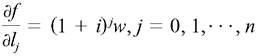
It follows at once that:

Similar relations hold for land. This ratio is supposed to be greater than one and to be uniform across firms and industries.
We have here the basis for a theory of factor demand, including the demand for (heterogeneous) capital.In order to determine the rate of interest, a solution proposed by Wicksell as a first approximation was to assume, by analogy with the case without capital, a given supply of saved-up labour and land in the various periods. It must be remarked, however, that this naturally refers to the short period rather than to the long, and in this case it is not clear why the rate of interest should be uniform. The analogy, therefore, is not complete. Wicksell oscillated between this “solution” and a conception of capital as an aggregate, whose precise composition was determined as a long-run phenomenon (see Kurz 2000). Yet by so doing it is clear that the “theoretical anomaly” comes back again.
Wicksell recognized that the marginal productivity of a given capital endowment is not a well-defined concept, but unfortunately his ingenious idea of reducing capital to “dated” primary inputs was of no use for a long-period distribution theory. Nor did the following literature provide better solutions: there simply is no microeconomic foundation for a scalar measure of heterogeneous capital, independent of income distribution, except for very special cases. The real situation of an economic system which can combine qualitatively different produced means of production with each other and with primary inputs is not equivalent to an imaginary situation in which a single capital good is combined with primary inputs. The lack of generality of Paul Samuelson’s “surrogate production function” is expressive of this dead end (see Samuelson 1962; Garegnani 1970).
More on the topic Marginal Productivity and Interest:
- Modernization of Bohm-Bawerkian Concepts
- .. and with Distribution Theory
- Distribution
- The Swedish economist Knut Wicksell is well known for his contributions to the marginal productivity theory of distribution and the theory of capital and interest, where he tried to create a unified framework from a synthesis of ideas of David Ricardo, Leon Walras and Eugen von Bohm-Bawerk.
- Interest and prices
- THE DETERMINATION OF INVESTMENT
- KNUT WICKSELL AND THE SWEDISH BRAND OF NEO-CLASSICISM
- Philip Henry Wicksteed (1844-1927)
- John Bates Clark was born in Providence, Rhode Island on 26 January 1847.
- John Atkinson Hobson (1858-1940)