Real Wages
To find out what happened with real wages, I used the data on nominal wages collected by de Vries for the period 1500-1815, which refer almost exclusively to the wages of building labourers,11 and which were also extended backwards to include the 1450-1500 period using data from Noordegraaf and Schoenmakers (1984).
The wage series used is very ‘traditional’ and needs modification as a result of future research, which is, however, beyond the scope of this chapter.12The real wage index that is presented in Figure 7.3 shows a very strong decline in the period between the 1460s and the 1570s. The decline was characterized
Figure 7.3 Real wages in the western part of the Netherlands, 1450—1800 (1450/74—100; polynomial trend added)
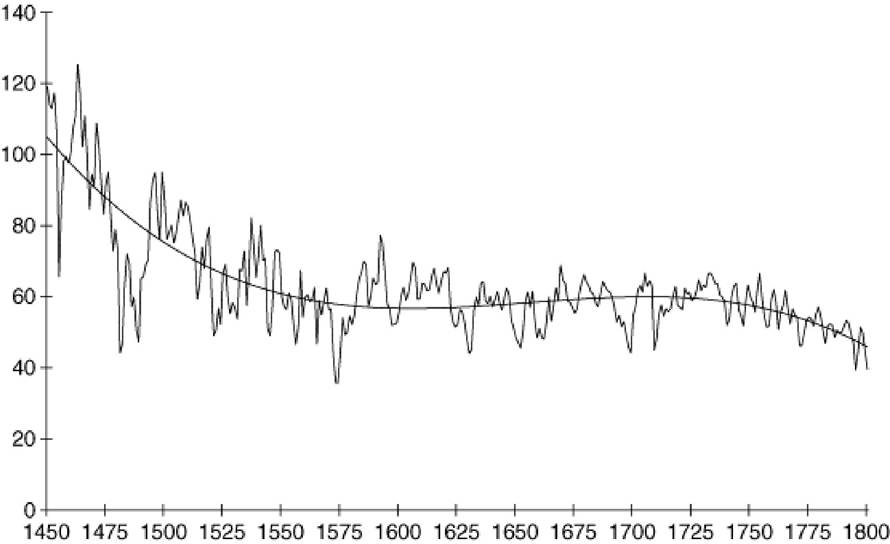
by a huge fall in real wages during the 1480s (the result of very high prices during years of war and harvest failure), a stabilization during the decades surrounding 1500, followed again by deep troughs in the 1520s and a renewed decline after 1560, which leads to the ‘years of hunger' after the Revolt of 1572. After the disastrous decade following the Revolt, real wages returned to the level of the 1540s and 1550s, and remained at that level for more than a century and a half, from the 1580s to 1760s. I do not find strong evidence for an increase in real wages during the Golden Age of the first half of the seventeenth century, nor does the decline in cereal prices which set in after about 1660 have much of an effect on the real wage. Long-run stability (though not without fluctuations, of course) seems to have been normal during the greater part of the seventeenth and eighteenth centuries; only after about 1760—70 did real wages begin to decline again.
A number of changes have not, however, been taken into account.
Noordegraaf (1985) and de Vries (1994a) assumed an increase in employment in the years after the Revolt because many holidays were abolished during the Reformation and the booming economy created a strong demand for labour. However, it is unclear whether an increase in working hours should be interpreted as a gain or as a loss in welfare. Leisure is a consumption good, and there probably existed a positive relationship between the demand for leisure and real income. Increased working hours can also be interpreted as an adaptation to the decline in the real wage that occurred after the 1460s. If we want to estimate the development of real family income, changes in the working hours of men as well as changes in the participation of women and children must be taken into account, along with changes in non-wage incomes such as work in protoindustry and changes in household production.In general, we lack sufficient sources to reconstruct family income in any detail. I have, therefore, attempted in another chapter to interpret the real wage as an important input in the decision-making process of households which determines the choices the members of a household can make. If the crucial ‘terms of trade' are declining (or are in absolute terms, low) a household cannot afford leisure and luxury consumption goods, and will have to substitute inferior goods for goods of a higher quality—that is, its standard of living so defined would have declined (see van Zanden 1999). The standard of living in this view can be interpreted as the degree of freedom a household has in its decision-making process: low real wages certainly limit its choices, whereas high real wages increase them.13 Therefore, in my view, we should not make corrections for changes in working hours, participation ratios, etc., when we analyse real wages as an indicator of the level and development of the standard of living.
Another aspect which needs to be mentioned is the decline in the amplitude of fluctuations around the trend value of the real wage. Visual inspection of the series suggests that after about 1600 these fluctuations become less sharp, which would certainly imply a positive welfare effect. This is valid assuming that the welfare loss of a sharp decline in real wages is higher than the welfare gain of a comparably large increase and that households are unable to save the extra real income of good years to finance the deficit of the bad years. This may, however, be the result of changes in the CPI itself (the introduction of rents after 1550 and of bread prices after 1596). More research into this topic is necessary to understand these dynamics.14
6.