Economic surplus: definition
Economic surplus is the key concept to understand and to resolve the problem of poverty. It was a central concept of classical political economy for which mass poverty was a main issue.
For the definition of economic surplus, we here give a description of an economy in a very simple way as follows (Sraffa 1960):

Aa, Ab, Ba, Bb are inputs in sectors a and b which include the subsistence consumption of labourers. Their consumption is included in inputs, as it were, like materials or fodders. A and B are outputs. A combination of inputs (Aa, Ba) produces an output A. In another process or industry, a combination of inputs (Ab and Bb) produces output B.
A subsistence economy
A subsistence economy can be depicted simply as follows:
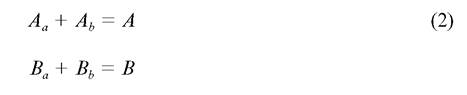
This economy is viable, but it has no possibility to grow, increase in population, no possibility of production and consumption of luxury goods and of the existence of unproductive classes. This economy is very vulnerable to natural disasters (bad weathers, floods, earthquakes, droughts, etc.) and human failures such as wrong policies. If natural disasters happen, some part of the population will die of hunger and the population will diminish. People live a life of mere subsistence (that is, the minimum standard of living that gives only the possibility to maintain the present size of population).
A system with a surplus
It is depicted simply as follows:

If we express the surplus in material terms: 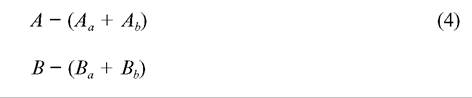
In this economy, there are possibilities of economic growth, population growth, production and consumption of luxury goods and the existence of unproductive classes.
Even in a surplus economy, if the whole surplus is used up in increasing population, producing and consuming luxury goods, or maintaining unproductive classes, it cannot improve the living conditions of common people.
It can grow only if part of the surplus it produces is invested in productive activities (maintenance of labourers that produce goods, production of machines, construction of factories, irrigation works, opening of new farm lands, and so on). Savings here mean the part of the surplus not devoted to unproductive consumption and used for investments that increase the productive capacity of the economy.If the economic surplus is used in increasing population, the economy can realize economic growth in the sense of the size of production, but may not improve the living standard of people. If an economy uses its surplus in maintaining labourers that produce luxury goods only, the economy can grow but the growth cannot continue if there is no technological progress. In this case, the standard of living of the common people can be improved a little if the distribution is not so unequal that the whole luxury goods are consumed by only a privileged part of the population, because the luxury sector employs some labourers.
A continuous growth and improvement of the living conditions of common people can be realized only if a part (and possibly a substantial part) of the economic surplus is used continuously in maintaining additional productive labourers that produce necessary goods and in the production of means of production. We may need to reform political and social institutions and change the mind of people in order to make possible a continuous economic growth and a rise of the standard of living of people.
More on the topic Economic surplus: definition:
- Economic surplus: definition
- Faccarello G., Kurz H.-D.. Handbook on the history of economic analysis. Volume III, Developments in major fields of economics. Edward Elgar,2016. — 659 p, 2016
- Political economy in the classical tradition
- Economics