Writing the Equations: Garegnani’s View
As we have just seen, in order to attempt a reconstruction of the development of Sraffa’s analysis from the prelectures to his equations, we may take as starting point the idea that in the summer of 1927 (or between the summer and November 1927) he decided that, at least in a special case, pursuing the reduction of the various inputs entering into the production process of a given commodity to an absolutely necessary commodity would have been consistent with the logic of economic analysis and would have delivered an exact result for the value of each commodity.
We may then accept Garegnani’s hypothesis that, approximately around mid-November 1927,15 he decided to delve deeper into that reduction and see how it could actually be accomplished. Indeed, some notes, identified as items D3∕12∕6∕1(1-6) [C XVI 1i-vi] and kept in a folder that is headed in Sraffa’s hand “Winter 1927-28”, have been described by Garegnani (2005, 465) as the locus of “a resumption of the argument [Sraffa] began [in the prelectures] about the ‘necessary commodity’ ” Garegnani, however, did not provide a detailed illustration of the relevant documents. For this reason, we now proceed to consider their structure and content.Item D3∕12∕6∕ 1(1) [C XVI 1i] is the first sheet of a series of six manuscripts (numbered 1-6 by Sraffa himself) and bears a sort of heading, most likely added by Sraffa while reconsidering this and other sets of notes sometime after they had been written. The heading (“Equations for whatever surplus”) may be justified by the fact that, while sheet 1 depicts a case where the surplus is nil, sheets 2-5, although focused on a case of positive surplus (just like sheet 6), adopt a notation that does not imply that the magnitude of the surplus be positive, negative or nil. The first sheet is crossed out, most probably by Sraffa—but, whichever meaning we may attach to this, its full text must be reproduced and discussed: 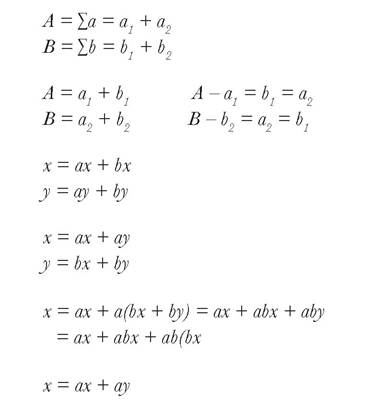
The first statement we can make about these equations is that they are visibly consistent with two of the elements, or directions, we have singled out above: no surplus is produced,16 and each production process may be seen as described by a list of commodities.17 But the content of the manuscript elicits further observations.
1. The three sets of equations where outputs appear to be expressed as A and B and inputs as a1, b1, a2 and b2 and the two sets where x andy express both outputs and inputs resemble schemes that can be found in several other manuscripts kept in the section of the Sraffa Papers (D3/12) that collects the main body of documents relating to the preparation of Production of Commodities.
2. The writing of the third of these sets of equations18 seems to stop on the verge of the determination of its solution, and we may presume that the absence of such a result follows from the absence of a distinction between each variable and its coefficient (i.e., between each commodity and its quantity, or each quantity and its value).19
3. The two subsequent sets of equations20 can be seen as containing an attempt to introduce exactly the distinction just mentioned.21 In this case, a simple substitution would provide a solution and determine the exchange ratio between x andy, but such a route is not pursued.
4. Indeed, the second of the latter sets of equations22 is developed into what may be interpreted as an attempt to calculate such solutions by what we would call full input substitution,23 which would be a reduction of the production process of commodity x to a single input.24
5. But the attempt (whether we interpret it as a formal method to solve the system or as a reduction) is soon abandoned.25 The reason why it is abandoned is not clear, but we can say that, if we take it to be a reduction to an absolutely necessary commodity, we must acknowledge that it contains a peculiarity: the substitution performed by Sraffa amounts to an attempt to eliminate inputy from the production process of x. This, in terms of reduction, would imply thaty is not the absolutely necessary commodity—which should then be x—but calculating the amount of x directly and indirectly employed to produce x would be of no use to establish the value of commodity x except in terms of the ordinary commodity y.
On the contrary, if x was taken to be the absolutely necessary commodity, to establish the value of y in terms of the absolutely necessary commodity, Sraffa should have pursued an attempt to eliminate inputy from the production process of y: he should have substituted the equation fory into the production process of y itself.26To sum up, it is not obvious that the document contains an attempt at calculating exchange values by means of a reduction to an absolutely necessary commodity, as maintained by Garegnani. In our view it could be more appropriately understood as aimed at calculating relative exchangeable values with only an incidental relation to such a reduction.27
The next sheet (item D3/12/6/1(2) [C XVI 1ii]) clearly contains an attempt to calculate the solutions of the system of equations in a more general case: three commodities and three equations are considered; no specific numerical value is given to the coefficients; the magnitude of the surplus is not tied to being positive, negative or nil. Furthermore, we may also note another important difference from the previous sheet: input coefficients are now both explicitly introduced and distinguished one from another. This suggests that the reason to abandon the systems in sheet D3/12/6/1(1) rested in the way the systems had been written, rather than in the way their solution, or a reduction (if any), had been attempted. The new system reads as follows:
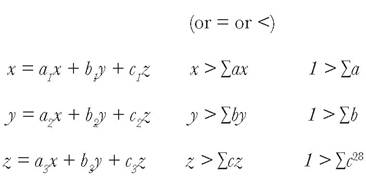
As a matter of fact, a solution is pursued following the same route as in document D3∕ 12/6/1(1): the method of full input substitution is applied by eliminating input z from the production process of x, which comes to be expressed in terms of x and of y (because no substitution is being done fory). The process, therefore, cannot be properly considered as a reduction to an absolutely necessary commodity
We reproduce only the first and the second stages of this process:
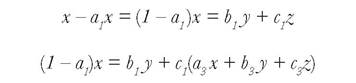
After a number of steps, in the last line of sheet D3∕12∕6∕1(2), Sraffa wrote the limit for the polynomial (dubbed 5) he had obtained for x, but he also added, “no, 5 still contains x”.
Indeed, this should come as no surprise, because, just as in the previous sheet, what he had been doing was eliminating z, not x. Sraffa’s remark may reveal that he meant to find the value of x/y. Alternatively, if, following Garegnani, we interpreted this manuscript as an attempt to reach a reduction to an absolutely necessary commodity, we should conclude that Sraffa could not see the proper way of doing it.Be that as it may, the same calculations are further pursued in sheet D3∕12∕6∕1(3), alas!, to no better effect. But in manuscript D3∕12∕6∕1(4), following a note placed at the bottom of the previous sheet,29 Sraffa started them again after having defined a new system of equations, with different coefficients:

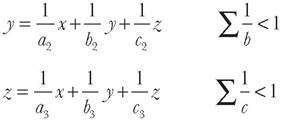
After a number of transformations, in the subsequent sheet (D3∕12∕6∕1(5)) a result is reached wherey/x is expressed as ratio between two polynomials in the coefficients a1, a2, a3, b1, b2, b3, c1, c2, c3. This—if document D3∕12∕6∕1(1-6) had been (as suggested by Garegnani) directly stemming from the prelectures—might have been expected to be heralded by Sraffa as a new and particularly important result, and should have marked a pause in his reflection. Yet he placed no emphasis on it, nor did he seem to regard it as satisfactory: in manuscript D3∕12∕6∕1(6), apparently believing that in this way a “mistake” could be amended,30 he explicitly introduced a magnitude representing a positive surplus product into equations elaborated from the previous system. But the ensuing calculations are interrupted before reaching any result. Assuming that in these manuscripts Sraffa was not pursuing a reduction to an absolutely necessary commodity and that his aim was the determination of x/y, we may ask why he discarded exactly that result in order to take into account a positive surplus.
Our explanation runs as follows: equations in documents D3∕12∕6∕1(2-5) had been originally conceived of as an attempt to describe a case of positive surplus. Then Sraffa realized that the systems he had written and the solution he had reached for x/y would also apply to cases where the surplus could be negative or nil. For this reason, in sheet D3∕12∕6∕1(6) he would have developed a system where a positive surplus was explicitly introduced. And for the same reason he would have introduced a correction in the initial definition of the system in sheet D3∕12∕6∕ 1(2) by adding “(or = or an early formulation of his “first equations,” and had at least conceived of his “second equations.” On the other hand, we have provided new evidence to support the hypothesis that Sraffa’s earlier steps toward writing his equations may had been rooted in the prelectures and in the way he had discussed the conceptions of physical real cost and of an absolutely necessary commodity. However, following an analysis of their content and of their likely dating, we have argued that the manuscripts singled out by Garegnani as the closest link between the prelectures and Sraffa’s equations did not reflect a development directly stemming from the prelectures and were not meant to serve as a starting point to pursue a reduction of production processes to quantities of an absolutely necessary commodity directly and indirectly employed in those very processes.In our view, manuscripts reflecting earlier steps in the development from the prelectures to the “first” and “second equations” may indeed—as maintained by Garegnani— be expected to contain systems of equations meant to pursue a reduction to an absolutely necessary commodity, but those systems should also show the characteristics—not stressed by Garegnani—of depicting outputs as the result of the combination of sets of commodities and of starting the analysis from a case of production with no surplus.
Furthermore, the same systems—as implied by the structure of the documents examined in section 3—should also show the additional characteristic of describing production processes by specific numerical examples rather than by more general notation.The Sraffa Papers contain several manuscripts that match these requirements, but, looking for candidates to fit the role of earliest analytical elaboration, two items may be singled out: manuscripts D3/12/2/32 and D3/12/2/34 [A1/27ii, iv]. These manuscripts, which discuss a no-surplus case, may then be associated to two other documents: manuscripts D3/12/2/33 and D3/12/2/35 [A1/27iii, v], which seem to have been written at the same time as items D3/12/2/32 and 34. All these manuscripts are kept among items dating to the 1940s and 1950s, but on one of them (manuscript D3/ 12/2/32) Sraffa annotated, “(From folder headed: ‘End of Nov. 1927’).” Furthermore, as already mentioned in section 4, above, that document is written on the back of the second page of a letter sent from Britain to Sraffa’s address in Milan and dated November 19, 1927. Presumably, Sraffa received that letter, forwarded from Milan to Cambridge, between November 22 and 24. This would imply that manuscripts D3/12/2/32-35 could not have been written more than a couple of days before November 26—the day when Sraffa showed his “first equations” to Keynes.
The schemes contained in manuscripts D3/12/2/32 and 34 employ an A, B notation similar to that in item D3/12/6/1(1). Here, however, as numerical coefficients are used, quite naturally each input and each output is associated to two magnitudes identifying each commodity and its quantity.
Both manuscripts D3/12/2/32 and D3/12/2/34 elaborate on the same system of equations:36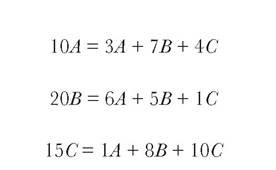
In sheet D3/12/2/32, the equations are arranged exactly as we have written them.37 They are then followed by a few calculations scattered throughout the page, which we reproduce in a single column: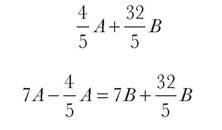
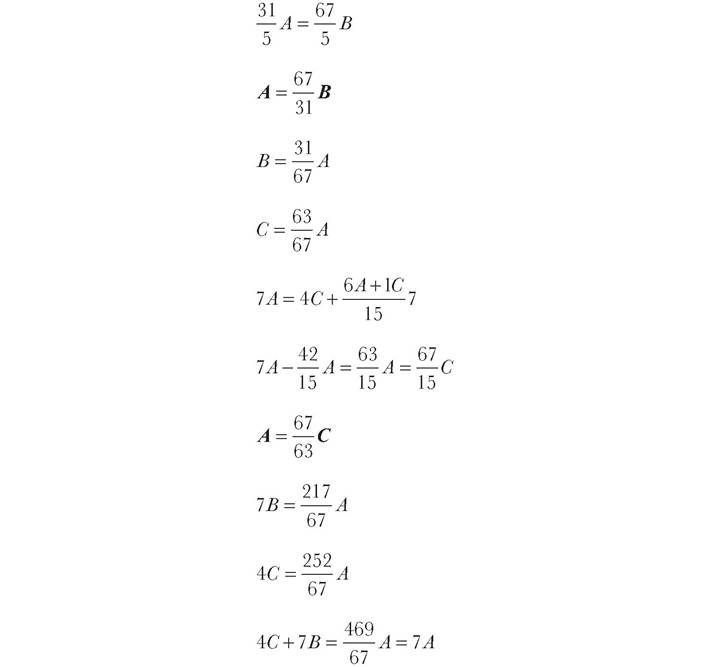
The solutions for A in terms of B and for A in terms of C (emphasized here in bold) are placed by Sraffa within circles, and it seems clear that Sraffa’s attention was focused on solving the system.38
In sheet D3/12/2/34 we find the same equations as in D3/12/2/32, but they are arranged in a row.39 Under each equation we find approximately the same calculations that appear, scattered, in document D3/12/2/32. Those calculations are now accomplished more systematically, as if to put in good order and check what in the other manuscript had been jotted down too quickly. The calculations lead to solutions by ordinary substitution (i.e., applied, just like in the calculations in item D3/ 12/2/32, after eliding the presence of the same variable when it appeared on both sides of each equation), and they stop when the values of B and C in terms of A are found:40 
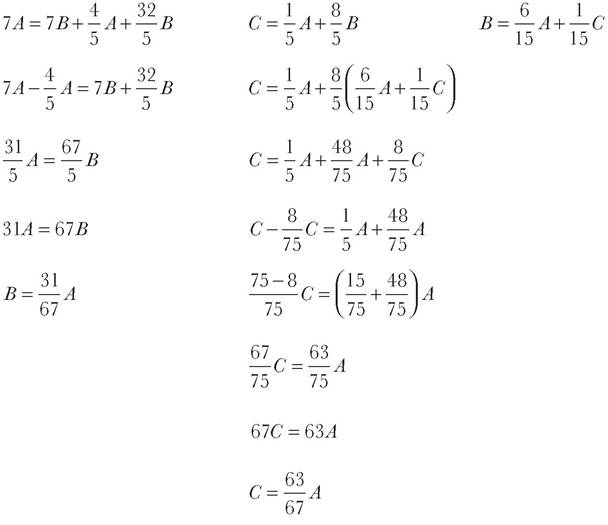
Arranging equations in a row and repeating previously scattered calculations are quite unusual features in the Sraffa Papers. We propose to interpret them as signs of Sraffa’s surprise in the face of a result he had reached somewhat unexpectedly. A surprise that would have induced him to reconsider what he had just done. In general, the characteristics of manuscripts D3/12/2/32 and D3/12/2/34 that we have just considered allow us to interpret them as the earliest documents reflecting Sraffa’s work on his equations, if not the very earliest steps of their elaboration.
How did Sraffa come to write and solve the equations in documents D3/12/2/32 and D3/12/2/34? The hypothesis that we want to put forward is consistent with Garegnani’s suggestion: Sraffa wrote those equations in order to lay down the groundwork of an attempt to calculate a reduction to an absolutely necessary commodity. Indeed, in these documents, the two of the crucial elements singled out in section 2, above, as outlining the stage reached by Sraffa in the summer of 1927 in terms of explanation of the values of individual commodities via a reduction to an absolutely necessary commodity (i.e., the description of production processes as lists of quantities of commodities and the identification of the case of an economy that produces no surplus) can be recognized.
The fact that no attempt to calculate a reduction (the third of the elements, or directions, singled out in section 2) may be found in these manuscripts does not necessarily weigh against our interpretation: the description of a no-surplus economy’s production processes would have been a necessary step toward such a reduction, but once Sraffa had written down that description as a set of equations representing additions of quantities of inputs, the possibility of solving the system and determining exchange ratios may have immediately appeared to his eyes as the likely outcome of the application of straightforward algebraical logic.41 Indeed, following such logic would have allowed Sraffa to see that the solution of the system could produce exchange ratios between commodities with no need to reduce inputs to an absolutely necessary commodity.
To sum up, if Sraffa had taken such a step, we may expect that a reduction to an absolutely necessary commodity would have immediately fallen outside his analytical horizon, while, at the same time, a question concerning what would happen if there were a positive surplus would have emerged. Indeed, we find no document that may be associated with such a reduction (save, possibly, for those, dating to a later period, pointed out by Garegnani and discussed in section 3, above), but an attempt to answer the question concerning a positive surplus may be immediately recognized in manuscripts D3/12/2/ 33, 35 [A1Z27iii, v].
Manuscript D3/12/2/33 shows the following system and calculations:42
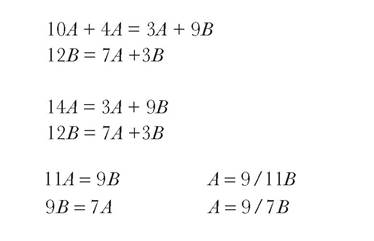
The latter results are accompanied by a big question mark and by the following annotations: “V. Chini p 41 (le equazioni sono contraddittorie quindi non esiste alcuna soluzione) Le equaz. devono essere non contraddittorie indipendenti.”43 We may presume this to have been the earliest formulation of Sraffa’s equations for the case of a positive surplus: he had not yet introduced any distributive variable, and he noticed that the system could not be solved. The train of thought they reveal confirms that this document had been written at a very early stage of Sraffa’s work on his equations, but it must certainly be subsequent to documents D3Z12Z2Z32,34.44
Document D3Z12Z2Z35 [A1Z27v] contains a further attempt to deal with the same difficulty:45 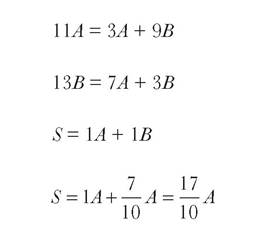
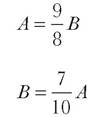
Also in this case Sraffa faced—and could not solve—the same problem he had met in the previous document. Accordingly, beside the three equations he wrote: “These are contradictory, whether 5, equal or not to zero.”
6.