In western countries until quite recently MM was common and until perhaps the mid-nineteenth century was often at levels similar to those in modern Less Developed Countries (LDCs).17
While the estimation of MM has serious problems (see below), its use as an indicator of the level of well-being and an insight into family structure and gender relations is generally accepted.
Because it is, like other aspects of women's reproductive health, a central topic of intellectual and practical concern, because it is so prominent in the European past and because its diminution occurred only in the latest stages of what might loosely be called modernization, it is an inviting topic for historical analysis, and especially for a volume on the standard of living in the past. Figure 11.2 shows maternal deaths per live birth over varying spans of time from England, Germany, Sweden, and from the Slavonian data.Figure 11.2 Historical maternal mortality rates
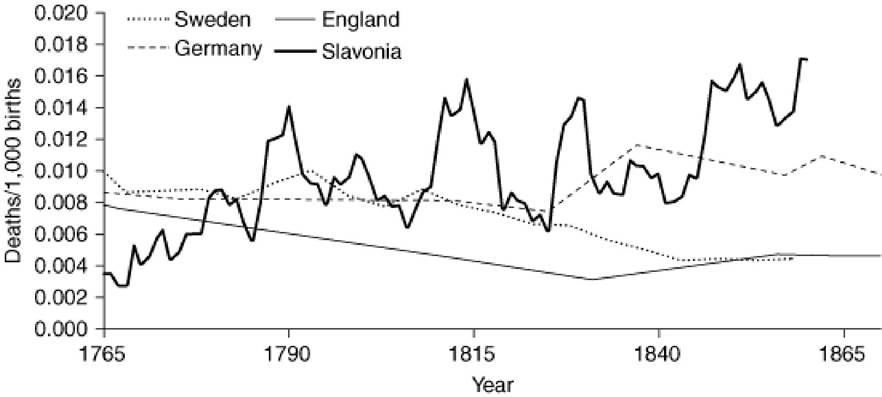
The trend is flat or downward overall in England, Sweden, and Germany (with a short increase in Germany after 1825); thus while MM was steady or declining in those countries, it was increasing in Slavonia until after the 1860s. Peak levels of MM in Slavonia equalled or exceeded those in most other locales.
5.1