Welfare economics
In response to Gaetano Scorza (1902) claiming that Pareto’s finding that equilibrium under free competition is an economic maximum (today’s first law of welfare economics) is nothing but “gross sophistry”, Pareto returned to the mathematical treatment of welfare economics.
As his work on welfare economics had, until that time, largely focused on production, there were some grounds for Scorza’s critique. Pareto’s reaction, while full of sarcasm and scorn, was also substantive as he extended his previous analysis of welfare to include both exchange and production. In the process, he provided economics with its first, analytically sound, first-order demonstration of the first fundamental theorem of welfare economics. Full treatments of the fascinating and lively polemic between Pareto and Scorza can be found in Chipman (1976) and McLure (2000).After the polemic, Pareto again returned to the issue of economic maximization through his analysis of types I and II phenomena in the Manual. The type I phenomenon yields an economic maximum for perfect competition because no movement from that point satisfies the criterion that at least one person gains and no one is harmed:
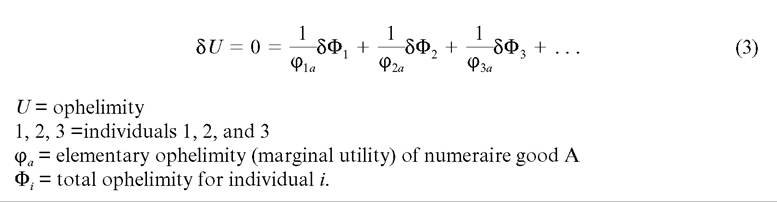
In contrast, the type II phenomenon does not yield an economic maximum. The investigation of the type III phenomenon in the Manual contains aspects of the second fundamental welfare theorem but the conclusion is largely unchanged from the earlier Cours: a socially planned distribution of income can achieve an economic maximum when production is efficiently coordinated by the “ministry of production”, but he goes on to stress that pure economics alone does not give us a truly decisive criterion for choosing between an organization of society based on private property and a socialist organization (1906 [2014]: 185).
Finally, the Manual is important to the history of diagrams in economics, as the famous Edgeworth, or Edgeworth-Bowley, box was also first introduced to economics in the Manual (1906, 1909 [2014]: 95, 180). This box diagram has played an important didactic role in the teaching of welfare analysis over many years.