Value and Price in Ricardo
Smith had supposed that, when producers could freely shift from one line of commodity production to another, natural prices would tend to adjust to equalize the “whole of the advantages and disadvantages of the different employments of labour” in the production of commodities (WN, I.x.1).
If the main component of the “advantages and disadvantages” is the labour time required to produce commodities, natural prices will tend to be proportional to required labour times. Ricardo generalized this conception to an economy in which “stock” had been accumulated, so that prices were determined by the sum of the labour actually performed (direct or living labour) and the labour embodied in the means of production (indirect or dead labour). Ricardo assumed that the various different types of labour (because of different skills and intensities of work) could all be reduced to a common standard unit (although he paid little attention to how this might be done). Then, measuring in this common standard, relative prices were determined by embodied labour ratios.These relative prices were Smith’s natural prices. Thus Ricardo wrote:
In making labour the foundation of the value of commodities, and the comparative quantity of labour which is necessary to their production, the rule which determines the respective quantities of goods which shall be given in exchange for each other, we must not be supposed to deny the accidental and temporary deviations of the actual or market price of commodities from this, their primary and actual price... In the 7th chap. of the Wealth of Nations, all that concerns this question is most ably treated. Having fully acknowledged the temporary effects which, in particular employments of capital, may be produced on the prices of commodities, as well as on the wages of labour, and the profits of stock, by accidental causes, without influencing the general price of commodities, wages or profits, since these effects are equally operative in all stages of society, we will leave them entirely out of our consideration, whilst we are treating of the laws which regulate natural prices, natural wages and natural profits, effects totally independent of these accidental causes.
In speaking then of the exchangeable value of commodities, or the power of purchasing possessed by any one commodity, I mean always that power which it would possess, if not disturbed by any temporary or accidental cause, and which is its natural price. (Ricardo 1821 [1951]: 88, 91-2)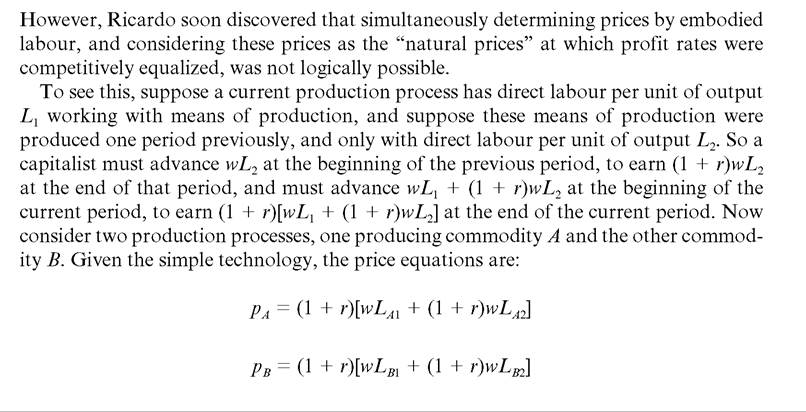
Suppose A and B are each produced by identical quantities of embodied labour, (La1 + La2) = (Lb1 + Lb2), so that they have identical values and hence natural prices. However, also suppose their production processes are differently divided as between direct and indirect labour. The time when the labour was embodied makes no difference to the quantity of labour embodied, which remains the same for the two commodities, but it matters a great deal to the capitalists concerned. If commodity A has more indirect labour embodied than commodity B, then the capital invested in the production of commodity A is tied up for longer than the capital invested in commodity B, and consequently the rate of profit accruing to each capitalist cannot be the same. The rate of profit on the capital invested in the production of commodity B will be higher, and this contradicts the definition of natural price as supporting an equalized rate of profit. Conversely, if the rates of profit are equalized, then the prices that bring this about cannot reflect the total labour embodied in the production of each commodity. The natural price of commodity A must be higher, and this contradicts the embodied labour theory of value.
Simple inspection of the price equations shows that the embodied labour theory of value and the equalization of the rate of profit are only compatible in two cases. The first case requires a zero profit rate (strongly reminiscent of Smith’s “early and rude state of society”). The second case requires the additional and highly special assumption that the time structure of embodiment is the same, so that La1 = Lb1 and La2 = Lb2, and the ratio of indirect to direct labour is the same in each production process. Whenever these ratios differ (which will normally be the case), prices at which the rate of profit is equalized cannot be formed out of the sum of direct and indirect labour.
The embodied labour theory of value cannot explain natural prices because it ignores the structure of production, and natural prices depend upon the structure of production.Ricardo never resolved this difficulty. Partly, he thought that it would not matter very much in practice, provided that differences in the structure of production were not too great (perhaps not too unreasonable an approximation in the early years of industrialization). Writing to Mill in December 1818, Ricardo contrasted his view with that of Adam Smith:
[I]t is not because capital accumulates, that exchangeable value varies, but it is in all stages of society, owing only to two causes: one the more or less labour quantity required, the other the greater or less durability of capital: - that the former is never superseded by the latter, but is only modified by it. (Ricardo 1821 [1951]: xxxvii)
And writing to Malthus in October 1820, he remarked,
You say that my proposition “that with few exceptions the quantity of labour employed on commodities determines the rate at which they will exchange for each other, is not well founded” I acknowledge that it is not rigidly true, but I say that it is the nearest approximation to truth, as a rule for measuring relative value, of any I have ever heard. (Ricardo 1821 [1951]: xl)
As well as acknowledging the difficulty of combining an embodied labour theory of value with the competitive equalization of the rate of profit but insisting that the incompatibility would not be large, Ricardo also tried a different approach. Since the incompatibility was produced by different structures of production, perhaps he could find some commodity with an “average” structure of production in some sense, so that its value would be determined only by the total labour directly and indirectly embodied in it. It could then be used as an “invariable standard of value”, invariable that is to changes in the wage, so that distributional relations could be then analysed independently of prices.
Otherwise, if the wage rate rose, the fall in the profit rate would entail effects on prices determined by the structure of production, and these in turn would alter the magnitude of the net product and hence wages and profits. Ricardo speculated that any particular commodity, such as gold, might not serve as an exact invariable standard:Neither gold then, nor any other commodity, can ever be a perfect measure of value for all things; but I have already remarked, that the effect on the relative prices of things, from a variation of profits, is comparatively slight; that by far the most important effects are produced by the varying quantities of labour required for production; and therefore, if we suppose this important cause of variation removed from the production of gold, we shall probably possess as near an approximation to a standard measure of value as can be theoretically conceived. (Ricardo 1821 [1951]: 45)
However, this was clearly theoretically unsatisfactory, and Ricardo never found the “average” commodity he wanted.
This turned out to be a very complicated problem. For a given technique of production, Sraffa’s “standard commodity” (Sraffa 1960) solves the analytical problem, but across different techniques no such invariable standard of value has been discovered (Kurz and Salvadori 1995: ch. 4, ss 3-5). Further, modern investigations based on data on average prices of commodities and their structure of production tend to support Ricardo’s conjecture that differences between natural prices and embodied labour ratios are not very large (for example, Shaikh 1998). Any such investigation, however, rests on some particular measure of the deviations of one relative price system from another, and empirical political economists have not reached agreement on any one method for measuring these differences.