Trends and Levels of Real Wages in Europe
In the case of Europe, I rely on my own investigation of real wages in major cities of Europe from the late Middle Ages to the First World War (Allen 2001). The cities include London, Oxford,2 Antwerp, Amsterdam, Paris, Strasbourg, Madrid, Valencia, Naples, Milan, Florence, Vienna, Leipzig, Krakow, Gdansk, Lwow, and Warsaw.
These are cities for which price histories—with their many tables of prices and wages—have been written. Building craftsmen and labourers and, occasionally, male agricultural workers are the groups whose living standards can be studied. The wages and prices were entered into computer files. The local weights and measures were translated into metric equivalents. The local units of account were converted into grams of silver. The conversion to silver was not made because silver has any transcendent significance. Instead, the procedure approximates the market exchange rate between the units of account since silver coins were the medium of exchange. This material makes it possible to compare wages across Europe, to compute consumer price indices3 over time and across space, and, finally, to calculate real wage levels by dividing silver wages by their purchasing power.This inquiry establishes three important generalizations about living standards in Europe:
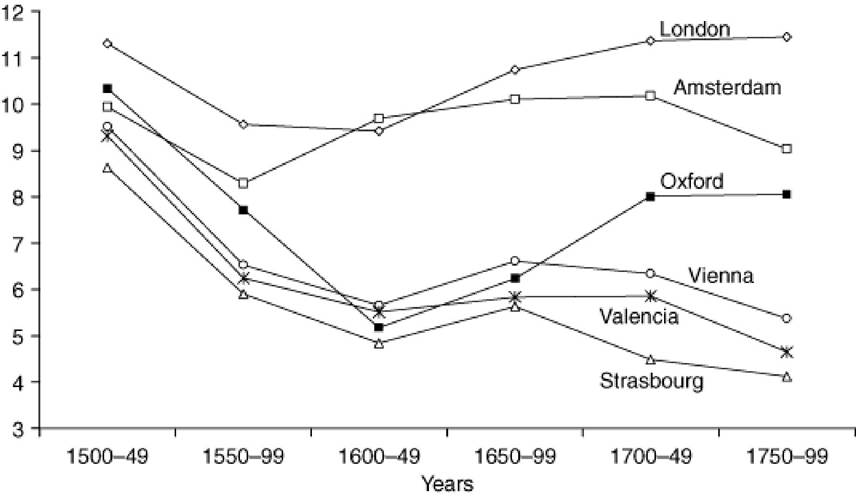
First, there was growing divergence in living standards between 1500 and 1750 (see Figure 5.1). At the end of the Middle Ages, real wages were remarkably similar across Europe. In the next two centuries, real wages collapsed in southern and central Europe. The drop was much less in London and the Low Countries. These were the growth poles of the early modern economy, and their living standards returned to the high level of the late fifteenth century. A large gap had
Figure 5.1 Real wages in Europe, 1500-1750 (silver wages deflated by CPI)
Source: See text.
emerged between these centres of international commerce and the rest of the continent by 1750.
Second, the sixteenth-century drop in the real wage in English provincial towns was as steep as on the continent and much greater than the decline in London. However, the dynamism of London spread to the rest of England in the eighteenth century. Real wages in places like Oxford rose sharply after 1700 when they surpassed wages in southern and central Europe and began to close the gap with London. These gains were confined to the urban economy. There had been little difference in the wage of Oxfordshire agricultural and building workers before 1700, but a gap emerged in the eighteenth century and continued to grow in the nineteenth century as Oxford building workers shared in the benefits of economic development, while farm workers were left behind.
Third, there was some fluctuation in the real wage series in England between 1500 and 1850, but no general advance was realized before the last third of the nineteenth century. Itwas only after 1870 that real wages finally began to rise in many cities in Europe and only then that the levels of the late fifteenth century were surpassed. The Industrial Revolution raised GDP per head, but it took a century before it raised the standard of living of building workers.
3.