The Post-Keynesian Theory of Growth and Distribution
We must now give a succinct account of another approach stemming from the London- Cambridge milieu and elaborated by Nicholas Kaldor and Joan Robinson in the 1950s. They applied the Keynesian apparatus of thought to the problem of distribution on the basis of a breakdown of aggregate real income (aggregate output) into wages and profits and the assumption that the propensity to save from profits was higher than the propensity to save from wages.
In a simple limiting case, let there be no saving from wages, and let the propensity to save from profits be sp. Denoting by Ythe real income (the aggregate output), by W and P, respectively, the total amounts of wages and profits and by I the investment (in terms of the output) the equality between savings and investment implies: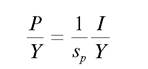
Assuming the capital/output ratio, K/Y as constant, defining i = (P/K) as the rate of profits and g = (I/K) as the rate of growth, we have:

This is known as the “Cambridge equation”. It should be stressed that the savinginvestment equality is not regulated here by price adjustments in competitive markets; rather, it is regulated by output formation and its distribution between profits and wages.
This basic model admits a number of variants. Kaldor’s original version (Kaldor 1955-56) includes a positive propensity to save from wages. In Pasinetti’s version (Pasinetti 1962) the propensities to save were referred not to wages and profits but to workers and capitalists (whether or not workers had any share in profits); also, Pasinetti took g to represent an exogenous rate of population growth, under full employment: in this understanding, the Cambridge equation has a normative nature.