The Physiocratic School and the Tableau economique
In July 1757 Quesnay met Victor Riqueti, Marquis of Mirabeau, in his entresol. Mirabeau had become famous with the publication, a few months earlier, of L’ami des hommes, an agrarian and populationist book.
In his own words, Mirabeau was going to bring about his “conversion” and the collaboration between the two men would last up to end of the 1760s. They first worked on a political treatise, the unpublished (before 1999) Traite de la monarchie, but the greatest work of Quesnay and Mirabeau at that time was undoubtedly the Tableau economique. There exist three early versions of the tableau: one from November/December 1758 and two from 1759. All of them contain the diagram itself (a visual representation of the flow of wealth between three classes in a nation) and a few explanations at the sides or after the figure. This is the “Zig-Zag” which is the fruit of Quesnay’s hand (with the help of Charles de Butre for the calculations) and which the doctor tried to explain to Mirabeau. Then, the Tableau oeconomique avec ses explications (1760) saw the first collaboration with Mirabeau, who wrote some of the “explanations” but at these dates he and Quesnay, with the help of arithmeticians were working on the Theorie de l,imp∂t (1760) and the Philosophie rurale (1763). Finally, the latter book contains a few tables, three “Zig-Zags” and another version without intermediate calculus, the “Pregis du Tableau economique”. In 1766 this abbreviated formula, transformed once again, became the famous “Formule arithmetique du Tableau economique”, that we find with other figures in the Probleme economique (1766) and Second probleme economique (1767).As in Ricardian “Strong cases”, the economic table was built in order to explain the functioning of basic principles. Which ones? Two kinds of economic table can be distinguished, even if, as indicated above, one can make room for a third kind with the disequilibrium approach in Philosophie rurale (1763), “Premier probleme economique” (1766) and “Second probleme economique” (1767) (Eltis 1996).
The first kind appears in the three successive editions of the “Zig-Zag” set in the years 1758-9 (see Figure 1); the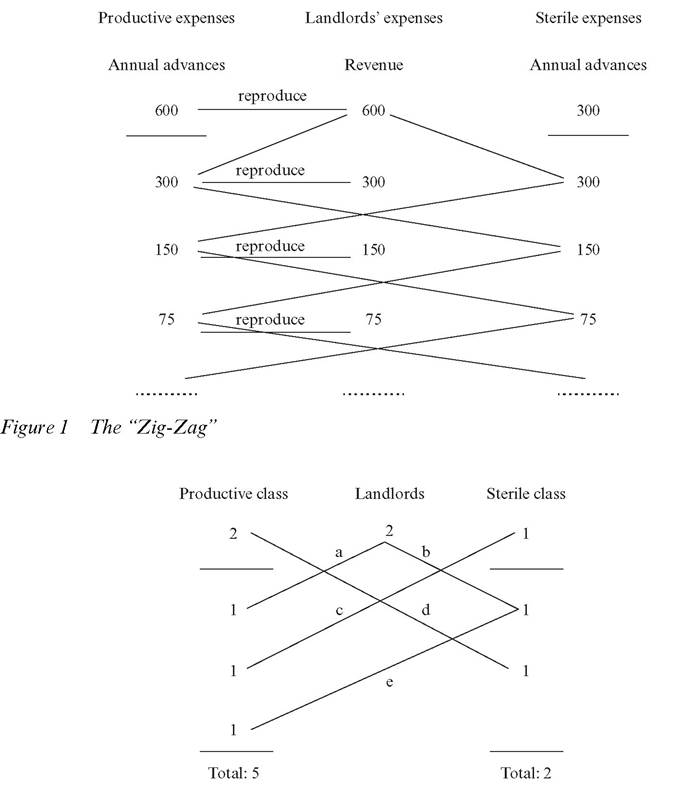
Figure 2 The arithmetic formula
second is limited to the “Analyse de la formule arithmetique du tableau economique” (see Figure 2).
In the “Zig-Zag”, the major concern was spending. The formalization showed how the rent paid by the farmers to the landlords (600 livres) was successively received and spent by the other two classes (the agricultural or productive class and the artisan or sterile class), giving rise to the same amount of net product (600 livres). The initial expenditure of the landlords is divided into two equal sums (300 livres), one for the luxury consumption of food and the other for the luxury consumption of furniture, clothes and the like. Then, the sterile class spends half of the money received (150 livres) in order to buy food and raw materials from the productive class, the other 150 livres are used to reconstitute the capital of the sterile class, possibly with some goods bought abroad. The productive class spends 150 livres in order to get manufactured goods from the sterile class, while the 150 left are spent within the sector. The two classes go on spending half the money received until all the money is finally spent. When this spending process is completed the gross total revenue received by the productive class (300 livres from the landlords and 300 livres from the sterile class) is equal to the circulating capital (or annual advances in Quesnay’s language) of this class; consequently, the reproduction of the capital generates a net product of an equal amount, as shown in the central column of the table. In line with Keynesian insights (there is a multiplier equal to two), Quesnay has shown that the sums spent by the landlords are crucial: the various classes are related by flows of money and, to use Michael Kalecki’s idea, those in possession of money (landlords) earn what they spend whereas the others spend what they earn.
Nevertheless, as mentioned by Franςois Veron de Forbonnais (1767), who carefully studied this version of the economic table, the table is not correct as far as the reproduction of capital is at stake. In the table, the gross revenue (600 livres) and the net revenue (300 livres) of both the sterile and the productive classes are equal, a result which is clearly at variance with the principle of the exclusive productivity of the productive class (see also Charles and Orain 2016). Aware of this fact, Quesnay, in his commentary on the table, introduced an extra flow (300 livres) from the sterile class to the productive class in such a way that the latter obtains a net revenue equal to the initial amount of the net product (600 livres). This is a clear sign that the economic table cannot prove the exclusive productivity of one sector alone, and that this exclusive productivity was a hypothesis, and a weak one according to many contemporaries (Graslin 1767; Galiani 1770).Hence, the formula can be considered as an attempt to overcome the difficulties remaining in the “Zig-Zag” model, that is, to say how the reproduction of the capital (circulating and fixed capital, money capital) results from the monetary flows among the three classes. At the outset, the productive class has 2 units of money, and has invested 10 units of fixed capital and 2 units of circulating capital; the sterile class has only 1 unit of circulating capital; this capital generates a gross production of 5 units of agricultural goods and 2 units of manufactured goods. Then the productive class pays the rent or net product to the landlords, with the 2 units of money. The circulation process begins with (a) landlords spending half of their rent to get luxury food from farmers (1 unit) and (b) luxury goods from artisans (1 unit); thereafter, artisans buy 1 unit of agricultural produce for their food (c) while farmers reconstitute their fixed capital with 1 unit of manufactured goods (d), since this capital suffers from an annual depreciation of one- tenth of its value.
Finally, (e) artisans spend this unit of money buying 1 unit of agricultural produce in order to reconstitute their circulating capital.To sum up, the landlords have spent all the money received as rent in order to consume; the artisans have sold 2 units of manufactured goods, and have spent the corresponding amount of money in order to buy food and to reconstitute their capital; the circulation process has thus allowed these two classes to get in the end what they had in the beginning. What about the productive class? They have sold 3 of the 5 units of agricultural goods produced, they have bought the necessary manufactured goods in order to reconstitute their fixed capital, while the 2 remaining units of agricultural goods reconstitute their circulating capital; finally, the money capital is reconstituted as well, since they have 2 units of money equal to their gross revenue (3 units) minus their expenses (1 unit). Every form of capital is thus reproduced, in value and in use value, by the class, which possessed it formerly: the process of circulation has reproduced the initial conditions of production.
The actual spending of all the money received by the various classes is a crucial hypothesis; however, Quesnay adds a further hypothesis since landlords have to spend half of their rent in each sector. If they do not, if they spend more on manufactured goods than on food, then, according to Quesnay, the reproduction of agricultural advances could not be achieved and a process of decline would necessarily ensue. Modern analysis does not corroborate this point, since if artisans go on spending all their money buying agricultural output, agricultural revenue would be left unchanged and the only effect would be a change in the proportion of both sectors in the economy (Cartelier 1991).
At the end of the 1750s, by way of Mirabeau’s brother, Quesnay had recruited another disciple in the person of Pierre-Paul Lemercier de la Riviere (1719-1801), who was to be the Intendant of the French West Indies in the early 1760s and the author of L’ordre naturel et essentiel des societes politiques (1767).
But it was also in the former Gournay Circle (Gournay had died in 1759) that Quesnay found new members: Turgot of course, who would rapidly grow apart from the doctor, but also Louis-Paul Abeille (1719-1807), a lawyer and former secretary of the Royal Agricultural Society of Brittany. In 1763, the best recruit was found in Pierre-Samuel Dupont (1739-1817), the future Dupont de Nemours, who would become the great proselyte of Quesnay’s ideas and someone who the master really “educated” as a son in economics. In 1764 Quesnay’s school, which would become known in history as the Physiocrats, was formed. Two great works were published under the name of Mirabeau: the Theorie de l,imp∂t in 1760, in reality composed by Quesnay, Mirabeau, Butre and two others arithmeticians (Le Grand and Morin) and the Philosophie rurale in 1763 by Quesnay (especially chapter 7), Mirabeau and Butre. These books could be seen as the most theoretically accomplished works by these men and the first to present the fiscal theory of the Physiocrats, that of the imp∂t unique. The authors wanted to abolish all the exemptions of the gentleman and all the complexity of the French taxation system so as to propose a single tax upon the “net product” of landlords. In Quesnay’s thinking, taxes upon consumption goods or wages increased the cost of production and the prices of agricultural and industrial products. On one hand, the profit and interest of the farmers were diminished and on the other hand the consumers, and especially the landlords, paid more for the goods. The argument was that the last group had already paid - directly or indirectly - the totality of taxes. With a single tax upon the “net product” (the rent) the cost of the levy would be considerably diminished, to the benefit of the landlords. Of course this result appeared quite paradoxical and not readily acceptable to the dominant classes and the semi-private company which collected indirect taxes, the General Farm. After the publication of the Theorie de l,imp∂t, Mirabeau was to be imprisoned and exiled for a few weeks. Quesnay, however, was never troubled.
More on the topic The Physiocratic School and the Tableau economique:
- The Physiocratic School and the Tableau economique
- “Philosophic economique” did not remain unchallenged during the Enlightenment.
- Faccarello G., Kurz H.D.(eds.). Handbook on the History of Economic Analysis, Volume 1: Great Economists Since Petty and Boisguilbert. Cheltenham: Edward Elgar,2016. — 813 p., 2016
- Political economy as a moral and political science
- Setting the stage
- The Controversies of the 1760s
- Introduction
- DOCUMENT 8 Theories of Surplus Value (1910)
- Index