The first bullionist pamphlet, Boyd (1801)
After the rise in the price of gold in 1800, a first debate was triggered by the publication of Boyd’s pamphlet Letter to the Right Honourable William Pitt, on the influence of the stoppage of issues in specie at the Bank of England: on the prices of provisions, and other commodities, published in 1801.
According to Boyd, the over-issue of banknotes permitted by the suspension of convertibility caused a rise in the prices of commodities, including gold and silver, and a fall in the exchange rates.He argued that depreciation of the pound sterling has several effects on the balance of
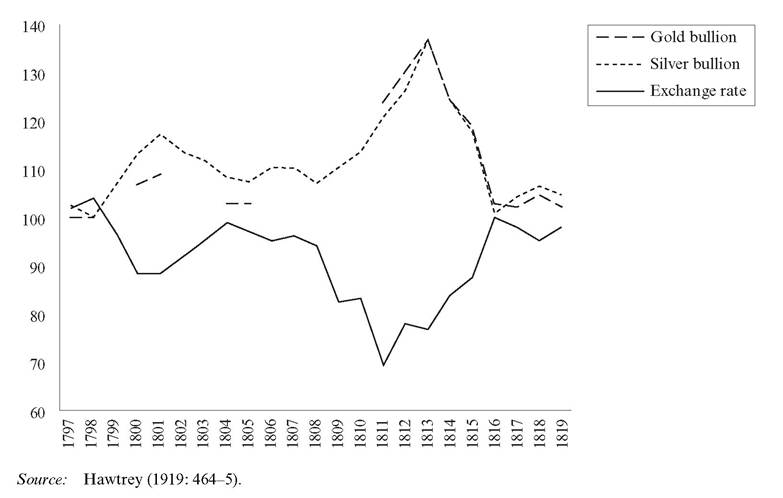
Figure 1 Prices of gold, of silver and exchange rate
trade: on the one hand, it increases the foreign demand for national goods, thus favouring exports; on the other hand, it increases the prices of imported goods, and therefore domestic prices. While this second effect reduces the demand for foreign goods, it also increases the value of a given volume of imports. By raising prices, it also counteracts the first effect. The total effect on the balance of trade of the decline in the exchange rates is therefore indeterminate. This is an anticipation of the Marshall-Lerner elasticities approach. In the end, Boyd favoured the effect of the increase in banknotes on the rising price of foods.
Concerning the issue of banknotes, Boyd estimated that from February 1797 to 1800 there had been an increase in circulation of £3.5 million, in other words an augmentation of nearly one-third of the former amount of banknotes. However, he stressed that there “exists no positive proof” of this increase because it is “a fact necessarily secret in itself” (quoted by Arnon 2011: 77). In Boyd’s view, the existence of the fact is established “by reasoning from effect to cause” (ibid.): the proof relies on the low rate of exchange and the high prices of commodities in general, including gold. The natural tendency of money (that is, banknotes and gold) to depreciation from the increase of it, or of its representative signs, is admitted to be a principle invariable “as the law of gravitation” (quoted by Arnon 2011: 78). Concerning the responsibility for this increase, Boyd thought that the Bank of England was the only bank to blame, because the situation of the country banks had not changed after the Bank Restriction Act.
Every note which the country banker issues is payable on demand either in specie or in notes of the Bank of England. It may therefore be inferred, that no part of these issues can possibly remain in circulation, beyond what the increasing prosperity and industry of the country where they circulate, can fairly absorb and digest. (Quoted by Arnon 2011: 80)
During the suspension, the amount of country banknotes rose and fell in proportion to the abundance or scarcity of the Bank of England notes.