The Book of Daniel
A given sum of money does not have the same importance or utility to different persons with different wealth. The greater is an individual’s wealth (“summa bonorum”), the less a given increment of it will be of importance to its owner.
If, with Daniel Bernoulli, infinitesimal increments of wealth are considered, this means that what is called today the marginal utility of wealth is decreasing. This is what had become to be known as “Bernoulli’s hypothesis”. It is moreover to be noted that Bernoulli’s concept of wealth is defined in a broad and modern way: it does not only consist in the material wealth already possessed, but it also takes into account the future incomes that a given human capital is susceptible to yield (Bernoulli 1738 [1954]: 25). Daniel illustrated his approach with Figure 4 - which in modern parlance represents the utility of wealth - where the horizontal axis denotes wealth and its possible increments (not infinitesimal here for the sake of clarity) and the vertical axis the benefit or utility obtained from them. The function is concave because of the positive but decreasing marginal utility. AB denotes the initial wealth before the game starts. By convention, the utility of AB is nil, so that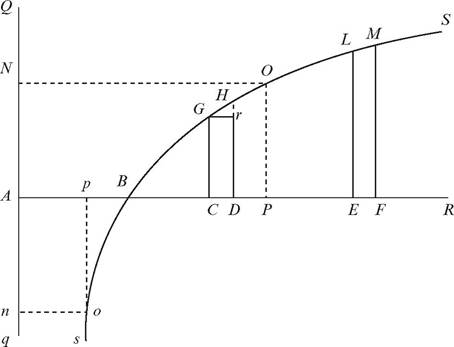
Figure 4 Daniel Bernoulli’s representation of the utility of wealth
the utilities CG, DH, EL and FM of the possible increments of wealth BC, BD, BE, BF, can be read easily on the figure.
In order to be more precise and to apply his approach to concrete cases (marine insurance, for example), Daniel advanced a second hypothesis: the increment of utility generated by an infinitesimal increase of wealth is inversely proportional to this wealth (Bernoulli 1738 [1954]: 25). In modern parlance, this is to suppose that the utility function is iso-elastic, the algebraic value of the elasticity of the marginal utility of wealth with respect to wealth being moreover equal to -1.
The (utility) function, Bernoulli writes, can thus be specified. Let a denote the initial wealth AB. At any point of the curve (for example, C), if x denotes the wealth, dx its increment, y the utility of x, and dy its increment (the segment rH in the graph), then, b being a positive constant:

where k is a constant of integration. Since, by convention, as stated above, y = 0 for x = a,

Since in a game of chance the mathematical expectation of the monetary gains can no longer be considered as the fair stake a player has to pay, what has to be calculated is instead the “emolumentum medium”, that is the “mean utility” or, as Cramer put it in 1728, the “esperance morale” (moral expectation) of the player - Condorcet later spoke of “esperance relative” (relative expectation). The formula of the moral expectation is simply that of the mathematical expectation, the possible gains BC, BD, BE, BF, etc. having simply to be replaced with their respective utility CG, DH, EL and FM, and so on. Suppose that there are m independent ways of obtaining BC, n of obtaining BD,p for BE, q for BF, and so on. Then, for the player, the “moral expectation” of the gains - PO in Figure 4 - is given by:

with the segment BP on the horizontal axis denoting the corresponding (and finite) expected gain.
Now, to get into the game, a player will never pay a sum, the disutility of which is greater than the moral expectation of the gain. As Cramer himself put it in 1728, the stake should be “of such a magnitude that the pain caused by its loss is equal to the moral expectation of the pleasure I hope to derive from my gain” (in Bernoulli 1738 [1954]: 34). How much, then, will a player be ready to pay? Letpo = PO be the disutility of the maximum stake.
It is easy to see in Figure 4 that this maximum stake is Bp - that is, the diminution of the initial wealth of the player, the disutility of which is precisely equal to po. Owing to the concavity of the curve, Bp < BP, that is, the greatest stake thatthe player should be prepared to pay is inferior to the expected gain. The values of all the variables can be calculated. In the case of the game of heads or tails mentioned above, the stake would be of a few ecus only.
This also shows that, whenever the stake is determined on the basis of the usual rule based on the expected gain, the player will always be a loser because the disutility of the stake would always be greater than the utility of the expected gain. However, the two rules of the mathematical and moral expectations are (1) equivalent if utility is directly proportional to the gain, in which case the function becomes a straight line, or (2) nearly equivalent in case the initial wealth is “infinitely great” compared to the greatest possible gain, in which case the graph of the function is approximately a straight line (Corollaries I and II, in Bernoulli 1738 [1954]: 27).
Daniel applied his new method of evaluating risk to questions of trade and insurance (Bernoulli 1738 [1954]: 29-30), for example, to state the conditions of profitable insurance, both for the merchant who thinks about insuring his trade and the insurer who insures the merchant. He showed also that the merchant can reduce his risk in dividing his merchandise and sending it on several boats instead of one single ship (ibid.: 30-31) - “it is advisable to divide goods which are exposed to some danger into several portions rather than to risk them all together” (ibid.: 30). The analysis of a better risk spread can also be extended to other questions. “This counsel will be equally serviceable for those who invest their fortunes in foreign bills of exchange and other hazardous enterprises” (ibid.: 31).
Another important theme can also be found in Daniel’s 1738 paper: the definition of risk aversion as a situation in which a player prefers a gain which is certain to a greater but uncertain (expected) gain - a case illustrated nowadays with a concave utility function.
As he wrote at the beginning of his text, still referring to the criterion of mathematical expectation:Somehow a very poor fellow obtains a lottery ticket that will yield with equal probability either nothing or twenty thousand ducats. Will this man evaluate his chance of winning at ten thousand ducats? Would he not be ill-advised to sell this lottery ticket for nine thousand ducats? To me it seems that the answer is in the negative. (Bernoulli [1738] 1954: 24, s. 3)
Bernoulli’s presentation of moral expectation was later taken up and developed in the expected utility theory, and his iso-elastic utility function is still widely used in problems of applied microeconomics. To conclude, two remarks are in order as regards the shape of the utility function. On the one hand, even when Bernoulli’s contemporaries accepted his first hypothesis (the decreasing marginal utility of wealth), the second, concerning the value of the elasticity of the marginal utility of wealth with respect to wealth, was contested. Condorcet, in particular, supposed that the absolute value of the elasticity was greater than one - with important consequences in favour of progressive taxation (Faccarello 2006: 26-30). On the other hand, the logarithmic form of the utility function is not the only one contemplated by Daniel Bernoulli. Cramer, in the 1728 letter to Nikolaus, extensively quoted by Daniel at the end of his essay, proposed y = "x. It is worth noting that Daniel accepted this specification as a possible solution. The manner in which Cramer expressed “the basic principle... that reasonable men should evaluate money in proportion to the use they can make thereof”, he wrote, is “in perfect agreement with our view” (in Bernoulli 1738 [1954]: 34, translation modified).
Gilbert Faccarello
See also:
Marie-Jean-Antoine-Nicolas Caritat de Condorcet (I); Formalization and mathematical modelling (III); French Enlightenment (II); Uncertainty and information (III).
More on the topic The Book of Daniel:
- Faccarello G., Kurz H.D.(eds.). Handbook on the History of Economic Analysis, Volume 1: Great Economists Since Petty and Boisguilbert. Cheltenham: Edward Elgar,2016. — 813 p., 2016
- The German Use Value School: Its Beginnings
- Notes on Contributors
- The eighteenth century: a marriage not consumated
- Pure economic theory
- Tibor Scitovsky (3 November 1910-1 June 2002) lived a varied life, both in the private sphere and in his public activity as an economist.
- References
- New developments and criticisms