Tentativecost-of-living indices by income class
Armed with the expenditure shares in Table 6.2 and price series like those illustrated in Tables 6.3 and Tables 6.4, one can put together cost-of-living indices that apply to the expenditure patterns of the different income ranks.
Figure 6.3 summarizes the contrasts in the cost-of-living trends for the top and bottom groups. In Figure 6.3, a rise is egalitarian in that it means that the cost of living rose more for the rich than for the poor. A decline is inegalitarian.The cost-of-living deflators for different income classes moved very differently before the early nineteenth century. For England (Panel A in Figure 6.3), the movements reveal historical eras that seem to match those delineated by other inequality indicators. First, during the famous but gradual price revolution between 1500 and 1650, the top income groups enjoyed a relative decline of about 20% in their cost of living, in the form of less price inflation, relative to the prices faced by workers and the poor. Then, between r.1650 and r.1750, the common people had
Figure 6.3 Movements in the cost of living in top income groups, relative to the cost of living in the bottom 40% or in workers' households: (a) Panel A. England, 1500—1900; (b) Panel B. France, 1500—1900; (c) Panel C. Holland, 1540-1799
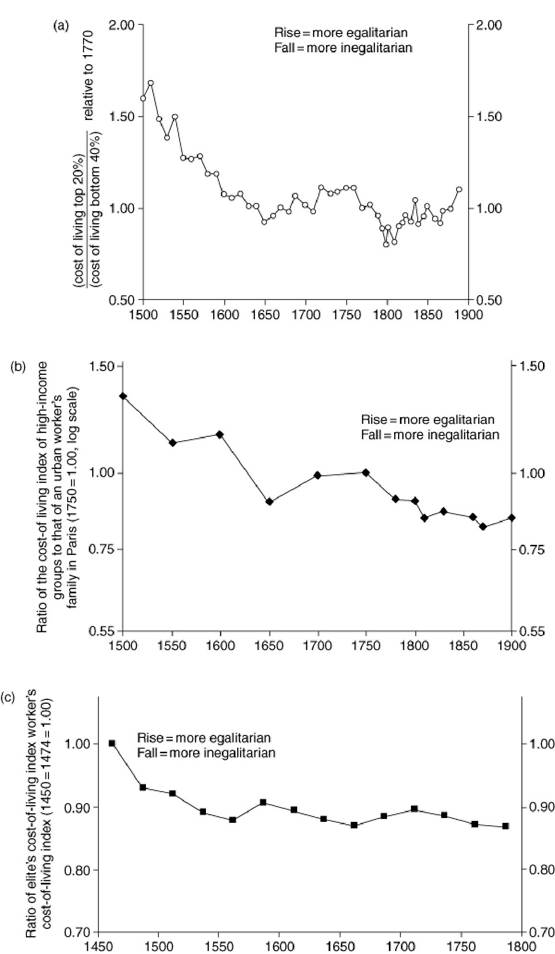
the better of it, with a reversal of that previous 20% movement. That is, by 1750 the cost-of-living bundles of the rich and the poor stood in the same relative-price ratio as they had 250 years earlier. In the second half of the eighteenth century, this swing was itself reversed again, so that in 1800 the relative cost-of-living hardship of being poor was as bad as back in 1650. In the late nineteenth century, the pendulum swung back in favour of workers and the poor.
In fact, it swung further their way than at any time over the previous three centuries. The early modern English swings, those before the early nineteenth century, were dominated by swings in the relative price of staple foods.In pre-Revolutionary France, the broad class differences in cost-of-living trends looked similar. Relative to an urban working-class household, a wealthy noble family had a declining cost-of-living up to the 1650 benchmark, especially if homeownership shielded them from the rapid rise in housing rents. In this respect, nobles and wealthy merchants differed. Some rented their high-class housing, just as the Duc de Saulx-Tavanes rented his Paris residence. Others owned their own housing, just as the Duc owned his country estate. There is again an egalitarian drift between 1650 and 1750 and a reversal between 1750 and 1790 though these movements were smaller than those in England were.
In Holland, as in France and England, the cost of a high-income lifestyle declined relative to the cost-of-living in a working-class household, as shown in Panel C of Figure 6.3. In both Holland and France, the real movement in relative living costs came in the era before 1650. We see only a slight imitation of England's late eighteenth-century inegalitarian trend.
7.