Sraffa’s Equations with Oil
Now let us assume an economy where instead of land, oil is the nonproduced good and it is used for the production of commodity n, say, electric energy In order to isolate the main problem at issue, let us suppose that oil does not require extraction costs and that the prices of the produced commodities do not change over time.
Let λjn(t) denote the total quantity of oil available at time t and used in process nj; and πj (t) the price of one unit (say a barrel) of oil. By analogy with equation (4), the price equation of process n, i in period t, t+1 would be:
where the stock of oil appears as an input and joint product, like in the case of land.9 Equation (5) can be rewritten:

Equations (5) and (5’) represent a revaluation of a quantity of oil, and the rate of appreciation is equal to the general rate of profit (an application of the Hotelling’s rule). We propose a different formulation instead of equations (5) and (5’).
Let f ll (t) denote the flow, as distinct from the total stock, of oil used in process n, j during period t. The quantity fj (t) represents a flow supplied by the owners of the deposits and can be assumed equal to an observable and measurable depletion of the total stock, which instead may not be observed but possibly conjectured. The price equations for commodity n are:

where the symbols refer to the same period of time and the index t is omitted. Equation (6) has the same mathematical form of the initial equation with land (2), and the system of equations (1) and (6) can be closed in the same ways assuming either extensive and intensive “cultivation” of the given flow of oil. By analogy with the determination of the price of land through the equation pj = r π j, we might also write πj (the price of a barrel of oil) equal to the capitalized value of the royalty pj over one period and derive from (6) the equation:

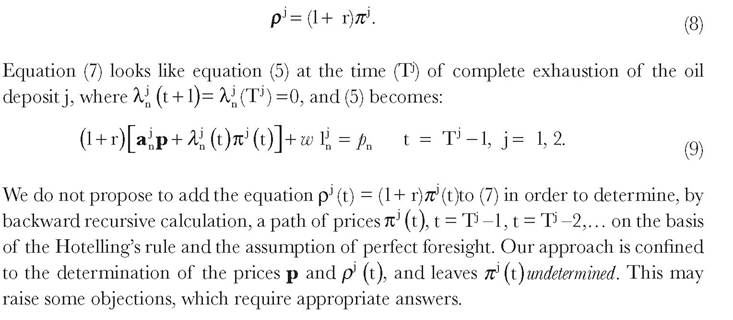
5.