Real wages for agricultural workers
It is difficult to detect a continuous increase before the second half of the nineteenth century (Jorberg 1972: vol. II, 337). Figure 14.1 shows real wages (measured as day-wages for agricultural workers deflated by the prices of rye).3 In Sweden as a whole, real wages seem to have declined between the late 1770s and the early 1800s.
They then increased until the early 1820s, after which a slight decline took place until around 1850. After 1850 real wages increased continuously, indicating a steady improvement in the standard of living of the agricultural labourers. The development in Malmhus County (locus of the four parishes of this study) deviates somewhat from this picture, by not showing any decline in real wages in the final decades of the eighteenth century. Instead, the real wage level stayed rather constant, albeit with marked short-term fluctuations, until the 1860s, thereafter it increased for the rest of the century. However, as was pointed out above, the rate of growth towards the end of the century is exaggerated due to the use of rye price as the deflator (see note 3). Nonetheless, there can be little doubt that real wages increased steadily from the 1860s onwards. Thus, to the extent that real wages for day-labourers give an accurate picture of the standard of living for landless labourers, it does not seem as if they gained very much from the agricultural transformation that occurred during the first half of the nineteenth century. However, the agricultural transformation may also have led to a higher, and seasonally more even, employment for agricultural workers, which means that stagnating real day-wages do not necessarily imply declining real incomeFigure 14.1 Real wages (day-wage/rye price) in Malmohus County and Sweden, 1766—1895
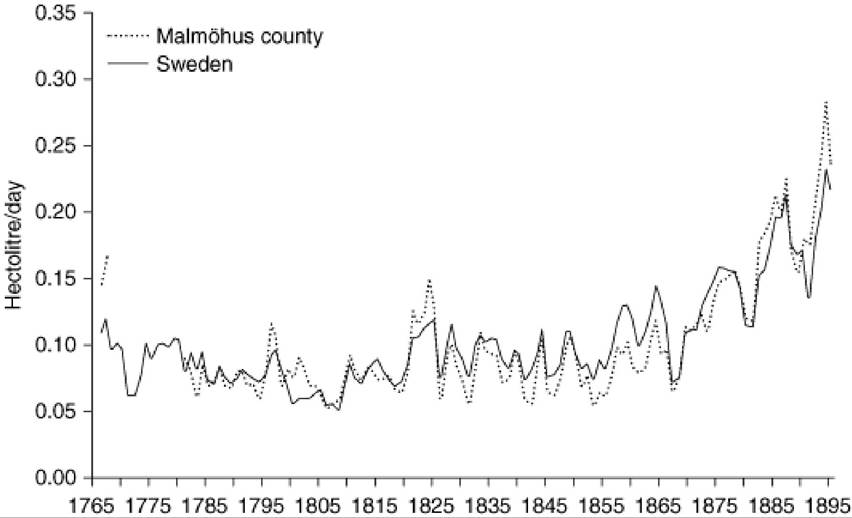
Source. Jorberg 1972.
(e.g.
Schon 2000). For England it has been estimated that the number of hours worked per year in agriculture increased by around 30% between 1760 and 1830 (Voth 2001: 129), which supports the idea that labour input increased considerably during the agricultural revolution. While it seems indisputable that the standard of living for labourers increased after the 1860s, it is more difficult to draw firm conclusions regarding the development during the first half of the nineteenth century.It is likely that commercialization of agriculture and increased production and productivity raised the incomes of the market-producing peasants, leading to an increased stratification of the peasant group (Winberg 1975). One indication of such stratification is the pattern of increasing textile consumption from the 1830s onwards. Initially the demand for high quality textiles grew fastest, which may be interpreted as indicating rising incomes in the wealthier social groups. But in the late 1840s the demand for everyday textiles also started to increase, which reflects the rising incomes of the larger peasant groups (Schon 1979).
2.3