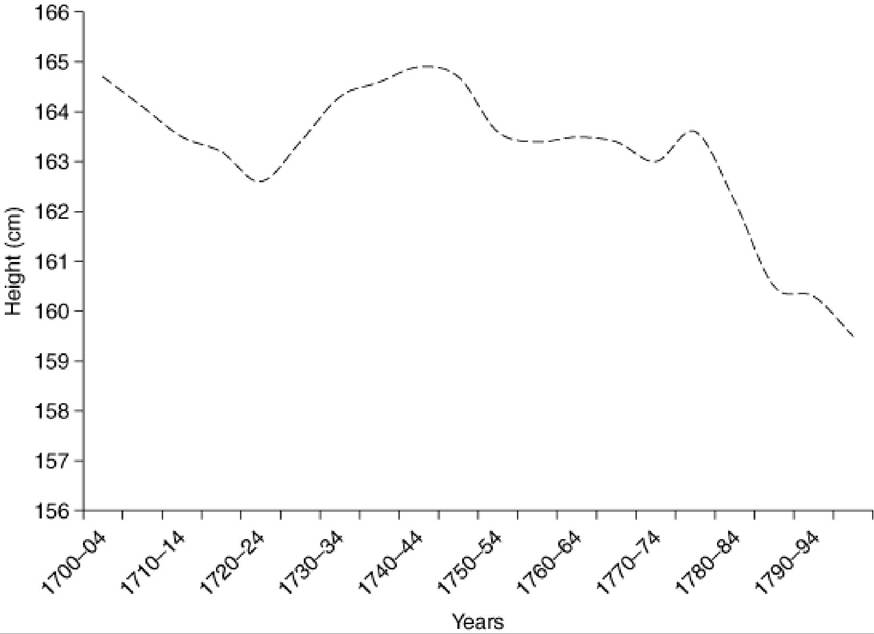
Processing the Data on Stature
The availability of Russian source material relating to the eighteenth and the first half of the nineteenth centuries does not allow us to use traditional indicators of well-being such as national income per capita, incomes of various social classes, and the level of inequality among them, or real wages.
But even if such indicators were at our disposal they would be obviously insufficient to characterize the material conditions of the great majority of the people. The peasantry that comprised about 90% of the population had weak ties with the markets for goods and labour. The lion's share of the products consumed by peasants were produced intheir own households, while they sold only a small part of their agricultural produce to get the money required for the payment of taxes and quitrent to the state and landlords. In the early eighteenth century only 13% of the country's population resided in towns, and by the late eighteenth century this figure fell to just 8%.1 In terms of the way of life, the greater part of this not-numerous urban population was also engaged in agriculture and did not differ much from peasants (Mironov 1990: 281—3). Owing to this fact, to illuminate changes in the living standard we shall use information about variations in the stature of male conscripts. Stature variation is a good proxy for changes in the overall biological status of the population. For Russia in the eighteenth century it is also a fairly reliable indicator of well-being and the standard of living since in pre-industrial Russian society more than half of a peasant's income was spent to maintain biological status. The earliest reliable budget inspections are from 1877 to 1883 by which time the way of life in the countryside appreciably changed towards the diversification of requirements. According to these budgets, peasants engaged mainly in agriculture spent nearly 54% of their income on the maintenance of biological status (40% on nutrition, 14% on clothes/dwelling) and those engaged mainly in home industry spent 78% (60% on nutrition, 18% on clothes/dwelling) (Materialy1903: 132—4).2
To assess variations in the biological and material status, we have information on the stature of 57,549 recruits born in 1700-99 and called up between 1731 and 1835.
Compulsory military service was introduced in 1699 and was extended to the whole taxable population in 1705. Unfortunately, the military began to measure stature only after the introduction of the minimum height standards in November 1730 (Stoletie Voennogo ministerstva 1902, Vol. 3, part 1, book 1, section 1: 61-2, 88). From 1730 to 1799 there were fifty recruitments, and twenty-six more followed in the first third of the nineteenth century. On average there were two recruitments every three years, although sometimes there were two recruitments a year. Not all of the official lists of recruits have been preserved. But owing to the fact that recruits were generally aged between 16 and 35, though sometimes older, the information available allows us to estimate stature variations for each year of the century. The information on stature was related to those who were medically examined and recruited. Their number varied from 14,000 in 1730 to 132,000 in 1796, to about 200,000 in the 1830s (Stoletie Voennogo ministerstva 1902, Vol. 3, part 1, book 1, section 1: 92, 271; Vol. 4, part 3, book 1, section 2: 5-6). Before the introduction of universal compulsory military service in 1874, mainly peasants (83-92% of the population) and the lower strata of the urban population, meshchane (3-7% of the population), together constituting about 96.5% of the total population, were recruited (Mironov with Eklof 2000: 238-89, 355). For the nobility (2% of the population), military service was compulsory before 1762 and became voluntary thereafter. As a rule, the nobility served as officers. The clergy (1.5% of the population) was exempted from service and the never-numerous bourgeoisie had the right to pay out of military service. Thus, throughout the century the social composition of recruits was stable: 95-97% were peasants of various categories.Table 10.1 Variations of minimum height requirements (in cm) and age requirements (years) for recruits of the regular Russian army, 1730—1874
| Min. height for recruits, ≥20 | Min. height for re- cruits,bgcolor=white>1730 | 160.0 | 160.0 | 15-30 | |
| 1731 | 160.0 | 155.6 | 15-30 | ||
| 1736 | 157.8 | 155.6 | 15-35 | ||
| 1741 | 160.0 | 142.2 | 17-35 | ||
| 1757 | 160.0 | — | 20-35 | ||
| 1766 | 160.0 | — | 17-35 | ||
| 1825 | 160.0 | — | 18-35 | ||
| 1840 | 160.0 | — | 20-35 | ||
| 1845 | 157.8 | — | 20-35 | ||
| 1854 | 155.6 | — | 20-35 | ||
| 1874 | 153.4 | — | 20 |
Source: Polnoe sobranie zakonov 1830, Vol. 8, no. 5645 (1730); Vol. 9, no. 7046 (1736); Vol. 11, no. 8446 (1741); Vol. 14, no. 10786 (1757); Vol. 17, no. 12748 (1766); Rediger 1892: 88-95.
The basic age and height requirements of 17-35 years and 160 cm varied significantly; this considerably facilitates the comparison of data for various years (see Table 10.1).
During protracted wars, the military relaxed these requirements, calling up recruits aged between 16 and 50 and of stature 1-5 cm below standards, and in exceptional cases recruiting without restrictions.
For example, in 1788 during the Russo-Turkish war volunteers were recruited without stature restrictions (Polnoe sobranie gakonov 1830, Vol. 22, no. 16681). This creates some difficulties when data for various years are compared, but the difficulties should not be exaggerated. First, information on the stature of recruits called up in the years when requirements were relaxed is relatively insignificant in the overall database. Second, the maximum effect of relaxing the height requirements during the Russo-Turkish war, lowered the average height of recruits by 1.8 cm. Third, reductions in the height requirements were often caused by an actual decrease in the overall stature of the population.An accurate assessment of stature and age is an important issue. At all enlistment offices recruits were measured with the aid of a stature-measuring device delivered from the Military Board. It was a tin-bound wooden plank with a scale marked in old Russian measures—arshin (71.7 cm), vershok (4.445 cm), and fourth and eighth parts of vershok (0.556 cm). At both ends the scale was sealed up with the seal of the Military Board (Stoletie Voennogo ministerstva 1902, Vol. 4, part 1, book 1, section 1: 125-6). During the medical examination the recruit was stripped to the skin, put to the plank, his back against the scale, a ruler was put on the top of his head and his measure was taken. The accuracy of the measurement was not regulated by instructions and depended, probably, on the honesty of the examiners: in some
cases they measured to ½ vershok (2.3 cm), in others to ¼ vershok (the most frequent version), and still in others to ⅛ vershok (0.6 cm). The medical examination of recruits was made in daytime; from daybreak until two o'clock in the afternoon. Examination by candle-light was prohibited. On the one hand, the examiners may have had an incentive to exaggerate stature in exchange for a bribe to accept a person who did not meet the requirements. On the other hand, they had an incentive to understate stature in order to insure against an accusation of intentionally exaggerating stature, especially since stature can alter by up to 2 cm from morning till nightfall, due to a slight compression of the vertebrae while standing. On arrival at the place of their service, recruits were measured for a second time and any deliberate distortion in measurement would be revealed.
If a recruit's height proved to be lower than the prescribed standard, the recruit could be sent back at the expense of the examiners, however, if a recruit's height turned out to be greater than the one fixed in the official list, there were no consequences for the examiner since the army was interested in tall soldiers. An over-riding wish to avoid problems led examiners to tend to understate actual stature. The repeated measuring showed that the understating was within the range 0.5—2.2 cm, but no claims from recruits of erroneous measuring were ever brought forward to the selection committees.3The data on assessment of age are worse. Official policy demanded verification of age with documents from censuses that had been taken regularly since 1719, or with registers of births, which had been kept more or less regularly by parish priests since the 1730s. Verification of age with documents was, however, somewhat burdensome for officials. The case was aggravated by the fact that in the eighteenth century administrative and territorial divisions were altered several times. Owing to this the materials of the latest census taken in one district were often kept in the archives of another district and it was indeed difficult and sometimes impossible (e.g because of a fire—rather a frequent occurrence) to find the required documentation. As a result, it was only in dubious cases that documentation was required, while in most cases simple questioning was used. As usually happens when censuses are taken in traditional societies with low literacy levels (in Russia in the eighteenth century literacy among peasants did not exceed 1%), people tended to give ages ending in 0 or 5 (the so-called problem of age heaping). Some were also fond of the figure thirty-three (the age of Christ), and many men exaggerated their age. Being aware of this peculiarity, the selection committee officials apparently were more likely to understate the given age of recruits than to overstate it.
In 1790 it was permitted to recruit carpenters from Kostroma province for the Black Sea fleet with no restrictions on their age or stature but with only the requirement that they should be healthy and fit for service. On arrival at the place of service 180 recruits were measured and questioned about their ages. Their remeasured stature turned out to be on average 1 cm higher (generally speaking this is normal since a man's stature varies during the day) but according to further questioning, average age turned out to be 10 years higher than that stated in the official lists. In the course of verification it was found that the ages of thirty-five recruits were indeed distorted. According toofficial lists the average was 30 years, but according to questioning at the place of service it was 58 years and according to the documents it was 37 years (Central State Archive of the Navy: f. 406, op. 8, d. 9, ll. 86, 114, 87-110). This example was an exceptional case of age distortion but one that reveals typical errors made in stature measurement and age assessment. Selection committees understated both stature and age; stature mostly insignificantly as it could be easily verified by the second measuring, but age sometimes significantly since it was more difficult to verify. Age distortion requires special care when using stature annual data and compels us to prefer five-year and ten-year data in which the problem of age heaping is largely eliminated. At the beginning of the nineteenth century the quality of measurement of recruits was largely improved—the accuracy of measurement was improved up to ⅛ vershok (0.6 cm) and age was verified with documents.
Table 10.2 Stature of Russian recruits by birth year, 1700-99, by five-year cohorts (in cm) border=0>