Mortality
Pronounced differences in mortality levels were apparent between the central region, including Daoyi, and the north and south. According to Table 16.1, male life expectancy at age 1 in the south exceeded that in Daoyi by 11.6 years.
Similarly, female life expectancy at age 16 in the south exceeded that in Daoyi by 5.6 years. We attribute low life expectancy in the central region, including Daoyi, not to lower living standards but rather to their close proximity to densely populated Shenyang and to their own higher population density. We suspect, in other words, that there was a ‘suburban penalty' associated with living in a rural area immediately adjacent to a major city.At least in the north and south, substantial differences within regions were also apparent. Once again, in many cases the state farm systems that differed the most were adjacent or even overlapping. Female life expectancy at age 16 was
8.4 years higher in Dadianzi than in Dami. Male life expectancy at age 16 was 5.3 years higher in Gaizhou Manhan than in Gaizhou Mianding. Female life expectancy at age 16 was 3.1 years higher in Daxingtun than in Guosantun. As was the case with fertility, an understanding of the source of these pronounced local variations will have to await additional details on the organization of specific state farm systems.
Child mortality declined remarkably over time, raising the possibility of an improvement in living standards. According to Figure 16.5, until the 1840s it was typical for roughly one-third of boys aged 1—15 to die within the next three years. After that, it was more common for only one-tenth to one-fifth of such boys to die within three years. Child mortality tends to be caused by acute infectious diseases. The lethality of many of these diseases is conditioned by the nutritional status of the child, and thus a sustained reduction in child mortality in the absence of improvements in public health and medicine may reflect improvements in living standards.
Pronounced gender differences were apparent in the evolution of adult mortality over time. Figure 16.6 presents male and female period life expectancies at age 16 from the middle of the eighteenth century to the beginning of the twentieth century. There is some suggestion that male life expectancy was rising especially during the
Figure 16.5 Probability that a male aged 1 sui will die before reaching age 16 sui in Liaoning
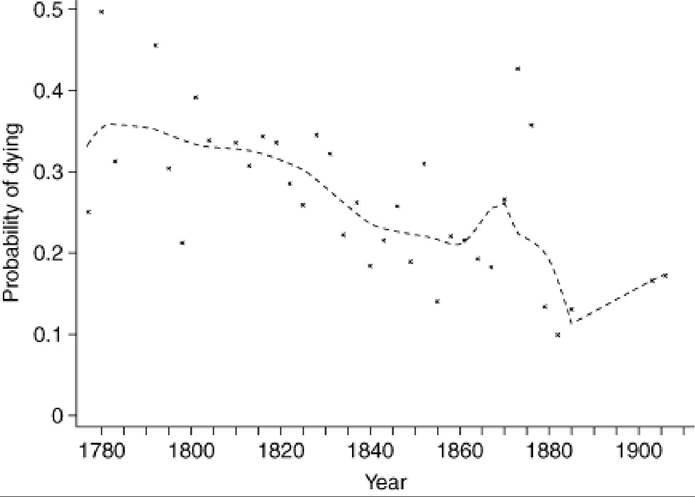
Figure 16.6 Male and female period life expectancy at age 16 sui in Liaoning
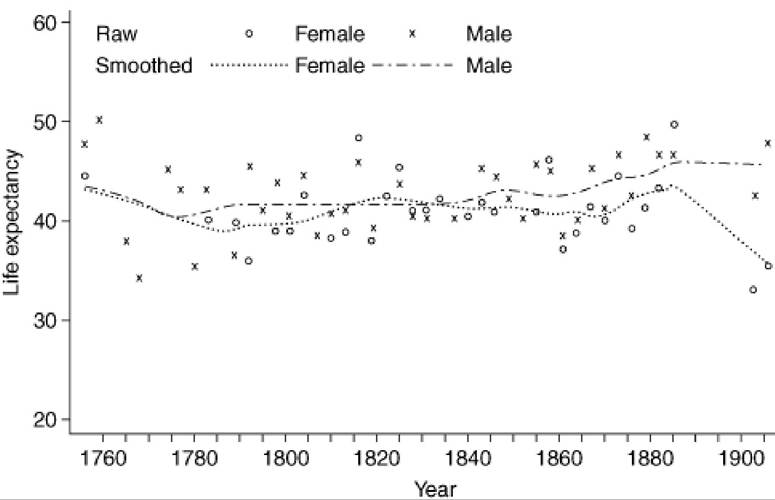
last half of the nineteenth century. Female life expectancy exhibited little trend. Short-term fluctuations in mortality levels were if anything more pronounced than long-term trends. Increases or decreases of several years from one three-year period to the next were not uncommon. The early 1880s appear to have been especially favourable to adult males, while the first decade of the twentieth century was extremely unfavorable to adult females.
Event-history analysis reveals that the reduction in male child mortality took place in all regions and in both time periods.” The most pronounced decline was in the south, where the chances of dying in the next three years fell by 1.28% every year. The mildest decline was in the central state farm systems, where chances fell
Table 16.5 Coefficients for logged low sorghum price from the complementary log—log regression of death in the next three years
| Model 1: 1734-1888 | Model 2: 1774-1834 | Model 3: 1834-88 | ||||
| Coefficient | p-value | Coefficient | p-valιue | Coefficient | p-valιue | |
| Males, age 1—15 sui | ||||||
| North | 0.0064 | 0.58 | 0.0102 | 0.68 | -0.0124 | 0.53 |
| Central | -0.0234 | 0.11 | -0.0786 | 0.08 | -0.0106 | 0.62 |
| Daoyi | 0.0246 | 0.03 | 0.0378 | 0.03 | -0.0022 | 0.94 |
| South | 0.0092 | 0.46 | 0.0164 | 0.45 | 0.0198 | 0.33 |
| N | 45,595 | 19,767 | 25,828 | |||
| Males, age 16-55 sui | ||||||
| North | -0.0013 | 0.87 | 0.0106 | 0.53 | -0.0099 | 0.42 |
| Central | -0.0201 | 0.06 | -0.0340 | 0.36 | -0.0222 | 0.10 |
| Daoyi | 0.0364 | 0.00 | 0.0247 | 0.09 | 0.0291 | 0.11 |
| South | -0.0116 | 0.18 | 0.0044 | 0.79 | -0.0233 | 0.06 |
| N | 103,900 | 48,184 | 55,716 | |||
| Females, age 16-55 sui | ||||||
| North | -0.0231 | 0.01 | -0.0093 | bgcolor=white>0.61-0.0150 | 0.23 | |
| Central | -0.0436 | 0.00 | -0.1022 | 0.01 | -0.0393 | 0.01 |
| Daoyi | 0.0158 | 0.10 | -0.0004 | 0.98 | 0.0448 | 0.02 |
| South | 0.0030 | 0.74 | 0.0114 | 0.51 | 0.0159 | 0.23 |
| N | 79,790 | 37,308 | 42,482 | |||
| Males, age 56-75 sui | ||||||
| North | 0.0186 | 0.03 | -0.0060 | 0.75 | 0.0089 | 0.50 |
| Central | -0.0168 | 0.14 | 0.0128 | 0.75 | -0.0207 | 0.16 |
| Daoyi | 0.0399 | 0.00 | -0.0040 | 0.81 | 0.0754 | 0.00 |
| South | 0.0050 | 0.60 | 0.0111 | 0.55 | 0.0034 | 0.79 |
| N | 20,118 | 8,856 | 11,262 | |||
| Females, age 56-75 sui | ||||||
| North | -0.0215 | 0.01 | -0.0445 | 0.02 | 0.0004 | 0.97 |
| Central | -0.0002 | 0.99 | -0.0540 | 0.23 | 0.0063 | 0.70 |
| Daoyi | 0.0183 | 0.10 | -0.0132 | 0.48 | 0.0323 | 0.13 |
| South | 0.0037 | 0.72 | 0.0172 | 0.38 | 0.0057 | 0.70 |
| N | 21,665 | 9,860 | 11,805 | |||
Notes: The models did not include main effects of year or low sorghum price, only the interactions between them and the four dichotomous indicators of region. To save space, coefficients for the region indicators and their interactions with the terms of the fourth-degree orthogonal age polynomial are omitted from this table.
We restricted analysis to observations where the immediately succeeding observation was also available.by only 0.64% a year. The cumulative effect of such declines would have been dramatic. The 1.06% annual reduction in the north would have translated into a two-thirds reduction in the chances of dying over the course of a century.
Trends in adult mortality were less consistent. They differed by region, age, and sex. In the north there was evidence of a widespread reduction in the chances of dying. Mortality appears to have fallen for adult males and for elderly males and females. In the centre and south, few trends were apparent. The exceptions were that adult female mortality rose in the south and elderly female mortality rose in the central regions.
The residents of Daoyi appear to have lived closest to the margin, and conditions there worsened over time. According to the coefficients in Table 16.5, mortality there appears to have been the most sensitive to grain price variations. Increases in low sorghum prices raised mortality at all ages and for both sexes in Daoyi, but had no effect or contradictory effects in the remaining regions. Males were more sensitive than females, and the elderly more sensitive than adults. Accordingly, the most extreme response in Daoyi was among elderly males: a 10% increase in prices raised their mortality by 3.99%. Moreover, comparison of coefficients between periods suggests that for everyone except male children, mortality rates were more sensitive to prices between 1834 and 1888 than they were between 1774 and 1834.
5.