Keynes and Keynesians
It is remarkable that whereas growth was at the centre of the concerns of the classical political economists, and then of Karl Marx, it moved to the periphery in the aftermath of the so-called “marginal revolution”.
Leon Walras (1874 [1954]) still tackled the problem in terms of his theory of “capitalization”, that is, of credit and capital accumulation (see Morishima 1977 and Knut Wicksell 1893 [1954]) in terms of his theory of capital formation. Thereafter it moved largely to the background of economic theory. The field was revitalized when attempts were made to extend Keynes’s 1936 short-run analysis to the long run by taking into account not only the income effect of investment in terms of the multiplier, but also the capacity effect of investment. Evsey Domar (1946) showed that productive capacity and effective demand grow in step with one another, if and only if investment grows at a rate that is equal to the ratio of society’s propensity to save, s, and the capital-to-output ratio (which is taken to be constant), v, that is: g = s/v. Roy F. Harrod (1939, 1948) sought to carry Keynes’s principle of effective demand over to the long run by studying the interplay of a proportional savings function and an investment function relying on the “acceleration principle”, which takes investment to react on changes in effective demand in the past and thus on changes in the degree of utilization of capital equipment. Within such a framework Harrod was able to show that the accumulation path is unstable: deviations of the actual growth rate of investment from the “warranted rate” (which is essentially the one Domar had shown to guarantee the continuous full utilization of productive capacity) leads either into a boom or a recession. This has become known as Harrod’s “knife-edge problem” in the literature. The instability results because if the actual rate of growth of investment exceeds (falls short of) the warranted rate, the income effect of investment exceeds (falls short of) the capacity effect, which is reflected in a growing (falling) rate of capital utilization. This can in turn be expected to lead to an acceleration (deceleration) of investment growth, which increases the upwards (downwards) deviation of the actual from the warranted rate and exacerbates the disequilibrium: the economy is bound to run into a boom (a depression), because market signals are read by single firms which leads to a collective behaviour that destabilizes the economy. Harrod saw the “instability principle” as an integral part of a theory of the business cycle, which had to explain, first and foremost, if and why there are upper and lower turning points giving rise to cyclical behaviour of output and employment.The papers by Solow (1956) and Swan (1956) mentioned in the previous section sought to answer not only Harrod’s (short-run) knife-edge problem, but also to do away with the possibility Harrod had contemplated of economic growth in the presence of cyclically fluctuating, but persistent unemployment. This was effectuated in terms of (1) the introduction of ample possibilities of substitution among factors of production etched in a macroeconomic production function and (2) the invocation of Say’s law by abandoning an independent investment function and assuming that each and every act of saving will always and instantaneously lead to an act of investment of the same magnitude. By this token both kinds of problems Harrod had analysed were made to disappear and the attention could focus on full employment-full capacity growth. Solow justified this approach in terms of the assumption that Keynesian stabilization policy would accomplish the job, in case the market economy would not. It deserves to be stressed that while Solow was perfectly aware that his model reflected an idealized world in which the problem of effective demand was deliberately shunted aside, many of his followers tended to mistake the model for a description of the real world.
However, there was not only a neoclassical response to the challenges Keynes and then Harrod had put to the profession. Another response came from Nicholas Kaldor (1955-56) and Joan Robinson (1956), who worked in the Keynesian tradition.
Kaldor’s contribution became known as the Neo-Keynesian model of growth and distribution.Kaldor distinguished between wage-earners and profit-earners, noticing that the propensity to save of the first group can be assumed to be smaller than that of the second group simply as a consequence of the fact that the bulk of profits accrues in the form of company profits and a high proportion of these profits are retained by firms in order to finance investment (see Kaldor 1955-56: 95 fn.). In a later contribution Kaldor (1966: 310-11) confirmed his intention to model the role of a large share of undistributed profits to favour self-finance. Kaldor assumed the following saving function:

where S is total savings of a given economy, and W and P are total wages and total profits. Since, in equilibrium, planned saving equals planned investment and since wages plus profits equal the national income, we have:

where I is net investment and Y is net national income. Finally, because of “the ‘Keynesian’ hypothesis that investment, or rather, the ratio of investment to output, can be treated as an independent variable” (Kaldor 1955-56: 95),

The rate of profits, r, is then obtained by multiplying equation (1) by the output-capital ratio, Y/K, which Kaldor (1955-56) assumed to be constant with respect to changes in distribution:

where I/K is the rate of capital accumulation. Since he considered a fairly constant capital-to-output ratio, K/Y, as a “stylized fact” of economic history, the rate of growth of output equals the rate of capital accumulation.
In contradistinction to Kaldor, Luigi L. Pasinetti (1962) dealt with claSSeS (capitalists and workers) rather than with income groups, suggesting the use of the following saving functions which assume that the propensity to save out of the profits earned by the capitalist class differs from the propensity to save out of the profits earned by the working class:
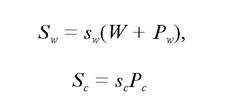
Further, Pasinetti explicitly introduced the dynamic equilibrium conditions, according to which capitalists’ and workers’ capitals, like all variables changing through time, must, in the steady state, grow at the same rate as the economy as a whole.
In addition, he pointed out that, since those who save out of wages must receive a part of the profit as interest for what they lend to capitalists, to determine the rate of profits it is necessary to specify the relationship between the money rate of interest and the rate of profits in steady growth. He maintained that “in a long-run equilibrium model, the obvious hypothesis to make is that of a rate of interest equal to the rate of profit” (Pasinetti 1962: 271-2). Then workers’ and capitalists’ capitals grow at the same rate g. That is, the following constraints hold:
where Kw is workers’ capital loaned to capitalists, and Kc is capitalists’ own capital (Kw + K = K).
If it is assumed that interest and profit rate coincide, then Pc = rKc and Pw = rKw. If, moreover, Kc > 0, then the rate of profits is immediately obtained from equation (4):

This is the “Pasinetti theorem”, which gave rise to a huge debate on the limits of Pasinetti’s result and involved, among others, Franco Modigliani and Paul A. Samuelson. For a detailed account, see Kurz and Salvadori (2010). For a more complete discussion of Keynesian contributions to the study of economic growth, see Commendatore et al. (2003) and Setterfield (2010).