Endogenous Growth Theory
The debate in the 1960s and 1970s between neoclassical and Keynesian economists and the criticism of the neoclassical concept of capital as a quantity that could be ascertained independently of, and prior to, the determination of relative prices and the rate of profits (see in particular Kurz and Salvadori 1995: ch.
14) sent growth economics into a slumber. It was only in the second half of the 1980s that it was awakened again. The proponents of the revival of growth economics dubbed their theories “new” or “endogenous”, henceforth NGTs, drawing attention to the fact that long-run growth was not taken to be given from the outside, as in Solow, but was explained from within the economic system, that is, endogenously.One of the key properties of the NGTs is intensive growth, that is, an increase in income per capita, another is the elimination or at least the limitation of any tendency of the returns to capital and the rate of profits to diminish. The first generation of models of NGT defined the confines within which subsequent contributions to NGT were carried out. The attention focuses on the mechanism that prevents the returns to capital from falling (below a certain level). For a more detailed treatment of these models, see Acemoglu (2009), Aghion and Howitt (1998), Barro and Sala-i-Martin (2003), Jones (1998) and Kurz and Salvadori (1998, 1999).
The first class of NGTs (in terms of simplicity, not in chronological terms) set aside all non-accumulable factors of production, such as labour and land, and assumed that all inputs in production are themselves producible and accumulable, that is, “capital” of some kind. The simplest version of this class is the so-called “AK model”, which assumes that there is a linear relationship between total output, Y, and a single factor capital, K, both consisting of the same commodity:

where 1/A is the amount of that commodity required to produce one unit of itself.
K is said to be able to comprise both physical and human capital and it is assumed that the two can be aggregated without further ado. The rate of return on capital r is given by: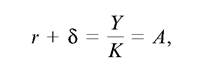
where δ is the exogenously given rate of depreciation. There is a large variety of models of this type in the literature. In the two-sector version in Rebelo (1991) it is assumed that the capital good sector produces the capital good by means of itself and nothing else. It is also assumed that there is only one method of production to produce the capital good. Therefore, the rate of profits is determined by technology alone. Then the saving-investment mechanism jointly with the assumption of a uniform rate of growth, that is, a steady-state equilibrium, determines a relationship between the growth rate, g, and the rate of profits, r. Rebelo (1991: 504, 506) obtains either:
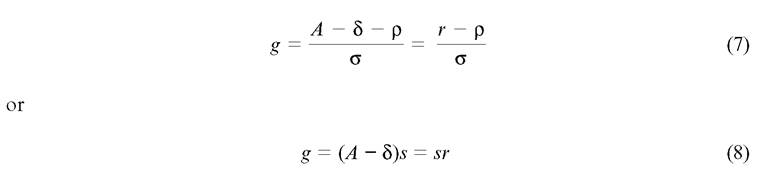
Equation (7) is obtained when savings are determined on the assumption that there is an immortal representative agent maximizing the following intertemporal utility function:
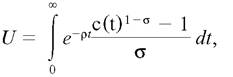
subject to constraint (6), where p is the discount rate, or rate of time preference, and 1∕σ is the elasticity of substitution between present and future consumption (1 ≠ σ > 0), and where Y = c(t) + it. (A dot above a variable refers to the differentiation of the variable with respect to time - in the present case to dK/dt.) Equation (8) is obtained when the average propensity to save s is given. Hence, in this model the rate of profits is determined by technology alone and the saving-investment mechanism determines the growth rate.
King and Rebelo (1990) essentially followed the same avenue. Instead of one kind of “capital” they assumed that there are two kinds, real capital and human capital, both of which are accumulable.
There are two lines of production, one for the social product and the real capital, which consist of quantities of the same commodity, and one for human capital. The production functions relating to the two kinds of capital are assumed to be homogeneous of degree one and strictly concave. As in Rebelo’s model the rate of profits is uniquely determined by the technology (and the maximization of profits which, because of the non-substitution theorem, implies that only one technique can be used in the long run); the growth rate of the system is then endogenously determined by the saving-investment equation. The larger is the propensity to accumulate human and physical capital, the larger is the growth rate.The second class of models preserve the dualism of accumulable and non-accumulable factors but restrict the impact of an accumulation of the former on their returns by a modification of the macroeconomic production function. Jones and Manuelli (1990), for example, allow for both labour and capital and even assume a convex technology, as the Solow model does. However, a convex technology requires only that the marginal product of capital is a decreasing function of its stock, not that it vanishes as the amount of capital per worker tends towards infinity. Jones and Manuelli assume that:

where h(k) is the per capita production function and b is a positive constant. The special case contemplated by them is:

where f(k) is the conventional per capita production function. As capital accumulates and the capital-labour ratio rises, the marginal product of capital will fall, approaching asymptotically b, its lower boundary. With a given propensity to save, s, and assuming that capital never wears out, the steady-state growth rate g is endogenously determined: g = sb. Assuming, on the contrary, intertemporal utility maximization, the rate of growth is positive provided the technical parameter b is larger than the rate of time preference p.
In the case in which it is larger, the steady-state rate of growth is given by equation (7) with r = b.Finally, there is a large class of models contemplating various factors counteracting any diminishing tendency of returns to capital. Here we shall be concerned only with the following two sub-classes: human capital formation and knowledge accumulation. In both kinds of models positive external effects play an important part; they offset any fall in the marginal product of capital.
Models of the first sub-class attempt to formalize the role of human capital formation in the process of growth. Elaborating on some ideas of Uzawa (1965), Lucas (1988) assumed that agents have a choice between two ways of spending their (non-leisure) time: to contribute to current production or to accumulate human capital. With the accumulation of human capital there is said to be associated an externality: the more human capital society as a whole has accumulated, the more productive each single member will be. This is reflected in the following macroeconomic production function:

where the labour input consists of the number of workers, N, times the fraction of time spent working, u, times h which gives the labour input in efficiency units. Finally, there is the term h*. This is designed to represent the externality. The single agent takes h* as a parameter in his or her optimizing by choice of c and u. However, for society as a whole the accumulation of human capital increases output both directly and indirectly, that is, through the externality represented by h*γ, where γ > 0.
Lucas’s conceptualization of the process by means of which human capital is built up is the following:

where υ is a positive constant. (Note that equation (10) can be interpreted as a “production function” of human capital.)
Interestingly, it can be shown that if the above mentioned externality is not present, that is, if γ in equation (9) equals zero, and therefore returns to scale are constant and, as a consequence, the non-substitution theorem holds, endogenous growth in Lucas’s model is obtained in essentially the same way as in the models of Rebelo (1991) and King and Rebelo (1990): the rate of profits is determined by technology and profit maximization alone; and for the predetermined level of the rate of profits the saving-investment mechanism determines the rate of growth.
Yet, as Lucas himself pointed out, the endogenous growth is positive independently of the fact that there is the above mentioned externality, that is, independently of the fact that γ is positive. Therefore, while complicating the picture increasing returns do not add substantially to it: growth is endogenous even if returns to scale are constant. If returns to scale are not constant then the non-substitution theorem does not apply, implying that neither the competitive technique nor the associated rate of profits are determined by technical alternatives and profit maximization alone. Nevertheless, these two factors still determine, in steady states, a relationship between the rate of profits and the rate of growth. This relationship together with the relationship between the same rates obtained from the saving-investment mechanism determines both variables.Models of the second sub-class attempt to portray technological change as generated endogenously. The proximate starting point of this kind of model was Arrow’s (1962) paper on “learning by doing”. Romer (1986) focuses on the role of a single state variable called “knowledge” or “information” and assumes that the information contained in inventions and discoveries has the property of being available to anybody to make use of it at the same time. In other words, information is considered essentially a non-rival good. Yet, it need not be totally non-excludable, that is, it can be monopolized at least for some time. It is around the two different aspects of publicness - non-rivalry and non-excludability - that the argument revolves. Discoveries are made in research and development departments of firms. This requires that resources be withheld from producing current output. The basic idea of Romer’s (1986: 1015) model is “that there is a trade-off between consumption today and knowledge that can be used to produce more consumption tomorrow”. He formalizes this idea in terms of a “research technology” that produces “knowledge” from foregone consumption.
Knowledge is assumed to be cardinally measurable and not to depreciate: it is like perennial capital.Romer stipulates a research technology that is concave and homogeneous of degree one:

where Ii is an amount of foregone consumption in research by firm i and ki is the firm’s current stock of knowledge. (Note that the foregone consumption good is a capital good utilized in the production of “knowledge”.) The production function of the consumption good relative to firm i is:

where K is the accumulated stock of knowledge in the economy as a whole and xi are all inputs different from knowledge. The function is taken to be homogeneous of degree one in ki and xi and homogeneous of a degree greater than one in ki and K. Romer (1986: 1019) assumes that “factors other than knowledge are in fixed supply”. This implies that “knowledge” is the only capital good utilized in the production of the consumption good. Spillovers from private research and development activities increase the public stock of knowledge K.
Assuming, contrary to Romer, that the above production function (12) is homogeneous of degree one in ki and K involves a constant marginal product of capital, the diminishing returns to ki are exactly offset by the external improvements in technology associated with capital accumulation. In this case it can be shown that, similar to the models of NGT previously dealt with, the rate of profits is determined by technology and profit maximization alone, provided, as is assumed by Romer, that the ratio KJki equals the (given) number of firms. The saving-investment relation then determines endogenously the growth rate. Once again endogenous growth does not depend on an assumption about increasing returns with regard to accumulable factors. Growth would be no more endogenous if increasing returns were to be assumed (but the analysis would be a good deal more complicated).
Since the publication of the papers mentioned, a huge literature has built up in which the several aspects dealt with have been studied more thoroughly and new aspects have been brought into the picture. Here we can draw attention only to some of the contributions to this literature; for a more comprehensive treatment see the summary accounts referred to in the above. Romer (1990) tried to enrich the model by introducing a
“product-diversity” specification of physical capital: in a research sector “new designs” for intermediate products are being invented, which are then used in another sector by monopolistic firms to produce these intermediate products. The sector producing the final product then employs the latter and is taken to be the more productive the greater is the product diversity of its capital inputs. Aghion and Howitt (1992) and Grossman and Helpman (1991) incorporate imperfect markets and research and development (R&D) in the growth model in seeking to formalize what Joseph A. Schumpeter called “creative destruction”. Martin L. Weitzman (1998) followed a different route by taking his inspiration from agricultural research stations, in which new “hybrid ideas” are generated by cross-breeding known ideas. Oded Galor (2005) put forward a “unified growth theory” designed to boldly interpret the entire history of mankind in terms of NGT. David de la Croix (2013) explored the role of fertility and education in generating growth. The economic historian Joel Mokyr (1990) used arguments forged in the recent growth literature to reconsider economic history and especially the origins and consequences of the Industrial Revolution for the growth performance of industrializing countries.
The interesting thing to note by way of conclusion is that, the NGTs’ occasionally great complexity notwithstanding, in the steady state they all replicate in one form or another a characteristic feature of the AK model: its linearity. As Romer (1990: S84) put it: “Linearity in [the number of intermediate products] is what makes unbounded growth possible, and, in this sense, unbounded growth is more like an assumption than a result of the model.” And Weitzman (1998: 345) concludes that in his model “everything comes full circle to steady-state growth rates being linearly proportional to aggregate savings”, just as in the models of Harrod and Domar and, we may add, in the AK model.
Heinz D. Kurz and Neri Salvadori