Japan
I begin with Japan since it has the most elaborated statistical history. Prices and wages for Kyoto, Osaka, and Edo and some villages have been collected. These allow the calculation of real wages from 1726 to the twentieth century.
Ohkawa et al. (1967: 153—5, 245) include the prices of many consumer goods from 1879 onwards as well as series of wage rates for building craftsmen, building labourers, and agricultural workers. These have been used to link the Japanese wage and price series with Europe. Five-year averages (1880—4) of the prices of the commodities shown in Table 5.1 were used to calculate the cost of the consumption basket shown there. The cost of that basket relative to the cost of the same basket in Europe was used to convert the average Japanese wages of building craftsmen, building labourers, and male day-labourers in agriculture for 1880—4 into ‘real’ terms. Indices of real wages in Japan4 were, then, rebased to equal this average value. These real wage series can be compared to European ones to measure the growth and level of living standards of the population in the two ends of Eurasia.The comparisons are carried out in Figures 5.2-5.5. Figure 5.2 shows the real wage of skilled building craftsmen (carpenters and masons) in London, Oxford, northern Italy, and Kyoto from 1727 to 1913. The real wage was similar in Kyoto and northern Italy, and there is little evidence of any increase before the First World War. Oxford wages were not much higher in the eighteenth century. London wages were highest throughout, and after about 1800, the Oxford wage rose above the Japanese wage approaching the London wage. After 1850, the
Figure 5.2 Masons' real wage, 1727-1913, England, Japan, and Italy
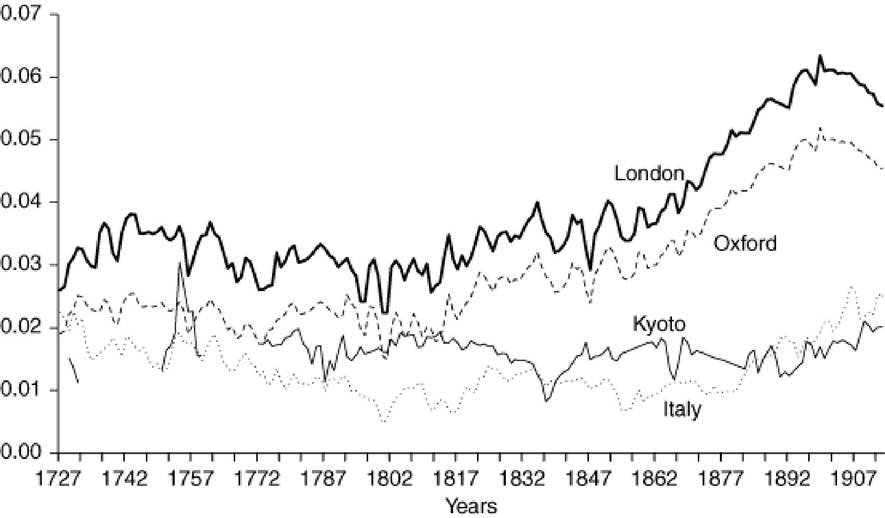
Source. See text.
Figure 5.3 Building labourers' real wage, 1727—1913, England, Japan, and Italy
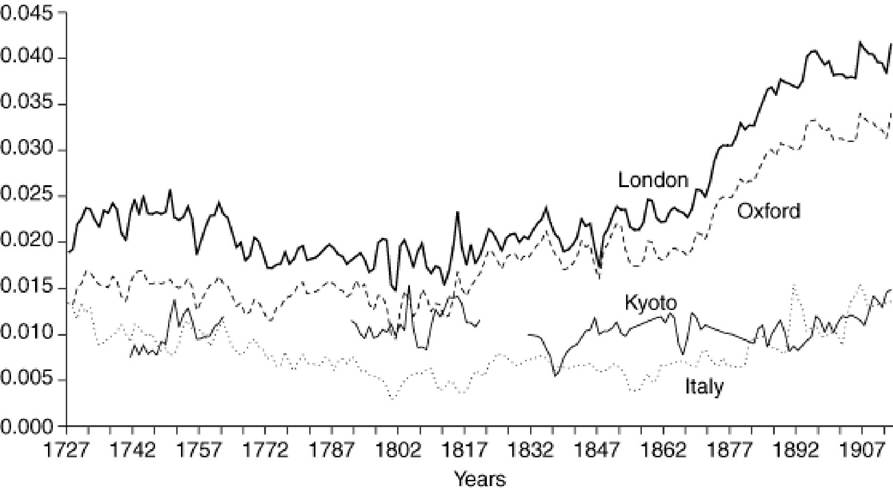
Source.
See text.Figure 5.4 Farm labourers' real wage, 1727—1913, England, Japan, and Italy
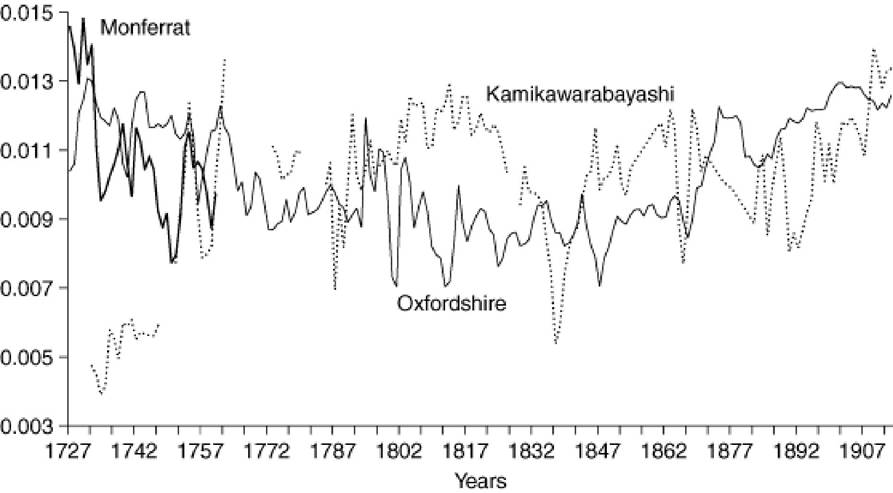
Source. See text.
wage in both London and Oxford rose decisively above the real wage in southern Europe and Japan. The wages of building labourers showed the same pattern (Figure 5.3).
Figure 5.4 summarizes the evidence respecting the wage of farm labourers. The Oxford series, which represented the earnings of male agricultural labourers in the
Figure 5.5 Labourers' real wage, 1727—1913, England and Japan
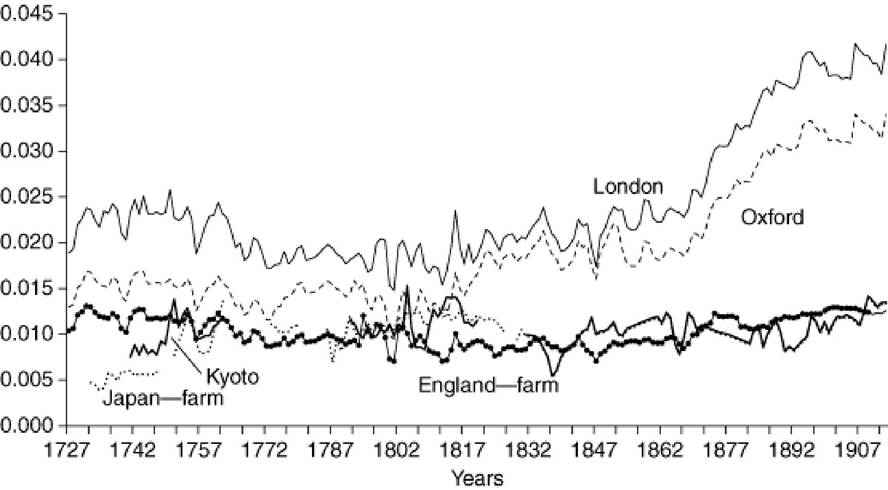
Source. See text.
county, showed no trend. The Italian wage data are taken from the village of Montferrat (Montaldeo) near Genoa for 1727—65 (Doria 1968). There was no significant difference between Oxfordshire and Italian wages in the early eighteenth century. The Japanese wage series is for the small town of Kamikawarabayashi near Kyoto. Real wages were very low in the early eighteenth century and were significantly below European farm wages. The rise in agricultural wages in the mid-eighteenth century in Japan, an increase noted by Tokugawa historians, closed the gap with Europe.
Figure 5.5 combines the English and Japanese series for building and farm labourers. This figure highlights important features of the labour markets of the two countries. (1) Real wages were highest in London. In part, this premium is an illusion as it was offset by the higher cost of housing, which is excluded from the index. The housing price differential was not large enough, however, to account for the higher London wages—it reflects the tight labour markets of the metropolis; (2) steady advance in the real wage only occurred after 1870, however; (3) the wage of Oxford building labourers exceeded that of Oxfordshire farm labourers in the early eighteenth century. This was a new development, for their wages were very similar in earlier centuries, and it represents the spread of a strong economy outward from London, throughout the Home Counties; (4) by the early nineteenth century, Oxford wages were following those of London, breaking away from Oxfordshire farm wages.
Those remained constant throughout the period as labour left agriculture.The situation in Japan was very different. The real wages of labourers in Kyoto and Kamikawarabayashi were identical—or virtually so—for the whole period.
This indicates both close integration of the markets and the absence of the dynamic urban economy that disequilibrated English labour markets and led to higher wages in English cities than in Japanese. Japanese labourers' wages were similar to those of English farm workers throughout and close to those of Oxford labourers in the eighteenth century.
Figures 5.2-5.5 have important bearing on the assessment of Japanese economic performance. Japanese living standards in the late Tokugawa were on a par with those in provincial England. Japanese wages were not as high as those in the western European growth poles, but they were similar to those on most of the continent. The figures also indicate that living standards began to diverge for most people after 1870. This was not because Japanese wages fell but because wages in England rose for many people. Should we regard pre-industrial Japanese economic performance as a success? It was in the sense that Japanese living standards were similar to those in many parts of Europe, but Japan lacked the high-wage economy of the dynamic cities of northwestern Europe. That economy was the leading edge of general prosperity. As more of England became incorporated into that economy, the advance in wages became more general. Japan did not achieve the same breakthrough until after First World War, perhaps even until after Second World War (Minami 1986: 296-396).
3.2