From economic welfare to social welfare
In “Il Massimo di utilita per una collettivita in sociologia” Pareto extended his economic theory of collective welfare, in which direct interpersonal comparison of each individual’s ophelimity is prohibited, to a sociological theory of social welfare, which specifies social utility in homogenous terms based on the interpersonal utility comparisons by individuals and government.
This sociological work on the maximization of utility is based on the proposition that each individual has a view about the relative benefits to society from their own consumption and from the consumption of other members of society. To maximize utility in this social sense, Pareto outlined a two-step process to measure “social utility”. In the first step, every individual subjectively weights the welfare of themselves and the welfare of every other individual in the community to establish each individual’s social utility function, as shown in equation (4):

where: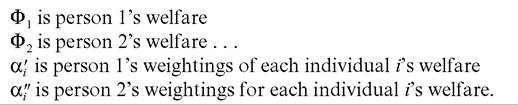
In the second step, the government weights each person’s assessment of social utility to derive a social welfare function in which utility is a homogeneous quantity with cardinal properties, which can be maximized through government policy in accordance with equation (5):

where:
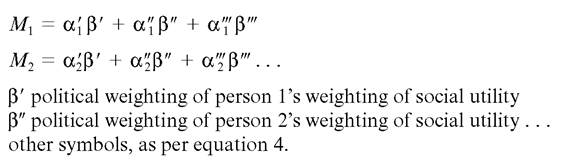
Unlike Pareto’s economic approach to maximization, his sociological approach is not necessarily constrained by the Pareto criterion (that is, the requirement that no one be harmed and at least one person gain) and there is obviously no prohibition on interpersonal comparisons of utility. Furthermore, there is no suggestion that utility for the purposes of social welfare considerations is an ordinal measure - in this sociological context Pareto treated social utility as a homogeneous quantity (over the period for which the prevailing social equilibrium is stable) for society as a whole. Pareto himself described his work in this area as a first step towards a “theory of social utility”.