Family farming and household landholding
In pre-industrial rural Japan, households were not only the unit of consumption but also that of production. Smallscale family farming became increasingly prevalent during the Tokugawa period and came to be the dominant type of agriculture by the
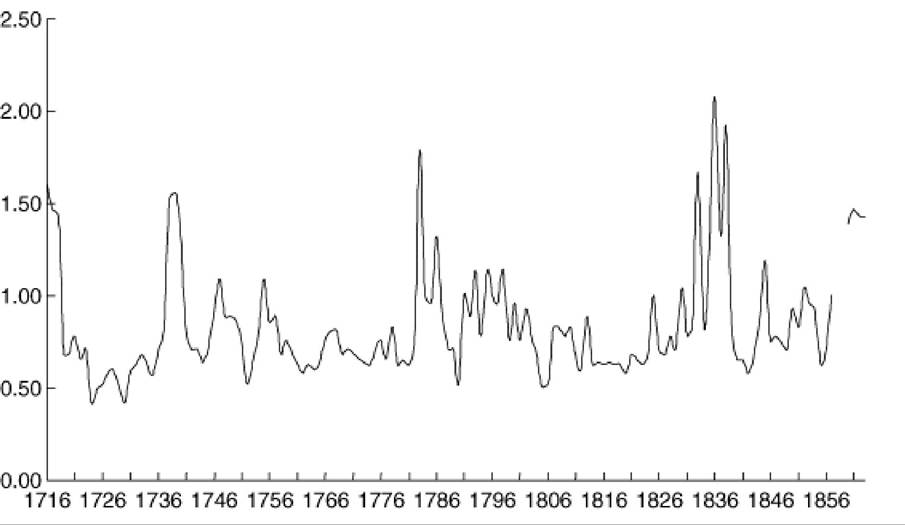
Figure 17.2 Raw rice prices (ryo per koku) in the market of Aizu, 1716—1863
first half of the eighteenth century (Smith 1977: 105—17; Hayami 1985: 92—3).
As explained above, in the Tokugawa agrarian economy peasants paid taxes on the expected yields of the land they owned. Taxes were imposed not on individual households but on villages, and when some households were unable to fulfil their tax burden, other households (in particular, households of other titled peasants) had to make up the balance.In the Nihonmatsu domain, the land used to produce rice was divided by lottery among all households in a village (nawabiki). The main purpose of the lottery was to equalize landholding among the households within a village. Shimomoriya appears to have held this lottery every ten years (Nagata, Kurosu, and Hayami 1998). Niita held a new lottery only once, in 1794, after the peasants petitioned for a lottery to correct the inequalities that they perceived (Narimatsu 1992: 138—9). In between lotteries peasants could obtain more land by borrowing it from other peasants who needed to loan or pawn their land because of economic difficulties. Actual landholding among households in farming villages in the domain was therefore adjusted by borrowing, loaning, and pawning land (Koriyama-shi 1981b: 276-9).
Villagers of agrarian villages were divided between titled peasants (called honbyakusho) who held land and landless peasants (called mizunomi) who owned no land (and thus were free from tax responsibilities). These landless peasants mostly served as tenant peasants to titled peasants. Though efforts were made to keep peasants (and their households) more or less equal and to equalize their tax burdens, inequalities clearly existed, not only between titled and landless peasants, but also among titled peasants according to their households' landholding. The amount of land held by each household (called mochιdak.a,) is
the best available indicator of the socio-economic status of households in our two almost totally agricultural villages.’ Examining temporal changes in household landholding in the two villages, our preliminary analysis found that the size of the average landholding increased from around 8—10 koku per household in the eighteenth century to around 11—12 koku in the nineteenth century. Later in the chapter, we will examine differences in the nature of demographic responses to changes in household landholding in the eighteenth and in the nineteenth centuries, separately.
2.5