Background
We use the household register data from the ‘Household and Population Registers of the Eight Banner Han Chinese Army' (Hanjun baqi rending hukou ce)i These were compiled on a triennial basis for a number of Han Chinese banner populations living on state farms in the northeast and certain other locations from the early eighteenth century until 1909.
The Qing relied heavily on these registers for civilian and military administration of these populations. They accordingly devised a remarkable system of internal cross-checks to ensure consistency and accuracy. First, they assigned every person in the banner population to a residential household (Iinghu) and registered them on a household certificate (menpai). Then they organized households into clans (zu), and compiled annually updated clan genealogies (zupu). Finally, every three years they compared these genealogies and household certificates with the previous register to compile a new register. They deleted and added people who had exited or entered in the last three years and updated the ages, relationships, and occupations of those people who remained. Each register, in other words, completely superseded its predecessor.The registers recorded at three-year intervals for each person in the target population the following information in order of appearance: relationship to their household head; name(s); adult banner status; age in sui; animal birth year; lunar birth month, birth day, and birth hour; marriage, death, or emigration, if any during the intercensal period; physical disabilities, if any and if the person is an adult male; name of their kin-group head; banner affiliation; and village of residence. Individuals were listed one to a column in order of their relationship to the head, with his children and grandchildren listed first, his co-resident siblings and their descendants
listed next, and then uncles, aunts, and cousins.
Wives were always listed immediately after their husbands.The banner registers provide far more comprehensive and accurate demographic and sociological data than the baojia household registers and lineage genealogies common elsewhere in China (Harrell 1987; Skinner 1987; Telford 1990; Jiang 1993). This is true for the entire northeast, which was the Qing homeland and was under special state jurisdiction, distinct from the provincial administration elsewhere. Regimentation of the population actually began as early as 1625, when the Manchus made Shenyang their capital and incorporated the surrounding communities into the banner system (Crossley 1997; Ding 1992; Elliott 2001). By the late eighteenth century, not only was the population registered in remarkable precision and detail, migration was strictly controlled, not just between northeast China and China proper, but between communities within northeast China as well. Government control over the population was tighter than in almost any other part of China. Indeed, individuals who departed from the area without permission were actually identified in the registers as ‘escapees' (taoding). As a result, the Eight Banner household registers are the most extensive and detailed records of a rural Chinese population in the late Imperial period (Lee and Campbell 1997: 223-37).
Our data are a subset from a sample of registers that provide more than 750,000 observations of over 100,000 individuals who lived on fifteen state farms in Liaoning from the middle of the eighteenth century to the beginning of the twentieth century. Table 16.1 summarizes the numbers of observations from each of the eleven state
Table 16.1 Available data
| Observations’ | Distinct individuals | |
| North | 179,684 | 34,177 |
| Dami | 22,615 | 3,962 |
| Feicheng Yimiancheng | 60,266 | 9,206 |
| Dadianzi | 60,580 | 13,727 |
| Bakeshu | 36,223 | 7,282 |
| Central | 82,334 | 15,497 |
| Guosantun | 32,742 | 4,912 |
| Daxingtun | 49,592 | 10,585 |
| Daoyi | 104,568 | 15,846 |
| South | 148,960 | 32,909 |
| Gaizhou Rending | 38,235 | 7,104 |
| Gaizhou Mianding | 21,286 | 4,104 |
| Niuzhuang Liuerbao | 47,044 | 9,269 |
| Gaizhou Manhan | 42,395 | 12,432 |
| Total | 515,546 | 98,429 |
‘ These figures exclude observations where individuals have died, married out, become tending, or are otherwise recorded as having exited since the last register.
farm systems we use here.
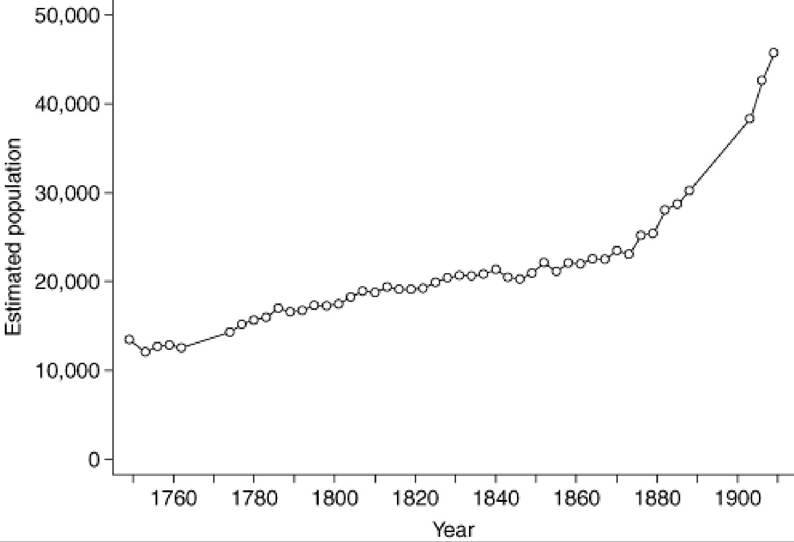
We excluded four of the fifteen state farms because one, Chengnei, was urban, while another three had not yet been coded when this chapter was first written.The population of the eleven state farms grew dramatically over the century and a half for which we have data, providing an excellent opportunity to survey the impact of rising population density on demographic behaviour and living standards. According to Figure 16.1, growth occurred in two distinct phases. The population grew steadily from 1749 to 1888 at an annual rate of approximately 0.5%. This was a respectable rate for a pre-industrial population, especially in light of the fact that most of it was attributable to natural increase. In-migration played a role only in the late eighteenth century and the beginning of the nineteenth century. From 1888 to 1909, the state farm populations exploded, growing at a rate of nearly 2% a year. In-migration, or more likely absorption into the state farms of already present residents of the region, appears to have accounted for much of the increase. Natural increase appears to have played only a minor role.7
As Table 16.1 indicates, the state farms were distributed among three very different regions. The northern state farms were located in a hilly and isolated region in the northeast of the province. We expect living standards there to have been poor. The central state farm systems, including Daoyi, were located just to the north of what is now Shenyang, currently the capital of Liaoning and the prefectural capital during the Qing period.8 While these populations would have benefited materially from their proximity to a major administrative centre, their death rates are likely to have reflected a ‘suburban penalty7. The southern state farm systems were all located in or near what is now Gaiping county on the Liaodong Peninsula. They were
Figure 16.1 Estimated population size, 11 Liaoning state farm systems
either on or close to the coast of the Bohai Gulf.
They were close to Yingkou, which became a treaty port open to international trade in 1858. Accordingly, the region was heavily involved in coastal trade, and during the last half of the nineteenth century, in international trade as well. As a result, the economy in this region was much more commercialized than in the central or northern region, at least during the last half of the nineteenth century.We apply a number of restrictions to the observations included in the analysis. We have excluded all observations where an individual is recorded as having exited since the last register, whether by death, out-marriage, out-migration, or illegal departure. Depending on the demographic outcome we study, there are additional restrictions on the observations that we use. Because the registration of daughters was incomplete, we only consider male births when we examine reproduction. As discussed later, for methodological reasons we exclude, from the event-history analyses of mortality and nuptiality, observations from the registers where both the immediately succeeding one and the one after it were missing.
The major limitation of the registers for demographic analysis is that they omit most sons who died in infancy and early childhood, as well as most daughters. Sons typically first appeared not in the register immediately following their birth, but in the one after it. If they died before the compilation of that register, there would be no record of their existence. As for daughters, in most of the state farm systems they never appeared in the registers as long as they lived as daughters in their natal families. Women only appeared in the registers once they were married. When they appeared, they did so as a member of their husband's household. As a result of these limitations, we cannot analyse infant mortality. We can only analyse the child mortality of males. Finally, our estimates of fertility are based solely on surviving male births, and need to be adjusted to yield estimates for all births of both sexes.9
Overall, the registers are an excellent source for the study of mortality.
Deaths since the last register are annotated, so that by record linkage we can create a dichotomous indicator of whether or not an individual dies in the next three years. Other exits from the registers are almost all annotated, whether by out-marriage, out-migration, or illegal departure, thus individuals who have left the population can be censored from the time of their departure. Unannotated disappearances are rare.The major limitation of the data is that we do not know dates of death, only the three-year period in which they occur. In examining price effects, therefore, we are limited to looking at how average prices in the three years between two registers affected the probability of dying in that three-year period. There are also a small number of individuals who survive to absurdly advanced ages that we exclude from consideration on the assumption that their entries in the register were being carried forward even after they had died.
The registers are also an exceptional source for the study of male first marriage. Because marital status is recorded for individuals in every register, and individuals can be linked across registers, we infer whether or not a male has married by examining whether his status has changed from being unmarried to being married or widowed between one register and the next. The major limitation is that once
again, as was the case with deaths, we do not have precise dates of marriage. We only know that marriages took place in the three years between two successive registers. In examining price effects, therefore, we are limited to looking at how average prices in the three years between two registers affected the probability of marrying in that three-year period. An additional, though minor, shortcoming is that in the rare cases where a man married but his new wife died before the next available register, there would be no evidence of his marriage, because he would appear single in both registers.10
In spite of the limitations noted earlier, the registers are also an excellent source for the study of reproduction.
Because children are listed immediately after their parents in the registers, establishing paternity and maternity is straightforward. From the age reported for the child in their first appearance, we can also calculate their year of birth. For the analysis of fertility we generated a file of person-year observations for married women that included variables describing their characteristics at the time of the most recent available register along with a count of the number of births attributed to them for that year. In contrast with the analyses of mortality and nuptiality, therefore, we can examine how prices in a year affected the chances that a married woman would have a surviving birth in that year.To study the influence of economic conditions on the probability of demographic events, we supplement the household register data with grain price series from an empire-wide system to monitor food conditions that began elsewhere in China as early as the late seventeenth century and was extended to Liaoning into the late eighteenth century (Wu 1996). In this system, county magistrates reported the price of five major food grains (rice, wheat, husked and unhusked millet, soybean, and sorghum) each week to the provincial government. The governor, in turn, prepared each month a brief summary for the central government of the lowest and highest county prices by prefecture. These monthly prefectural summaries of the highest and lowest reported prices provide the bulk of our price data.
We use monthly price reports from Fengtian prefecture in Liaoning. To date we have collected 1,500 of these lunar monthly summary reports.11 Our previous analysis suggests that the fluctuations in grain prices in this area reflect changes in climate and harvest yields more than changes in market demand or state intervention, thus prices should be a proxy for peasants' grain production (Lee and Campbell 1997: 31—5). Since the peasants in our populations produced primarily for themselves, and are likely to have bought or sold only a small portion of their grain on the market, prices should be a proxy for their food consumption. Even if peasants were heavily involved in the market, results on historical Europe suggest that they would not have benefited from high prices, because the inverse correlation between production and prices was strong enough that for small producers the benefits of being able to sell at a higher price, were typically offset by the drawbacks of having less to sell (Galloway 1988). Thus we expect high prices to have been associated with poor harvests and reduced consumption, and low prices associated with good harvests and increased consumption.
Figure 16.2 Annual average of low sorghum prices
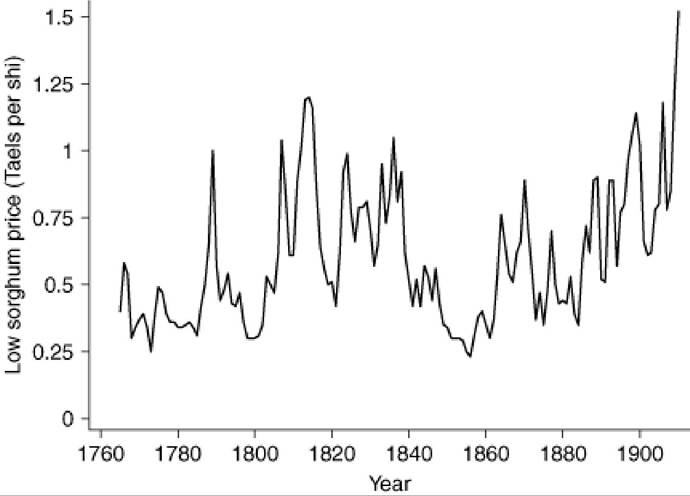
Sorghum was a key crop in the region, thus we use its price as an indicator of conditions. We use the low sorghum price series because we believe it was more reflective of the situation in rural areas than the high price series, which are most likely to have been from urban areas. Figure 16.2 summarizes low sorghum prices during the period under consideration. Since the sustained increase that began in the 1880s may have been an artefact of inflation, and may not have reflected actual reductions in consumption or real income, we excluded the period after 1888 from the analysis of price effects. Prices before 1888 were clearly volatile, in some cases doubling or tripling from one year to the next and then remaining high for several consecutive years.12 Since there was no secular trend in prices before 1888, and regressions using detrended prices series yielded broadly similar results, in our analysis we made use of logged raw prices.
3.