The Early Twentieth Century
By comparison with the rest of the world the Russian School of economics in the nineteenth century was rather backward. In 1890, when Alfred Marshall’s Principles of Economics were published, a publication appeared in Russia, in which an attempt was made to create a so-called “neo-classical approach”, that is, to combine classical value theory with marginal utility and marginal productivity theories.
It was an article by M.I. Tugan-Baranovsky (1890), which did not display originality, but did mark the beginning of a closer exchange with Western economics. Similar approaches were adopted in the works of V.K. Dmitriev, W.S. Woitinsky, A.D. Bilimovich, N.N. Shaposhnikov and E.E. Slutsky. All of these scholars worked independently of each other and their works were of varying quality. The works of Dmitriev (1904 [1974]) and Slutsky (1915 [1952]) became known worldwide, but much later. (For assessments of the contribution of Dmitriev and Slutsky, see the entries devoted to them in Volume I of this Handbook. A separate entry is also devoted to Ladislaus von Bortkiewich, who was born in Russia and graduated from St Petersburg University and who can, to a certain extent, also be considered a Russian mathematical economist.)Essays on the Theory of Labour Household (1912) by A.V. Chayanov has been undeservedly forgotten for a long time. In this work Chayanov attempted to produce a mathematical model of the labouring household. As an example he took the separate peasant family that exploited only the labour of its own members. Chayanov put forward two functions as determining the balance of the labouring household. Let x be the total income of the working family in roubles. Then the first function f(x), being a monotonously increasing function, indicates the drudgery entailed in the acquisition of a marginal rouble, while the second monotonously decreasing function φ(x) describes the value of marginal utility of these roubles (see Figure 2).
Chayanov’s idea was that as the amount of work increases, the subjective value of a marginal rouble will always decrease and the difficulty of its acquisition will always increase. Therefore, the plots of these functions will intersect at a single point x1, reflecting
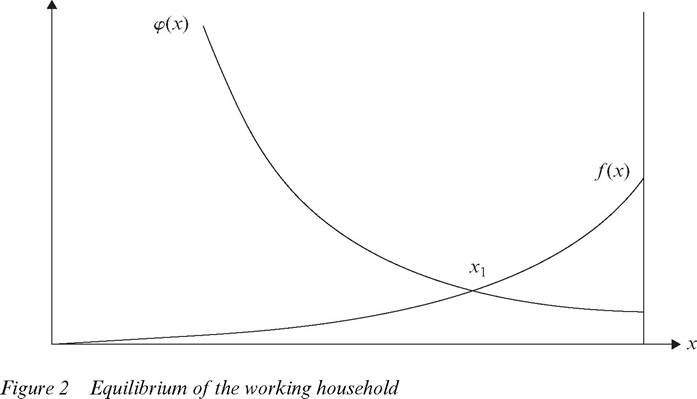
the equality f(x1) = φ(x1). This led him to an important conclusion that any labour household has the natural limit of its production determined by a balance between the yearly labour effort and the level of demand satisfaction of a given working family (Chayanov 1966). His analysis of the labouring household brought Chayanov to another important conclusion, namely, that a peasant household is a specific type of household without motive to gain profit or to maximize income. Using this model, Chayanov managed to carry out a thorough investigation of the contribution of labour productivity to the establishment of economic equilibrium. He suggested that the higher labour productivity is, the less difficult is the acquisition of a marginal unit of the sum x, which means that a new balance will be established at a higher level of needs satisfaction. He tried to prove his hypotheses using data on peasants’ household budgets in Switzerland in 1909 and 1910 collected by Ernst Laur, as well as data on the Volokolamsk region of Moscow province collected by himself.
Chayanov was not a pioneer in the development of marginal utility theory. Being fluent in German and French he probably knew Western works in this field. The importance of his approach consisted in efforts to construct utility functions based on actual statistical data on consumers’ budgets in different countries (Belguim, Germany, Russia and Switzerland). This enabled Chayanov to produce a corrected model containing new conclusions on functions describing the condition of equilibrium. Later his approach received due attention and was consequently developed by Western scholars (see Durrenberger 1984).
During this period, the basis was laid for further developments in the field of mathematical economics. Mathematical methods gained general acceptance and some experience was acquired in the mathematical modelling of economic phenomena. Russian economists obtained their first serious scientific results. However, this progress was interrupted by the Revolution and the Civil War.