The Dynamic Input-Output Model
So far we have concentrated on the flows of goods between sectors. But production also involves capital goods, which are stocks. Let us assume that for every unit of output in sector j we need kij units of good i (i = 1, 2,..., n) as capital goods.
These coefficients can be represented by the matrix of capital coefficients K. As long as outputs remain the same, the capital stock must not be changed. However, when production increases, the capital stock must be expanded. Since the production of new capital goods requires time, a dynamic model must be formulated in order to take capital accumulation into account. Let us assume that new capital goods can be produced in one year’s time. If the activity levels of period t are equal to xt and those of period t + 1 equal to xt +., then clearly the amounts of new capital goods which must be produced are equal to i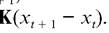 It
It follows that instead of (3) we now have:

Rearranging terms, we obtain a system of recurrence equations linking the activity levels of different periods:

