The commodity law of exchange and total value added
For Marx, following Ricardo, the value of a single commodity comprises the value embodied in the means of production with which labour works (transferred through concrete labour to the product of the production process) and the socially necessary labour time worked by living labour.
If A is a matrix of input-output coefficients, aij expressing the amount of commodity i required to produce one unit of commodity j, and l is a vector whose components lj express the number of hours of labour required to produce one unit of commodity j, then the vector of values is:
Under equivalent exchange at natural prices proportional to labour times required for the production of commodities, the relationship “price equals value divided by the value of money” obviously holds for any aggregate of commodities. In particular, it holds for value added (H).
In physical terms, gross outputs (x) and net outputs (y) are related by:

Postmultiplying equation (3) by x, premultiplying equation (4) by λ and subtracting yields:

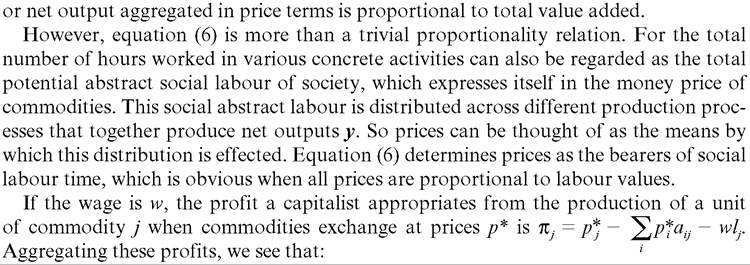
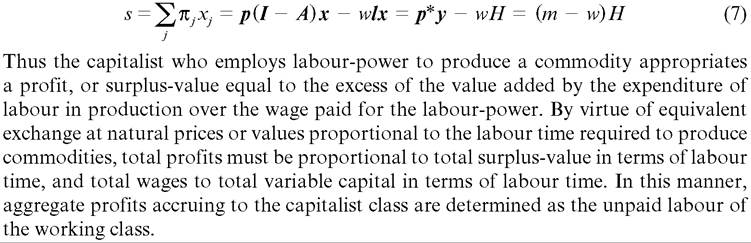
where lx ? H. Hence: