The so-called “transformation problem”
Probably best known among Bortkiewicz’s writings is an essay in which he sought to correct Marx’s attempt to “transform” labour values in prices of production in volume III of Capital, posthumously edited by Friedrich Engels in 1894 (see Bortkiewicz 1907a, 1949).
Marx had approached the problem in the following way. (We assume for sim-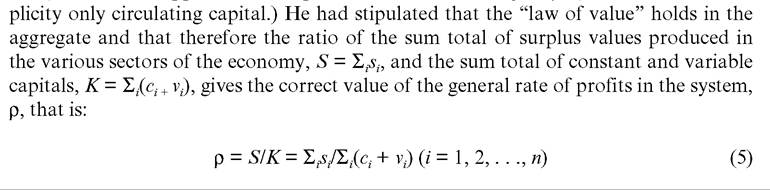
He then used this rate to discount forward the values of constant and variable capitals in the different sectors in order to arrive at prices of production:

where pi designates the production price of commodity i in whose production the same rate of profits is earned in competitive conditions as in all other sectors of the economy. Marx was aware that this procedure was deficient, because it implied that inputs were sold and bought at labour values, whereas outputs were sold and bought at production prices. However, he appears to have been of the opinion that transforming also the constant and variable capitals in production prices would not undermine the validity of his determination of the general rate of profits in labour value terms.
The fact that in conditions of free competition and the corresponding tendency towards a uniform rate of profits commodities cannot exchange at labour values had been noticed already by readers of volume I of Capital. It had prompted Engels when editing volume II in his foreword to defy economists to show “in which way an equal average rate of profit can and must come about, not only without a violation of the law of value, but on the very basis of it.” Interestingly, one of the economists who accepted the challenge was Wilhelm Lexis (Bortkiewicz’s supervisor in 1892 in Gottingen).
According to Engels, none of the people participating in the “prize essay competition”, including Lexis, succeeded in solving the riddle and so the publication of volume III of Capital, which was announced as containing the solution, was eagerly anticipated. However, the book did not keep its promises. While several people criticized the procedure Marx had suggested, very few were able to grasp its shortcoming, let alone suggest an algorithm that would solve the transformation problem for good, provided a solution existed. Probably the most effective criticism of Marx came from Eugen von Bohm-Bawerk (1896), who, however, failed to see the slip in Marx’s argument and contented himself with pointing out a “fundamental contradiction” between values and prices in Marx.In 1907 Bortkiewiz published a paper in which he achieved two aims at once: he solved the transformation problem, but in doing so he also showed that the magnitudes in the numerator and in the denominator of the expression giving the general rate of profits were generally affected by the transformation and could not be taken to be invariant with regard to it, as Marx had assumed. The implication of this was that the general rate of profits, r, was not equal to the one ascertained in labour value terms, p. Bortkiewicz argued that Marx’s “successivist” procedure - determining the general rate of profits first and only after this had been accomplished determining prices of production - was inadmissible in general and had to give way to a “simultaneous” determination of both, the rate of profits and prices.
Bortkiewicz established these results within a circular framework of production with three “departments”, department 1 producing means of production, department 2 wage goods and department 3 luxury goods consumed by capitalists. He assumed a stationary economy, that is, simple reproduction, which implied that the sum total of wages (or variable capitals) is entirely spent on wage goods and the sum total of profits (surplus value) entirely on luxury goods.
He formulated the following system of simultaneous equations: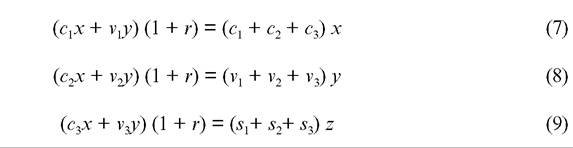
In it the ci s, vi s and si s (i = 1, 2, 3) are known labour value magnitudes, from which Marx had started his reasoning; x, y and z are price coefficients that may be interpreted as value-price transformation coefficients; and r is the general rate of profits. The system has three equations and four unknowns: x, y, z and r. Fixing a standard of prices by setting x, y or z equal to unity (for example, z = 1, as Bortkiewicz did) allows one to determine the remaining unknowns, including the general rate of profits. It turns out that except in very special technological conditions (or with particular normalizations) none of Marx’s invariance postulates holds: the sum of values is not equal to the sum of prices, the sum of surplus values is not equal to the sum of profits, and the sum of capital advances in labour value terms is not equal to the sum in price terms, and, most importantly, r ≠ p. The “law of value” turned out not to provide
the solid basis upon which the edifice of political economy could safely be erected, as Marx had thought. This does not mean that Bortkiewicz sided with the critics of Marx: these, he maintained, had thrown out the valuable along with the undesirable. Marx’s idea of transforming labour values in prices of production did not imply chasing a will- o’-the-wisp. It can be done, but when it was done correctly, it necessitated important revisions of Marx’s doctrine. Last but not least, while Marx had assumed that the (labour) values of commodities are known magnitudes, it is clear that in a circular (as opposed to a unidirectional) framework they can only be ascertained by also solving a system of simultaneous equations. This system reflects a very special constellation of the sharing out of the product. To emphasize this fact, Sraffa in the early 1940s coined the term “Value theory of labour” (see Sraffa Papers D3/12/44: 3, D3/12/46: 24): values are proportional to labour quantities if and only if there are no profits (setting aside the exceedingly special case of uniform input proportions across all industries of the economy).
Bortkiewicz (1906-07: 56) traced Marx’s ineptitude to provide correct solutions to the problems he raised back to the “meagreness of his mathematical abilities”. He praised instead Ricardo for having provided sufficiently correct answers on a number of issues with regard to which Marx failed.