Shocks and Missing Responses: The Variety of Macroeconomic Disequilibria
The confusion in the debate between the Keynesian and the monetarist and new classical schools has its roots first and foremost in the fact that also Keynesians seemed to believe that a key problem in macroeconomics is nominal wage rigidity.
In contrast, Keynes in his famous chapter 19 of the General Theory had shown that flexible nominal wages in no way guaranteed the dynamic stability of a full-employment equilibrium in case of demand shocks that mainly emanate from the volatility of the marginal efficiency of capital. Prospects of lower rates of return represent a real shock that, according to Keynes, is not absorbed by adjustments of the (real) rate of interest because the latter (with constant inflation) is governed by liquidity preference and/or rigid yield aspirations.Following the taxonomy suggested by Leijonhufvud (1983), the General Theory addressed an R/R type of macro disequilibrium where a real shock is not properly offset by an adjustment of a real market variable: a change of the marginal efficiency of capital (d mec) coming up against a constant real interest rate (r), basically an intertemporal coordination failure between investment and saving (Table 1). However, during the era of the neoclassical synthesis, debates were located in the R/N cell where a real mec shock was said to cause unemployment due to a rigid nominal wage (w). This, however, is a misguided diagnosis as the cause of the trouble is not rooted in the labour market. Keynes already had shown that nominal wage flexibility cannot help to stabilise the macro effects of expected-profitability shocks.
Table 1 The “Swedish flag”
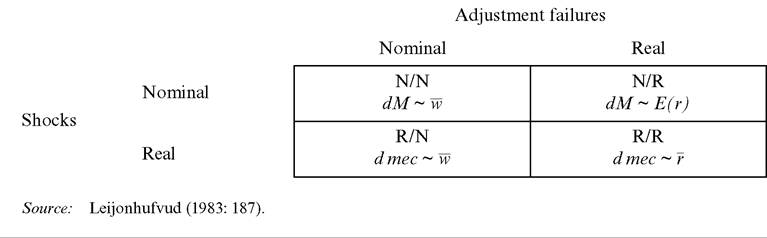
Monetarism then activated the N/N issue on money neutrality: wage stickiness may cause employment to vary temporarily with money supply changes (dM).
This is less of an important discovery in Friedman’s story of expansive monetary policy, but more so when assessing the economic costs of disinflation. In any case, Keynes’s message somehow seemed to have been forgotten. The new classicals turned their attention to the N/R constellation: a nominal monetary policy impulse induces an increase of output as producers take a general price increase as a sign of a profitable move of firm-specific prices; the expected rate of profit E(r) moves although it should not.The positive association of price changes and output arises because suppliers misinterpret general price movements for relative price changes. (Lucas 1973: 333)
Monetary changes have real consequences only because agents cannot discriminate perfectly between real and monetary demand shifts. Since their ability to discriminate should not be altered by a proportional change in the scale of monetary policy, intuition suggests that such scale changes should have no real consequences. (Lucas 1972: 116, original emphasis)
In the monetarist case, workers suffer from incomplete information on consumer prices (or from money illusion), hence they interpret higher nominal as higher real wages, which allows a period of temporary over-employment. New classical macroeconomics shifts the information problem onto producers. They bear the profit risk of ill-founded supply decisions whereas workers no longer are fooled: flexible nominal and real wages let them reach positions on the labour supply curve at any time (the possibility of parallel movements of wages and prices, and the involuntary persistence of a disequilibrium real wage, are ignored). The NCM story can best be understood as a description of selfemployed market agents searching profitable sales contracts. Apart from misinterpreted price movements, we have market clearing throughout.
The argument of disappointed expectations on relative prices pj∕P (where pj is the supply price of firm j and P the price level) is important for a possible explanation of disinflation costs: firms may hesitate to lower the rate of increase of their supply prices (and workers likewise their wage growth aspirations) in a period of monetary restraint because there may be signs that the firm’s market position is upheld in the ongoing process of competition and structural change; thus it appears rational to wait until firmspecific demand starts to weaken.
If many firms suffer from a too optimistic assessment of their market position, downward price rigidity may ensue.However, the aforementioned line of argument rests on a misjudgement of the expected market forces affecting pj, not on a wrong estimation of P. The NCM story has it the other way round, which is much harder to swallow. It can be justified only by specific assumptions on information dissemination in a segmented market structure; this sounds convincing in Lucas’s (1972, 1975) island model where producers visit separated market places in a sequential order, but in general the information on the path of money and inflation is readily available without any costs. This may not hold if policy follows an erratic activist strategy, hence Lucas (1975: 1139) finds that his analysis “provides a rationalization for rules which smooth monetary policy” - surely a trivial recommendation drawn from a model where all market disturbances result from the field of macro policy.