Notwithstanding a few more general perspectives on the history of econometrics (Darnell 1984; Morgan 1990; Qin 1993; Hendry and Morgan 1995; Morgan and Qin 2001; Gilbert and Qin 2006; Louςa 2007),
writing the history of an entire discipline is complicated because a scientific discipline consists of several interacting layers, such as a layer of tools and techniques, one of models and theories, one of methodologies, and so on.
Moreover, econometrics has not emerged historically as a unified field. Any attempt to write the history of econometrics is bound to fail. An entry on econometrics will have to consist of several histories or perspectives.The overarching framework, therefore, that will be used for providing these histories is Thomas Kuhn’s (1970) “disciplinary matrix”. This notion reflects nicely the multi-layered character of a discipline. According to Kuhn a discipline consists of four elements: symbolic generalizations, metaphysical parts, values and paradigms.
Symbolic generalizations are expressions, deployed without question or dissent by group members, which can readily be represented in logical or mathematical form. They are the formal or the readily formalizable elements of the disciplinary matrix. An example of such symbolic generalization in econometrics is the commonly used Durbin- Watson statistic:
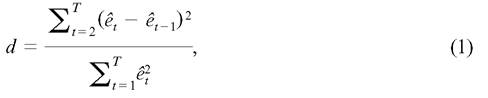
where et is the tth ordinary least squares residual from the general model Y = Xβ + ε based on T observations. This perspective will not be given here. It implies a history of econometric tools and techniques, which cannot be but a very detailed account, too large for a Handbook entry.
The metaphysical parts are the shared commitments to beliefs in particular models, including their heuristic value. These models help to determine what will be accepted as an explanation and as a puzzle-solution; conversely, they assist in the determination of the roster of unsolved puzzles and in the evaluation of the importance of each. An example of this metaphysical part in econometrics is the vector autoregression (VAR) approach.
In this approach each time series variable is explained by a linear function of its own lagged (past) values and the lagged values of all other variables in the system.Values are shared more widely among different communities than either symbolic generalizations or models. Though they are present in the background at all times, their particular importance emerges when the members of a particular community must identify a crisis, or, later, choose between incompatible ways of practicing their disciplines. One of these values is the role of economic theory in econometrics. However, what econometrics is all about is also one of these shared values.
The fourth and final sort of element in the disciplinary matrix are the paradigms, used here in its original sense of exemplars, that is, the concrete solutions to problems that students encounter from the beginning of their scientific education, whether in laboratories, in examinations, or in their textbooks. These shared exemplars can be supplemented by some of the technical problem-solutions found in the periodical literature that scientists
encounter during their post-education careers. These include classic publications, like Trygve Haavelmo’s (1944) “The probability approach in econometrics”.
It appeared that the disciplinary elements of metaphysics and paradigms are so entangled in econometrics that their histories cannot be given separately. Therefore, the two perspectives for setting out the history of econometrics will be a history of econometric values and a history of metaphysics and their paradigms.