Non-reproducible resources: Hotelling and after
It was not until Hotelling’s seminal work (1931) that resource problems were explicitly and rigorously analysed by means of an economic model. In the process of the rapid development of a capitalist economy in industrial countries, particularly in the United States, people became more concerned with the possibility of exhaustion of some natural resources.
Hotelling’s contribution was the start of publication of numerous papers on non-reproducible natural resources.The basic Hotelling model (see Halvorsen and Smith 1991) is the following (see also Krautkraemer 1998). Denote the production function as:

with y, xp, xe, Z, t, and n(∙) as output, reproducible inputs used in processing activities and extraction of natural resources, cumulative extraction, time, and an extraction subproduction function, respectively. Denoting also S as the total stock of the resource, the constraint can be written as:
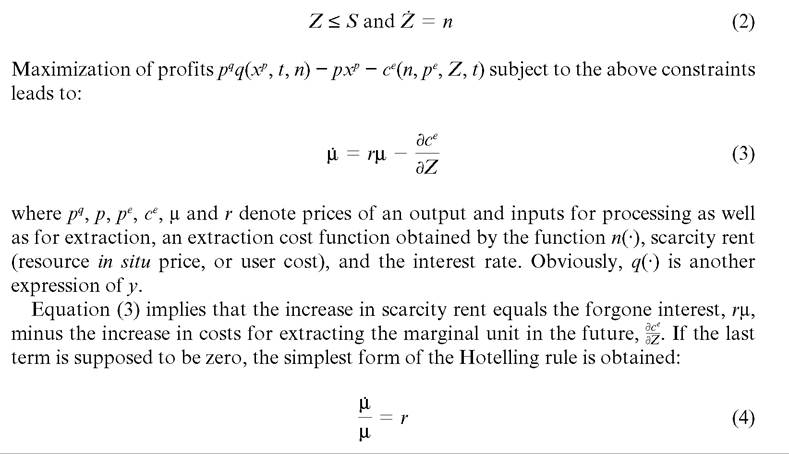
which implies that the price of a non-reproducible resource will rise at the interest rate. When the price arrives at a certain level, the technology which uses the non- reproducible resource is replaced with a backstop technology: a technology which substitutes relatively abundant resources in a broad sense for non-reproducible resources. Solar power generation is an example for a backstop technology of power generation by fossil fuels.
Although the rule is extremely simple and attractive, a serious problem was found with it. There was a gap between theory and reality: contrary to the anticipation of the simple rule (4), prices of almost all non-reproducible resources such as coal, oil, minerals and so on decreased for a long time.
Since the extraction cost cannot be ignored, the fundamental principle of the change in scarcity rents should be (3) instead of (4).
Considering this, even if the scarcity rents increased, one may see that resource prices might decrease possibly due to technical progress, substitution among resources and so on, so that the Hotelling rule, if it is formulated by (3), could be correct. Some studies to confirm whether movement of the scarcity rents followed formula (3) or not have been published (see Neumayer 2000). Some (Stollery 1983; Miller and Upton 1985) are more affirmative upon certain conditions, and others (Slade 1982; Farrow 1985; Halvorsen and Smith 1991) are rather negative.There are two different but related points on this controversy. One is on an academic matter, which is about whether Hotelling’s formulation, not the formulation represented
by the narrowly defined Hotelling rule (4) but that represented by the broadly defined rule (3) or a more general formulation (Dasgupta and Heal 1979), is theoretically and empirically supported. To answer this question, elements such as (1) substitutability among natural resources, (2) recycling, (3) man-made capital, (4) technical progress, (5) exploration costs, (6) uncertainty, and so on must be taken into account in the model and empirically tested by the relevant data.
The other point is on a practical matter. Is the resource optimism justified, and, if so, can the Malthusian spectre be dismissed? If so, serious attention does not have to be paid to the natural resource constraint, regardless of fluctuation of prices of natural resources.